
A familiar label is not acceptance evidence
Construction supply chains connect manufacturers, distributors, fabricators, freight providers and subcontractors across several countries. Each handover can separate a product from the information needed to verify it. A delivery may look correct while its grade, origin, batch identity or supporting test evidence remains unresolved. Counterfeit and misrepresented materials are one concern; accidental substitution and lost records can create equally serious uncertainty.
Traceability is the ability to connect a specific item or batch with relevant records across these handovers. It does not mean that a barcode certifies quality or that a database proves every statement inside it. The practical objective is to know what was specified, what was supplied, how it was checked and where it was used.
Start the evidence chain in the purchase requirement
A purchase description should identify the accepted specification and revision, required product identity, quantity basis, permitted substitutions and documentary requirements. State which records must arrive before dispatch and which accompany delivery. Agree how batch or serial references will appear on packaging, delivery notes and inspection records. Requirements introduced after shipment can be expensive or impossible to satisfy.
Use proportionate controls. A critical pressure component may require a different evidence package from a noncritical consumable. The responsible technical team should define the distinction. Procurement's task is to make the accepted requirement unambiguous and commercially included, with a named process for deviations. A low price without the necessary evidence is an incomplete comparison.
Distinguish identity, conformity and custody
Identity establishes which product, batch or serial item is being considered. Conformity concerns whether it meets the accepted requirements. Custody records describe possession and transfers. These categories support each other but do not substitute for one another. A complete transport history cannot establish a missing technical test result, and a test certificate cannot explain an unrecorded substitution during delivery.
Create a simple evidence map for each consequential material class. Specify the record, issuer, identifier, verification method and acceptance authority. Where authenticity is in doubt, use an established verification channel with the issuing organization. Do not rely solely on the email address printed on a questionable certificate. Preserve the uncertainty until the responsible authority resolves it.
A worked example: matching a steel delivery
An illustrative project orders reinforcing steel under an accepted material specification. The receiving team has a purchase line, delivery note, bundle labels and a proposed mill certificate. The first task is to reconcile product description, diameter, quantity unit and batch or heat references. A certificate for the correct grade but an unrelated heat does not complete the chain for these bundles.
If two labels are unreadable, separate those bundles under the project's controlled receiving process and seek the missing evidence. Do not amend the certificate locally to make the references match. Record the exception, affected quantity and disposition authority. The example describes document reconciliation; acceptance, testing and handling requirements must come from the actual specification and qualified project procedures.
Make receiving a controlled release point
Plan enough time and space to inspect deliveries before they disappear into shared storage. Record shortages, damage, unclear identification and missing documents at receipt. Separate received quantity from accepted quantity. A signed transport receipt can acknowledge custody without constituting technical acceptance, depending on the applicable procedure and contract.
Where materials are held, identify them physically and in the register so they cannot be mistaken for available stock. Name the person authorized to release the hold and the evidence needed. Communicate the effect on upcoming work. A silent quarantine can become a planning failure when a supervisor assumes that a full storage area means the package is ready to install.
Preserve traceability through splitting and installation
A large delivery may be split between floors, workfronts or subcontractors. If the batch identity remains only on an outer wrapper that is discarded, the useful chain ends at the warehouse. Decide how identifiers will be carried through cutting, repacking, issue and installation where traceability is required. Use a method that field teams can maintain under actual site conditions.
Avoid collecting more personal or commercial information than the project needs. Access to supplier prices, security details and private contact data should follow the project's normal controls. A public product identifier does not require publishing the entire purchase record. The most useful register gives authorized reviewers the evidence they need without exposing unrelated information.
Keep digital matching within its real limits
TrendyBuilders supplier catalogue and RFQ exchange supports local structured comparisons using supplied catalogue and request data. Exact supplier and SKU matching can help reveal inconsistent descriptions and quantity assumptions. It does not authenticate manufacturers, verify certificates, inspect goods, connect to a live traceability network or place an order. Review the output before transferring it into the project's authoritative records.
Keep the accepted specification, delivery evidence and inspection disposition linked through stable references outside the comparison tool where necessary. Record manual checks explicitly. A successful CSV import means the data met the import rules; it cannot establish that the physical goods correspond to the file.
Practice a retrieval before a real defect appears
Choose one accepted batch and ask another team member to locate its order requirement, delivery evidence, acceptance record and installation location. Then reverse the exercise from an installed component back to its supply evidence. Record gaps and repair the process while access and memories remain available. This is more revealing than counting uploaded certificates.
For an executive review, monitor unresolved receiving exceptions, time to disposition and traceability retrieval results. Avoid presenting a universal percentage of traceability unless the denominator and evidence standard are clear. The measure that matters is whether the team can identify the affected scope and make a defensible decision when a question arises.
A practical procurement-control protocol
Begin with a reviewed demand statement. Identify the item, specification, quantity, commercial unit, required location and need date. Keep the technical approval status visible. If any of those fields remains provisional, identify who must resolve it before commitment. A supplier cannot reliably price or reserve the correct requirement when the project itself has not defined what it intends to buy.
Normalize the commercial basis before comparing offers. Check delivery point, packaging, minimum order, quote validity, currency and tax assumptions. Retain the original quotations and show adjustments separately. Seek clarification where an exclusion or ambiguous term can change the decision. Do not silently complete one supplier’s offer using favorable assumptions that are not applied to the others.
Connect the purchase to its operating dependency. Identify the installation or testing activity that needs the item, and work backward through approval, manufacture, transport and acceptance. Confirm which event starts each quoted lead time. A purchase-order date is not necessarily a manufacturing-release date, and a delivery date is not necessarily the date the material is ready for use.
Keep authority distinct from record entry. A buyer may prepare a comparison while a technical reviewer approves suitability and an authorized commercial role approves commitment. The project-control tool should retain those references without implying that entering an order transmits it or executes payment. Confirm the actual supplier acceptance through the organization’s established process.
Use evidence-based status updates. A quotation, accepted order, released manufacture, dispatch record and accepted receipt establish different conditions. Record the next milestone and the evidence needed to confirm it. Avoid carrying an unsupported green status merely because nobody has reported a delay. An honest uncertainty gives the team time to investigate and preserve options.
At receipt, check identity, condition, quantity and documentation against the approved requirement. Quarantine discrepancies where the quality process requires it. Reconcile accepted stock with the purchasing record before treating it as available for installation. A truck arrival should not automatically close the procurement exposure if critical parts or acceptance evidence remain missing.
Finally, review supplier performance against the assumptions used in the decision. Retain specific evidence about delivery, completeness and support. Use that learning proportionately in future evaluations. The purpose is a reliable flow from reviewed demand to usable material, supported by clear approvals and a comparison that another person can reconstruct.
A review routine the team can sustain
Choose one real package for the first review rather than attempting to repair every record at once. Ask its estimator, buyer and field owner to agree the accepted scope and identify the sources they actually use. Write down the unresolved questions and the next decision each one prevents. This short exercise makes the method concrete and reveals where the project needs better evidence before it needs another calculation.
Keep the original working records available while testing a revised approach. Use a dated project copy for scenarios and record the input changes individually. Ask a second person to reproduce a sample result from the stated sources. If they cannot explain the unit, revision or assumption, improve the record before circulating the total as an accepted basis. A reproducible result is more useful than an impressive display that depends on its author's memory.
At the next regular package meeting, compare the planned action with what happened. Identify whether the obstacle was missing information, capacity, authority or a changed site condition. Update the relevant assumption and assign the remaining action to a named person with a practical due date. Keep the previous basis so the movement remains explainable. Avoid silently replacing uncertainty with a default value simply to complete the report.
Scale the process only after the pilot has produced a useful decision. Retain fields that support an actual review and remove duplicate recording that adds no evidence. Tell the people receiving the output which version is accepted and what remains conditional. The goal is a working habit that survives a busy site week: clear sources, visible assumptions, explicit authority and a traceable action when the evidence changes.
Decision table
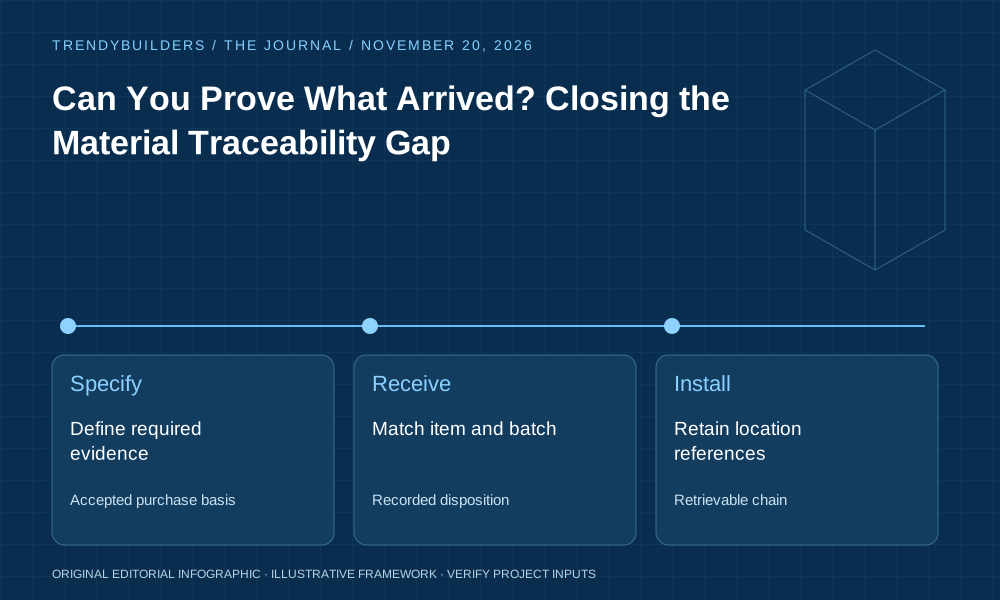
Use this table as a meeting prompt alongside the explanation above. It summarizes the evidence chain; it does not establish technical acceptance or replace the responsible project process. Numerical examples in this article are illustrative and contain no live supplier rates.
| Stage | Action | Evidence |
|---|---|---|
| Specify | Define required evidence | Accepted purchase basis |
| Receive | Match item and batch | Recorded disposition |
| Install | Retain location references | Retrievable chain |
Apply the method in TrendyBuilders
Open Supplier catalogue & RFQ exchange and read the supporting workflow guide before entering project information. Use a reviewed project copy, confirm the measurement units and source revisions, and inspect warnings and exclusions before relying on any output. The calculations depend on the information supplied; selecting a tool does not validate the underlying technical or commercial assumptions.
Keep the accepted project documents and required approvals linked to the planning record. Export the assumptions with a dated result so another reviewer can reproduce the comparison. Where the workflow reveals a missing input or a decision outside the tool's scope, assign that issue to the responsible person rather than treating a blank field as evidence of zero exposure.
Sources and further reading
NIST: Supply chain traceability, IR 8536. This primary-source reference provides relevant background in its own stated scope and jurisdiction. It does not endorse this article or TrendyBuilders. Reference checked November 18, 2026. The worked examples and operating recommendations are original editorial analysis; they are not reported project outcomes, quotations or professional certification.
Related reading
- The Labor Shortage Cannot Be Solved by Headcount Alone
- The Lowest Bid Can Become the Highest Project Cost
- Rework Is a Procurement and Planning Problem Too
Use the moderated discussion to share the decision you are trying to make and the assumptions that matter. Omit confidential drawings, supplier prices and personal information.
The conversation
Constructive, relevant discussion is welcome. Comments are moderated. You may edit your own comment for one hour after its original submission; administrators can edit at any time.
Be the first to contribute a thoughtful comment.