
Executive brief
A delivery date is the end of a chain of decisions. Technical submissions, approvals, commercial agreement, production release, factory inspection and transport may all have to happen before material reaches site. If the programme records only an installation date and a supplier lead time, it can overlook the work that starts the manufacturing clock.
The practical response is backward planning from the date when an accepted item must be ready for use. That is more demanding than recording the truck’s expected arrival. Include unloading, inspection, testing, preservation and any preparation needed before the package can support installation.
Find the real starting condition
A supplier may quote ten weeks from receipt of an accepted order, ten weeks from drawing approval or ten weeks from an agreed production-release milestone. Those statements are not interchangeable. Ask what must be complete before the lead time begins and what evidence confirms the production slot. Clarify whether public holidays, shipping and inspection are included.
Separate project-controlled activities from supplier-controlled activities. Design approval may be within the project’s coordination process, while manufacture depends on the vendor. A single lead-time field can still support planning, but the supporting record should explain the components. Otherwise a late approval can be misreported as a manufacturing failure, and the same planning error may recur on the next package.
An illustrative backward plan
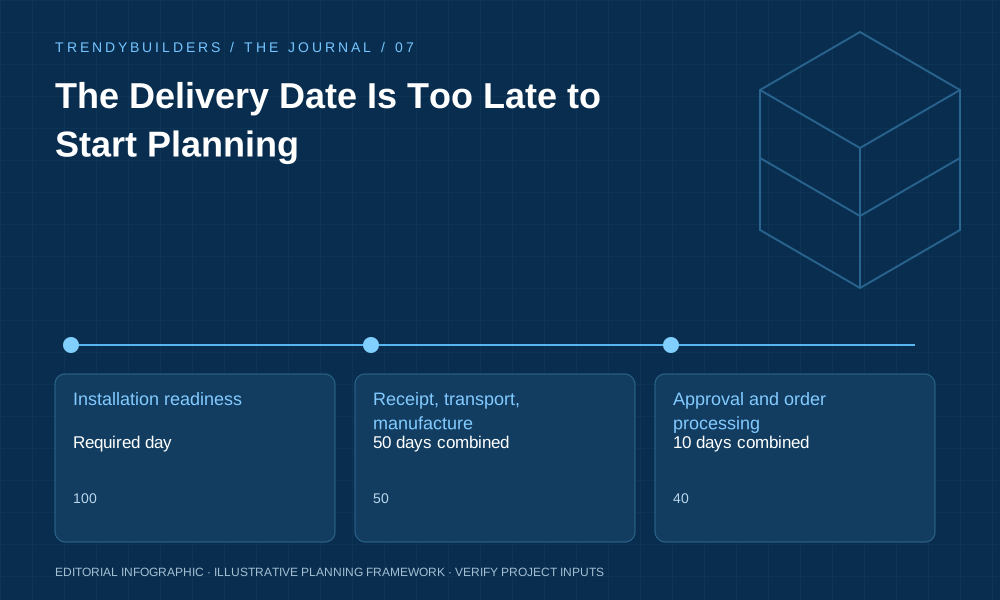
Suppose an accepted item is required for installation on day 100. Allow five days for site receipt and acceptance, ten for transport, thirty-five for manufacture, seven for technical approval and three for order processing. With sequential dependencies and no additional float, the planned ordering process must begin by day 40. The calculation is 100 minus the combined sixty days.
This is an illustrative planning chain, not a promise that every step can be compressed or performed concurrently. Check working calendars and the actual dependency relationships. If approval can occur before commercial award, or transport includes a fixed sailing, represent that explicitly. Do not subtract a generic number of calendar days while the supplier is quoting working weeks.
Use float as a decision resource
Procurement float is valuable because it preserves options. Spending all of it on slow internal approval can leave the project dependent on premium freight or supplier acceleration. Track the latest responsible dates for technical approval, award and dispatch. Escalate when those dates are threatened, rather than waiting until the final delivery becomes late.
Do not assume that an early order eliminates all risk. The specification may change, site storage may be unavailable or the product may require maintenance before installation. Define ownership of those risks before committing early. A well-timed purchase aligns design stability, supplier capacity, cash availability and site readiness.
Put the schedule into TB
Use TrendyBuilders Procurement to enter need dates, lead-time assumptions and ordering dates. Link the item to the correct material quantity and specification. Programme can retain activity relationships and working dates, while Resource calendars can help expose the capacity assumptions behind installation. Retain the approval milestones in the project record even where they are managed outside the calculation.
TB does not monitor a supplier factory or confirm dispatch automatically. Update status from verified project evidence. If a standalone scheduling scenario is used, review it before transferring accepted dates into the working project. A new forecast should not silently overwrite the approved baseline; preserve both so the team can explain the movement.
Make the expediting meeting productive
Organize the review around exceptions: missing approvals, unconfirmed manufacturing slots, failed inspections and threatened dispatch dates. Give each exception an owner, a required response and an escalation date. A meeting that reads every purchase-order line aloud can consume time while the critical issue remains unresolved.
Confirm the effect on installation and commissioning whenever a milestone moves. Some late deliveries can be absorbed through resequencing; others block the critical path. The decision should consider the full response cost, including additional handling, storage, supervision and testing. The useful outcome is a controlled recovery plan with verified milestones, rather than another optimistic expected-delivery date.
Build a procurement release gate
Define the information that must exist before an order is released. For a complex package, that may include approved technical particulars, interfaces, a quantity basis, commercial terms, a payment authorization and a confirmed delivery requirement. Keep the gate proportionate. A simple standard item should not inherit the same review burden as a bespoke piece of critical equipment.
Assign the gate to a named role and identify substitutes for absence. A process can appear complete on paper while depending on one unavailable approver. Establish the escalation route before the latest responsible ordering date is threatened. The purpose is to resolve missing decisions quickly, not to create a sequence of signatures that nobody can explain.
Test the supplier’s lead-time statement against the release gate. If manufacture starts after approved drawings, an accepted purchase order alone does not start the clock. If a deposit is required, confirm when payment authorization can be completed through the existing process. Keep those conditions in the procurement schedule so the team can see which milestone is actually controlling delivery.
Review any proposed acceleration in detail. Ask what work will change, what additional capacity is available and what evidence supports the revised date. Premium freight cannot recover an unfinished factory item, and overtime may not overcome a missing specialist component. An acceleration payment should be assessed through the authorized commercial process against a credible recovery method.
After delivery, compare actual milestone durations with the original assumptions. Separate internal approval time, supplier manufacture, transport and site acceptance. This allows the next package to use a more realistic basis. A single total lead-time figure may be convenient for planning, but the lessons come from understanding which part of the chain moved and why.
A practical procurement-control protocol
Begin with a reviewed demand statement. Identify the item, specification, quantity, commercial unit, required location and need date. Keep the technical approval status visible. If any of those fields remains provisional, identify who must resolve it before commitment. A supplier cannot reliably price or reserve the correct requirement when the project itself has not defined what it intends to buy.
Normalize the commercial basis before comparing offers. Check delivery point, packaging, minimum order, quote validity, currency and tax assumptions. Retain the original quotations and show adjustments separately. Seek clarification where an exclusion or ambiguous term can change the decision. Do not silently complete one supplier’s offer using favorable assumptions that are not applied to the others.
Connect the purchase to its operating dependency. Identify the installation or testing activity that needs the item, and work backward through approval, manufacture, transport and acceptance. Confirm which event starts each quoted lead time. A purchase-order date is not necessarily a manufacturing-release date, and a delivery date is not necessarily the date the material is ready for use.
Keep authority distinct from record entry. A buyer may prepare a comparison while a technical reviewer approves suitability and an authorized commercial role approves commitment. The project-control tool should retain those references without implying that entering an order transmits it or executes payment. Confirm the actual supplier acceptance through the organization’s established process.
Use evidence-based status updates. A quotation, accepted order, released manufacture, dispatch record and accepted receipt establish different conditions. Record the next milestone and the evidence needed to confirm it. Avoid carrying an unsupported green status merely because nobody has reported a delay. An honest uncertainty gives the team time to investigate and preserve options.
At receipt, check identity, condition, quantity and documentation against the approved requirement. Quarantine discrepancies where the quality process requires it. Reconcile accepted stock with the purchasing record before treating it as available for installation. A truck arrival should not automatically close the procurement exposure if critical parts or acceptance evidence remain missing.
Finally, review supplier performance against the assumptions used in the decision. Retain specific evidence about delivery, completeness and support. Use that learning proportionately in future evaluations. The purpose is a reliable flow from reviewed demand to usable material, supported by clear approvals and a comparison that another person can reconstruct.
Warning signs to investigate
Be alert when every procurement activity has zero float and the plan still assumes routine approval performance. That may mean the schedule contains no realistic recovery space. Examine the critical packages individually and identify which decisions could be advanced without committing to unstable scope. The right response may be earlier technical review rather than an earlier purchase order.
Another warning is an order marked complete while factory documentation or site acceptance remains open. Define completion consistently. Delivery can close a transport milestone while leaving the installation dependency unresolved. Retain the remaining action and its effect on readiness. This prevents a procurement dashboard from appearing healthy while the site still lacks a usable, approved package for the planned work.
Decision table
This table summarizes the article’s planning distinction. Numerical examples are illustrative, use no live supplier prices, and exclude costs or assessment stages unless expressly stated. Review the complete explanation before applying an example to a project.
| Milestone | Illustrative duration | Backward date |
|---|---|---|
| Installation readiness | Required day | 100 |
| Receipt, transport, manufacture | 50 days combined | 50 |
| Approval and order processing | 10 days combined | 40 |
Put the method to work
Open Procurement in the TrendyBuilders workspace and work from a reviewed project copy. Confirm the activity identifiers, measurement units and applicable source revision before changing any input. Read the supporting workflow guide for the tool’s scope and review requirements. Keep a dated backup of the accepted basis and export the assumptions with the result so the next reviewer can reconstruct the decision.
Treat the output as a planning result based on the information supplied. Confirm material specifications, supplier commitments, acceptance criteria and professional approvals through the responsible project processes. Where the calculation exposes missing information, record the missing input and assign a next action instead of treating an empty field or a default value as evidence. Revisit the scenario when the source information changes, and preserve the prior version so the movement remains explainable.
Sources and further reading
World Bank: Procurement fit for purpose and value for money. The World Bank evaluation discusses the value of early procurement planning. Project lead times must still be verified package by package. Source checked for the launch collection on November 17, 2026. The worked examples, operating protocols and recommendations are original TrendyBuilders editorial analysis; they are not quotations from the source or professional certification.
Continue the conversation
- Lower Carbon Starts Before the Purchase Order
- The Most Expensive Scope Is the Scope Nobody Owned
- When Every Team Has a Different Number
Bring a project-specific question to the moderated discussion below. Explain the relevant scope and assumptions without sharing confidential drawings, prices or personal information. Useful discussion helps other readers understand the decision and its limits.
The conversation
Constructive, relevant discussion is welcome. Comments are moderated. You may edit your own comment for one hour after its original submission; administrators can edit at any time.
Be the first to contribute a thoughtful comment.