
Executive brief
Rework is often recorded where the defect becomes visible, even when its cause sits earlier in design coordination, purchasing or work preparation. An incorrect product arrives, an interface remains unresolved or an inspection is bypassed to protect the programme. The eventual repair consumes material, labor, access and management attention that the original estimate may never have anticipated.
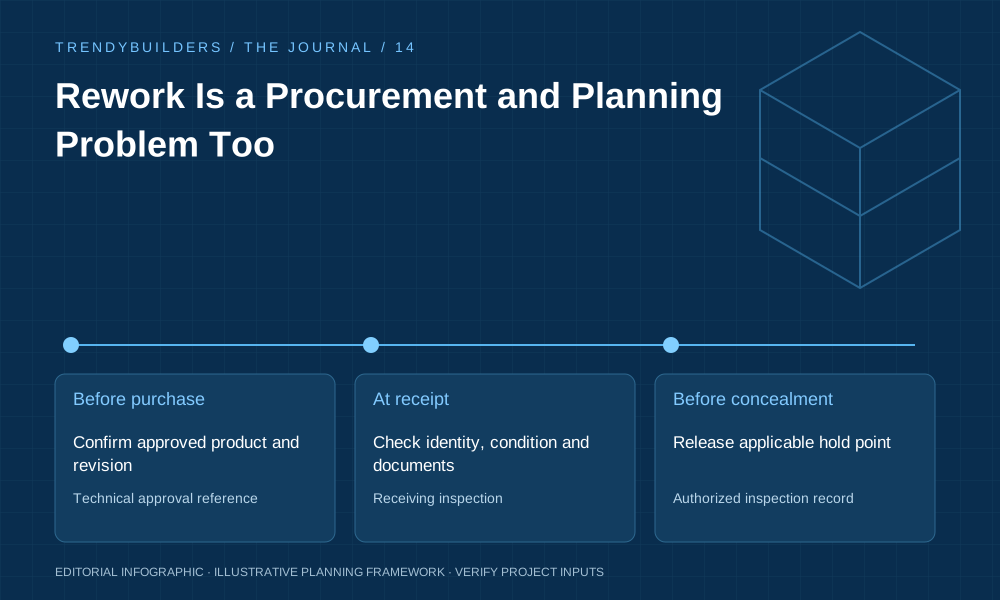
The practical response is to connect acceptance criteria to procurement and production. Define what must be approved before purchase, what must be checked on delivery and which work cannot be concealed before inspection. A quality plan that exists only as a document does not provide those operating controls.
Start with a clear acceptance basis
A purchase description should identify the required product, performance and evidence. A generic material name can leave too much room for an unsuitable substitution. Confirm the specification revision and the required certificates, samples or tests. Where an alternative is proposed, record the technical approval before treating the lower price as a saving.
Acceptance criteria should also be available to the people receiving and installing the material. If the storekeeper sees only a purchase-order number, an obvious mismatch may remain undetected. A short receiving checklist linked to the approved product can prevent a much more expensive discovery after installation.
An illustrative concealed-work defect
A service installation uses a component that appears similar to the approved item but has an incompatible rating. The difference is not identified at receipt. Installation proceeds, the work is concealed and testing later reveals the problem. The repair now requires opening finishes, removing installed work, replacing material and repeating inspection.
The cost is more than the replacement component. Include access, protection, disposal, reinstatement, retesting and the effect on other trades. Distinguish direct repair cost from wider programme consequences. This analysis helps the team understand why a modest receiving or approval control could have been commercially important without pretending that every defect has a simple single cause.
Use hold points deliberately
A hold point should identify the activity, the evidence required, the authorized reviewer and the release condition. Too many vague hold points can become an administrative burden; too few can allow irreversible work to proceed unchecked. Focus on operations where later correction is difficult, costly or unsafe.
Build inspection needs into the programme and resource plan. An inspector who is requested only after the crew is ready can become an avoidable bottleneck. Confirm notice periods, access and test equipment in the look-ahead review. The schedule should support the quality process rather than creating pressure to bypass it.
Keep TB production and cost records honest
Use TrendyBuilders Production logs to distinguish observed output from accepted completed scope. Progress should not increase simply because material has been installed if acceptance remains unresolved under the project’s reporting convention. Cost control and Cost reconciliation can retain the commercial effect of repair work separately from the original estimate.
Use Evidence & audit to retain source references and review records. TB does not certify workmanship, approve a substitution or replace an inspection and test plan. Its useful role is to make quantity, effort and cost consequences reviewable. A correction should preserve the original record and explain the reason for the movement rather than making the defect disappear from the history.
Learn without reducing the issue to blame
Classify the cause using evidence: specification ambiguity, purchasing mismatch, handling damage, installation method, coordination or inspection failure. Several causes may interact. A useful review asks which control was absent or ineffective and what should change before the next similar package.
Track accepted first-pass output and repeat defects alongside direct repair cost. A fall in recorded rework is meaningful only if reporting remains reliable. Encourage early identification while repair options are still simple. The commercial goal is less disruption and a defensible acceptance trail, supported by practical changes to design coordination, purchasing and work preparation.
Cost a defect without losing its cause
Create a separate record for the repair scope and connect it to the original activity and nonconformance reference. Identify replacement material, labor, equipment, access, protection, removal, disposal, reinstatement and retesting. Keep the calculation proportionate, but do not describe the component’s purchase price as the entire cost of the defect.
Distinguish observed cost from forecast consequence. Some repair costs may already be incurred while programme effects remain uncertain. Record the assumptions behind extended supervision, repeated mobilization or delayed access. Avoid adding every possible indirect effect without checking whether it actually changes the expected completion position.
Review the cause with the people who controlled specification, purchasing, receipt and installation. Ask where the mismatch could reasonably have been detected and what evidence was available at that time. This is more useful than judging every earlier decision with information that became available only after the defect appeared.
Choose a preventive action that addresses the identified cause. A receiving checklist may help a product mismatch but will not solve an unresolved design interface. A revised method statement may help an installation problem but will not correct an unsuitable specification. Assign ownership and check whether the next comparable package applies the change.
Retain the original defect and correction history. Correcting the installed work should not erase the record of why the cost and progress changed. A transparent record supports learning, commercial review and reliable forecasts. It also makes it easier to distinguish a genuinely improved process from a reduction in reported defects caused by weaker reporting.
A practical delivery-control protocol
Define the work package in a measurable unit and identify the acceptance basis. Separate installed quantity from accepted completed scope where the project requires that distinction. Record the location and revision so production observations refer to comparable work. Without that foundation, a productivity or progress percentage can combine activities that need very different effort and controls.
Check readiness before assigning more capacity. Confirm approved information, materials, access, predecessor completion, suitable equipment and inspection arrangements. Record missing conditions as actions with owners and due dates. A scheduled start is an intention; readiness evidence establishes whether the team has a practical opportunity to execute the work.
State the resource and calendar assumptions. Crew composition, equipment capability, working periods, setup and shared constraints can materially change the result. Avoid treating nominal headcount or a full shift as guaranteed productive capacity. Safety, competence and technical operating limits remain the responsibility of the appropriate qualified people and established site processes.
Observe output and effort using a consistent convention. Record interruptions and changes in conditions alongside the quantity. This helps distinguish an unrealistic planning rate from a preventable readiness failure or a genuinely more difficult work area. Use the evidence to improve the production system rather than attributing every difference to the crew.
Recalculate the remaining work from a reviewed remaining quantity. Consider whether the observed rate is suitable for the next areas and whether an intervention changes the assumption. Preserve the original baseline while preparing the current forecast. A realistic response plan is easier to assess when the team can still see the position from which it moved.
Review the wider consequence of a proposed recovery. Additional equipment may need setup and approval; more workers may create congestion; overtime may affect fatigue and supervision. A shorter activity does not automatically shorten project completion if another dependency governs the finish. Explain those limits before describing a recovery as secured.
Close the review with a specific action and an evidence check. At the next meeting, verify whether the material arrived, the access became available or the inspection was released. Compare the resulting output with the forecast. Delivery control becomes reliable when the project repeatedly links a stated constraint, a practical response and an observed result.
Warning signs to investigate
A warning sign is a repair record that contains only replacement material. Ask about removal, access, protection, reinstatement, testing and the effect on adjacent work. The original component price may represent a small part of the actual consequence. Keep uncertain indirect effects separate from costs already observed so the report remains both complete and defensible.
Also examine defects that recur after a corrective action was marked complete. The action may have addressed the symptom rather than the cause, or it may not have reached the next workface. Verify application through a sample of comparable work. Learning is demonstrated by a changed process and a better observed result, rather than by closing an administrative item while the same acceptance problem continues.
Decision table
This table summarizes the article’s planning distinction. Numerical examples are illustrative, use no live supplier prices, and exclude costs or assessment stages unless expressly stated. Review the complete explanation before applying an example to a project.
| Stage | Preventive control | Evidence |
|---|---|---|
| Before purchase | Confirm approved product and revision | Technical approval reference |
| At receipt | Check identity, condition and documents | Receiving inspection |
| Before concealment | Release applicable hold point | Authorized inspection record |
Put the method to work
Open Production logs in the TrendyBuilders workspace and work from a reviewed project copy. Confirm the activity identifiers, measurement units and applicable source revision before changing any input. Read the supporting workflow guide for the tool’s scope and review requirements. Keep a dated backup of the accepted basis and export the assumptions with the result so the next reviewer can reconstruct the decision.
Treat the output as a planning result based on the information supplied. Confirm material specifications, supplier commitments, acceptance criteria and professional approvals through the responsible project processes. Where the calculation exposes missing information, record the missing input and assign a next action instead of treating an empty field or a default value as evidence. Revisit the scenario when the source information changes, and preserve the prior version so the movement remains explainable.
Sources and further reading
ILO: Safety and health in construction. The ILO code supports planned construction processes and prevention. The quality-cost framework here is editorial analysis rather than a certification standard. Source checked for the launch collection on November 17, 2026. The worked examples, operating protocols and recommendations are original TrendyBuilders editorial analysis; they are not quotations from the source or professional certification.
Continue the conversation
- The Crane Is Booked Twice. The Programme Still Looks Fine.
- Small Contractors Need Better Decisions, Not More Software
- One Missing Component Can Stop an Entire Project
Bring a project-specific question to the moderated discussion below. Explain the relevant scope and assumptions without sharing confidential drawings, prices or personal information. Useful discussion helps other readers understand the decision and its limits.
The conversation
Constructive, relevant discussion is welcome. Comments are moderated. You may edit your own comment for one hour after its original submission; administrators can edit at any time.
Be the first to contribute a thoughtful comment.