
Executive brief
A project can have too few skilled people and still waste the capacity it already has. Crews wait for access, approved drawings, material, lifting equipment or inspection. Adding workers to a constrained workface can increase cost without increasing accepted output. The first management question is therefore not how many more people to recruit, but which work can be executed safely and continuously with the resources available.
Labor planning needs to connect quantity, production rate, crew composition, working time and physical constraints. A target date is useful only when its resource requirement is achievable. Treat productivity as a measured project condition, not a universal constant imported from a previous estimate.
Distinguish effort from output
Attendance records establish paid time. They do not establish productive time or completed scope. A useful production log records the activity, location, accepted quantity, crew composition, labor hours, equipment hours and interruptions. Keep the unit consistent. Square metres installed per crew-day cannot be compared directly with square metres per person-hour without understanding crew size and shift length.
Avoid penalizing workers for delays outside their control. Record material shortages, permit delays, unsafe conditions and unavailable access separately. Those categories help management direct corrective action. The objective is a fair diagnosis of the production system, followed by practical improvement, rather than a dashboard that turns every lost hour into an individual performance accusation.
A worked crew scenario
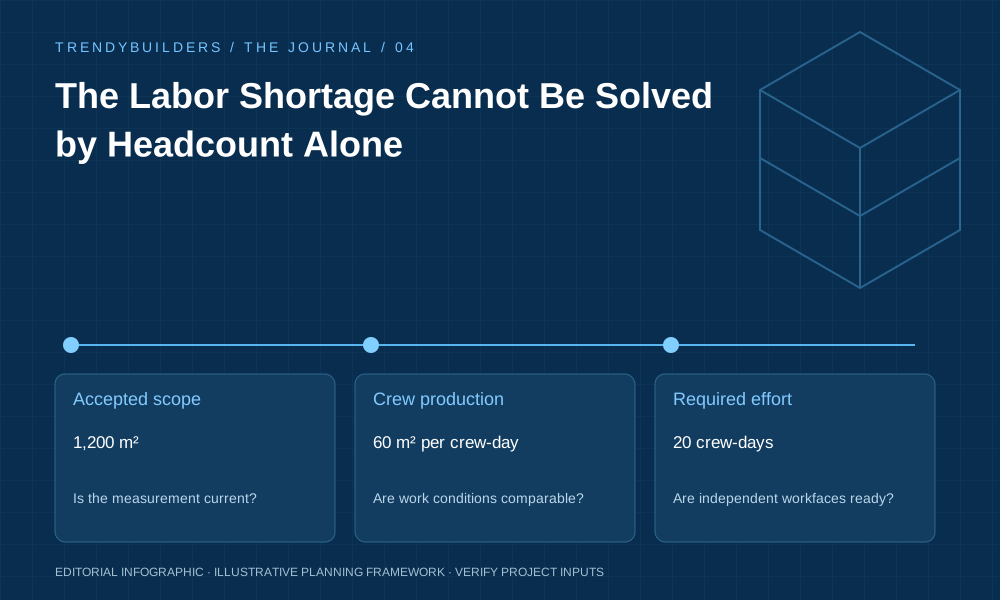
An illustrative package contains 1,200 square metres of blockwork. A crew is expected to complete 60 accepted square metres per working day under the planned conditions. The basic requirement is twenty crew-days. Two independent, fully supplied workfaces could make a ten-day plan plausible. Putting two crews into one narrow workface does not establish the same result, because congestion and shared access may prevent the assumed output.
If observed production is only 45 square metres per crew-day, the remaining duration should be recalculated from the remaining accepted scope. Do not continue reporting the original date simply because the workforce matches the estimate. Investigate whether the difference comes from geometry, material handling, learning, inspection or an unrealistic initial rate.
Prepare the work before increasing capacity
Use a short look-ahead review to confirm drawings, materials, access, predecessor completion, equipment and inspection arrangements. A ready activity should have a defined work area, a competent crew and a practical sequence. Where one condition is missing, assign an owner and a deadline. Merely placing the activity on a weekly schedule does not make it executable.
Consider the support roles that allow skilled workers to remain productive. Material distribution, lifting coordination and reliable setting-out can be more effective than simply adding more tradespeople. Any change in shift pattern should account for fatigue, supervision, safety and applicable local rules. A nominal increase in available hours is not automatically a sustainable increase in production.
Use TB resources and production records
TrendyBuilders Resources can connect entered production assumptions with crews, equipment and target duration. Programme and Resource calendars can make planned availability visible, while Production logs and Forecast & completion support comparison with observed work. Review the scope quantity and unit before using the result. A productivity input is an assumption until it is supported by project evidence.
The standalone resource-leveling tool can explore dependencies and limited capacities using entered calendars. Its output is a scenario, not a guarantee of universal feasibility or an individual shift roster. Check physical workfaces and supervisory capacity outside the calculation. Save the reviewed project and export the basis so a site manager can challenge the assumptions rather than only the final date.
Choose useful performance signals
Track accepted output against paid effort, but interpret the measure with work type and location. Review readiness failures, rework and interruptions alongside production. A crew that installs more work but creates defects may simply move cost into a later period. Likewise, an inspection hold can make a day look unproductive while protecting the quality of the finished asset.
At executive level, ask which constraint is limiting the next critical activity and what management action will remove it. The answer may be a technical decision, a delivery, a second access route or a realistic change to the programme. Recruitment remains important, but it works best inside a production system that gives skilled people a clear and executable task.
Run a workface-readiness experiment
Choose one repetitive activity and observe it over several comparable work periods. Before each period, confirm material availability, approved information, access, predecessor completion and inspection arrangements. Record the crew composition and working time. The purpose is to establish whether the activity had a fair opportunity to achieve its planned output, not to create a surveillance exercise or rank individuals without context.
Record accepted output in a consistent unit and separate interruptions by cause. A late delivery, unavailable setting-out or shared lifting conflict should be visible. Note changes in geometry or complexity so a difficult area is not compared unfairly with a simple repetitive area. Ask the supervisor and crew what prevented continuous work and which support action would have made the greatest difference.
Select one manageable intervention, such as staging material closer to the workface or confirming an inspection slot in advance. Keep other major assumptions as stable as practical. Compare the next similar period and retain the circumstances. A single better day is useful evidence, but it is not enough to establish a permanent universal rate. Look for a repeatable improvement before changing the standard planning basis.
Review the commercial consequence with care. Higher output can reduce duration, but savings depend on which resources and overheads can actually be released. A shorter activity may not reduce the project’s total preliminaries if another critical activity still governs completion. Explain the direct labor effect separately from any wider programme benefit.
Use the result to update the remaining-work forecast and the readiness checklist. Where the constraint remains outside the crew’s control, assign it to the appropriate manager. This makes productivity improvement a coordinated operating task. Recruiting skilled people remains valuable, but the project gains more from each addition when materials, information and access are ready for the work they were hired to perform.
A practical delivery-control protocol
Define the work package in a measurable unit and identify the acceptance basis. Separate installed quantity from accepted completed scope where the project requires that distinction. Record the location and revision so production observations refer to comparable work. Without that foundation, a productivity or progress percentage can combine activities that need very different effort and controls.
Check readiness before assigning more capacity. Confirm approved information, materials, access, predecessor completion, suitable equipment and inspection arrangements. Record missing conditions as actions with owners and due dates. A scheduled start is an intention; readiness evidence establishes whether the team has a practical opportunity to execute the work.
State the resource and calendar assumptions. Crew composition, equipment capability, working periods, setup and shared constraints can materially change the result. Avoid treating nominal headcount or a full shift as guaranteed productive capacity. Safety, competence and technical operating limits remain the responsibility of the appropriate qualified people and established site processes.
Observe output and effort using a consistent convention. Record interruptions and changes in conditions alongside the quantity. This helps distinguish an unrealistic planning rate from a preventable readiness failure or a genuinely more difficult work area. Use the evidence to improve the production system rather than attributing every difference to the crew.
Recalculate the remaining work from a reviewed remaining quantity. Consider whether the observed rate is suitable for the next areas and whether an intervention changes the assumption. Preserve the original baseline while preparing the current forecast. A realistic response plan is easier to assess when the team can still see the position from which it moved.
Review the wider consequence of a proposed recovery. Additional equipment may need setup and approval; more workers may create congestion; overtime may affect fatigue and supervision. A shorter activity does not automatically shorten project completion if another dependency governs the finish. Explain those limits before describing a recovery as secured.
Close the review with a specific action and an evidence check. At the next meeting, verify whether the material arrived, the access became available or the inspection was released. Compare the resulting output with the forecast. Delivery control becomes reliable when the project repeatedly links a stated constraint, a practical response and an observed result.
Warning signs to investigate
A common warning is a resource plan that assumes the same production rate across every floor, room or work area. Repetition can improve familiarity, but congestion, access and geometry may change. Review the remaining locations before extrapolating the best observed day. Keep learning effects and difficult conditions visible instead of choosing whichever rate produces the preferred completion date.
Also watch for progress that rises while inspection acceptance or rework remains unresolved. Faster installation can create a misleading impression of productivity if repair effort is recorded elsewhere. Agree the acceptance convention and review first-pass quality alongside output. A credible labor forecast connects paid effort to work that satisfies the project’s requirements, while treating workers fairly and keeping the causes of interruption within management’s view.
Decision table
This table summarizes the article’s planning distinction. Numerical examples are illustrative, use no live supplier prices, and exclude costs or assessment stages unless expressly stated. Review the complete explanation before applying an example to a project.
| Planning input | Illustrative value | Review question |
|---|---|---|
| Accepted scope | 1,200 m² | Is the measurement current? |
| Crew production | 60 m² per crew-day | Are work conditions comparable? |
| Required effort | 20 crew-days | Are independent workfaces ready? |
Put the method to work
Open Resources in the TrendyBuilders workspace and work from a reviewed project copy. Confirm the activity identifiers, measurement units and applicable source revision before changing any input. Read the supporting workflow guide for the tool’s scope and review requirements. Keep a dated backup of the accepted basis and export the assumptions with the result so the next reviewer can reconstruct the decision.
Treat the output as a planning result based on the information supplied. Confirm material specifications, supplier commitments, acceptance criteria and professional approvals through the responsible project processes. Where the calculation exposes missing information, record the missing input and assign a next action instead of treating an empty field or a default value as evidence. Revisit the scenario when the source information changes, and preserve the prior version so the movement remains explainable.
Sources and further reading
ILO: Safety and health in construction. The ILO construction code addresses planning, prevention and working conditions. The productivity workflow here is TrendyBuilders editorial analysis. Source checked for the launch collection on November 17, 2026. The worked examples, operating protocols and recommendations are original TrendyBuilders editorial analysis; they are not quotations from the source or professional certification.
Continue the conversation
- Measure Once. Buy the Right Quantity.
- The Cheapest Material Is the Material You Do Not Waste
- The Lowest Bid Can Become the Highest Project Cost
Bring a project-specific question to the moderated discussion below. Explain the relevant scope and assumptions without sharing confidential drawings, prices or personal information. Useful discussion helps other readers understand the decision and its limits.
The conversation
Constructive, relevant discussion is welcome. Comments are moderated. You may edit your own comment for one hour after its original submission; administrators can edit at any time.
Be the first to contribute a thoughtful comment.