
Executive brief
International procurement brings together offers written in different units, currencies and delivery conventions. A price can look attractive because the comparison is incomplete. A quotation per piece may be compared with a rate per metre; a nominal dimension may be mistaken for an actual dimension; an exchange assumption may be stale. These errors can outweigh the apparent saving.
The solution is a common comparison basis with a traceable conversion. Preserve the original offer and show every adjustment. Do not normalize away a technical difference that requires professional approval. A converted number can be mathematically correct while the proposed product remains unsuitable.
Normalize quantity without losing the specification
Start with the approved technical requirement and a common unit. Record whether dimensions are nominal, actual or governed by a particular product standard. Check thickness, grade, tolerance and applicable certification. A supplier’s similar description does not establish equivalence. Resolve the technical question before treating the offers as interchangeable.
Commercial units need their own review. A bundle may contain a variable number of pieces, a roll may have a stated width and length, and a tonne-based rate may depend on actual or theoretical mass. Record the supplier’s basis and the conversion used. Keep enough precision in intermediate calculations, then apply the appropriate purchasing rounding at the end.
An illustrative length comparison
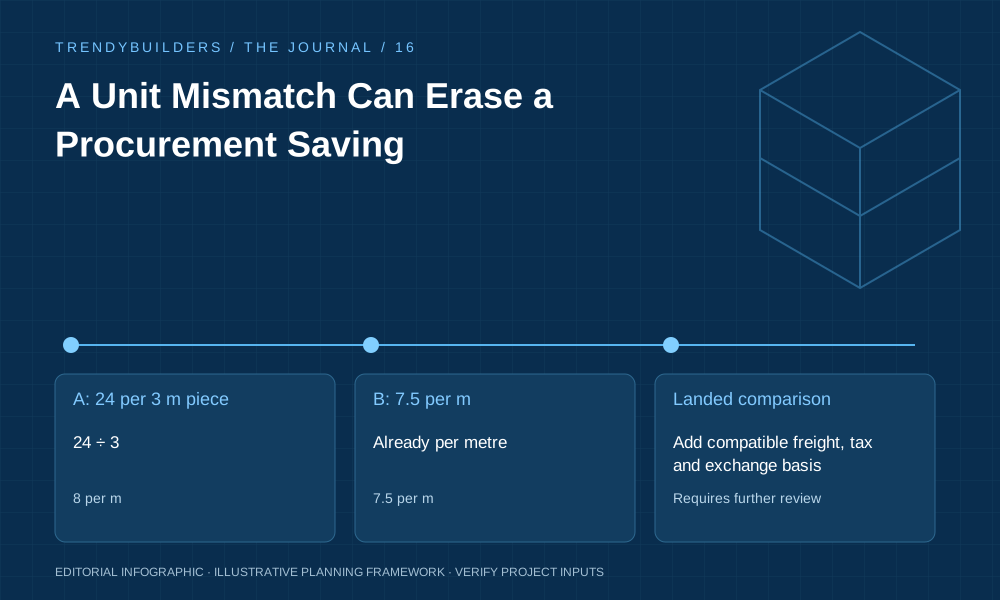
Supplier A quotes 24 currency units for a three-metre piece. Supplier B quotes 7.5 per metre for a technically equivalent item. A’s normalized material rate is 8 per metre, so B appears lower on that narrow basis. If B’s minimum order, freight or waste from available stock lengths differs, the purchase comparison can change again.
The example deliberately excludes actual currency conversion and delivery terms. In a real comparison, state the exchange-rate source and date, bank or conversion charges where relevant, and the agreed delivery point. Do not combine a favorable historic exchange rate with a current supplier quote and present the result as a firm landed price.
Keep currency exposure separate from markup
A commercial markup is not an exchange allowance. Identify the quote currency, reporting currency, conversion assumption and the amount still exposed before payment. If a purchase is already paid or contractually fixed in the reporting currency, do not apply the same exchange scenario to it as to an uncommitted import.
Use scenarios to understand sensitivity rather than pretending to predict the market. The organization’s authorized finance and commercial teams should determine any hedging or payment strategy. The project-control record should make the exposure visible and keep it separate from contingency, tax and margin.
Apply the TB normalization workflow
TrendyBuilders keeps country, currency and units distinct. Use Supplier quotes and the supplier exchange tool to review entered data, exact identifiers, validity dates and unit bases. Use Scenarios to test entered exchange and cost assumptions. Selecting a country does not supply a verified exchange rate or establish local compliance.
The regional rate importer processes a permitted normalized file with source metadata; it does not provide a licensed market-rate dataset. Review the declared rights and the compatibility of the units and tax basis. Preserve the original source and the normalized comparison so another reviewer can reconstruct the calculation.
Close the loop at delivery
The receiving team should confirm that the delivered product matches the approved normalized comparison. Check piece length, quantity, grade and documentation. A supplier may substitute a different pack or stock length while keeping the same broad product description. That change can affect purchasing efficiency and technical suitability.
Record discrepancies before accepting the goods into usable stock. Reconcile the invoice unit with the purchase-order and receipt units. The strongest international procurement control follows the same item from specification through quote, conversion, order, delivery and invoice, rather than stopping once the comparison spreadsheet produces a lowest total.
Reconcile the offer in its original form
Keep an untouched copy of the supplier quotation and create a separate normalized comparison. Record the original unit, currency, delivery basis and validity. Show the conversion formula rather than replacing the quoted number. This allows a reviewer to distinguish the supplier’s statement from the buyer’s adjustment.
Verify the technical description with the responsible reviewer. Product standards, nominal sizes and tolerances can differ across markets. A dimensional conversion does not establish compliance. If the proposed product is an alternative, identify the approval status and any consequences for installation, maintenance or certification before ranking it as equivalent.
Reconcile pack sizes and stock lengths with the project’s required pieces. A lower rate per metre can be offset by a less efficient available length or a large minimum order. Apply commercial rounding to the actual purchase, then evaluate usable remnants and storage. Do not compare only the unrounded theoretical requirement when suppliers sell whole units.
State the exchange assumption and which amount remains exposed. Keep any conversion charges, tax assumptions and freight adjustments visible. The project’s finance and commercial teams should determine the authorized payment and risk-management arrangements. A sensitivity calculation shows possible consequences; it does not predict exchange movement or establish a financial strategy.
Before payment approval, reconcile the supplier invoice to the accepted purchase and receipt units. Investigate substitutions, short deliveries or changed packaging. This final check protects the normalization work performed at tender stage. International procurement becomes more reliable when every conversion remains traceable through the complete commercial and physical transaction.
A practical procurement-control protocol
Begin with a reviewed demand statement. Identify the item, specification, quantity, commercial unit, required location and need date. Keep the technical approval status visible. If any of those fields remains provisional, identify who must resolve it before commitment. A supplier cannot reliably price or reserve the correct requirement when the project itself has not defined what it intends to buy.
Normalize the commercial basis before comparing offers. Check delivery point, packaging, minimum order, quote validity, currency and tax assumptions. Retain the original quotations and show adjustments separately. Seek clarification where an exclusion or ambiguous term can change the decision. Do not silently complete one supplier’s offer using favorable assumptions that are not applied to the others.
Connect the purchase to its operating dependency. Identify the installation or testing activity that needs the item, and work backward through approval, manufacture, transport and acceptance. Confirm which event starts each quoted lead time. A purchase-order date is not necessarily a manufacturing-release date, and a delivery date is not necessarily the date the material is ready for use.
Keep authority distinct from record entry. A buyer may prepare a comparison while a technical reviewer approves suitability and an authorized commercial role approves commitment. The project-control tool should retain those references without implying that entering an order transmits it or executes payment. Confirm the actual supplier acceptance through the organization’s established process.
Use evidence-based status updates. A quotation, accepted order, released manufacture, dispatch record and accepted receipt establish different conditions. Record the next milestone and the evidence needed to confirm it. Avoid carrying an unsupported green status merely because nobody has reported a delay. An honest uncertainty gives the team time to investigate and preserve options.
At receipt, check identity, condition, quantity and documentation against the approved requirement. Quarantine discrepancies where the quality process requires it. Reconcile accepted stock with the purchasing record before treating it as available for installation. A truck arrival should not automatically close the procurement exposure if critical parts or acceptance evidence remain missing.
Finally, review supplier performance against the assumptions used in the decision. Retain specific evidence about delivery, completeness and support. Use that learning proportionately in future evaluations. The purpose is a reliable flow from reviewed demand to usable material, supported by clear approvals and a comparison that another person can reconstruct.
Warning signs to investigate
A comparison should be challenged when a converted rate looks unusually favorable but the original commercial unit is unclear. Confirm whether the quote is per piece, pack, metre or mass unit and whether the product dimensions are nominal or actual. Reproduce the conversion from the untouched source offer. The apparent saving may disappear once the same purchase basis is used.
Another warning is an exchange assumption without a source date or an explanation of which payments remain exposed. Keep that uncertainty separate from markup and tax. A sensitivity case can inform the review, but it should not be described as a confirmed landed price. Preserve the original and normalized records through ordering and invoice review so later differences can be investigated accurately.
Decision table
This table summarizes the article’s planning distinction. Numerical examples are illustrative, use no live supplier prices, and exclude costs or assessment stages unless expressly stated. Review the complete explanation before applying an example to a project.
| Quoted basis | Illustrative conversion | Normalized material rate |
|---|---|---|
| A: 24 per 3 m piece | 24 ÷ 3 | 8 per m |
| B: 7.5 per m | Already per metre | 7.5 per m |
| Landed comparison | Add compatible freight, tax and exchange basis | Requires further review |
Put the method to work
Open Supplier quotes in the TrendyBuilders workspace and work from a reviewed project copy. Confirm the activity identifiers, measurement units and applicable source revision before changing any input. Read the supporting workflow guide for the tool’s scope and review requirements. Keep a dated backup of the accepted basis and export the assumptions with the result so the next reviewer can reconstruct the decision.
Treat the output as a planning result based on the information supplied. Confirm material specifications, supplier commitments, acceptance criteria and professional approvals through the responsible project processes. Where the calculation exposes missing information, record the missing input and assign a next action instead of treating an empty field or a default value as evidence. Revisit the scenario when the source information changes, and preserve the prior version so the movement remains explainable.
Sources and further reading
BIPM: The International System of Units. BIPM defines SI units. Supplier pack sizes, commercial descriptions and currency assumptions require additional project-specific checks. Source checked for the launch collection on November 17, 2026. The worked examples, operating protocols and recommendations are original TrendyBuilders editorial analysis; they are not quotations from the source or professional certification.
Continue the conversation
- Small Contractors Need Better Decisions, Not More Software
- From Quantities to Delivery: Close the Planning Loop
- The Labor Shortage Cannot Be Solved by Headcount Alone
Bring a project-specific question to the moderated discussion below. Explain the relevant scope and assumptions without sharing confidential drawings, prices or personal information. Useful discussion helps other readers understand the decision and its limits.
The conversation
Constructive, relevant discussion is welcome. Comments are moderated. You may edit your own comment for one hour after its original submission; administrators can edit at any time.
Be the first to contribute a thoughtful comment.