
One material can have several volume descriptions
Earthwork estimates become misleading when quantities with different physical bases are added together. Soil measured before excavation, soil in a truck and soil compacted into an embankment need not occupy the same volume. A project may show equal cut and fill on a drawing summary yet still require imported material, disposal or additional handling. Material suitability and timing can prevent reuse even where the geometry appears balanced.
These distinctions matter globally because hauling capacity, disposal access and borrow sources can dominate the operating plan. The useful question is not simply how many cubic meters the project contains. Ask what each volume represents, which material class it concerns, where that material can be used and when it will be available. Keep those answers visible beside the arithmetic.
Establish the survey and measurement basis
Identify the existing-ground survey, proposed surface revision, excavation limits and exclusions. Separate topsoil, unsuitable material, structures, over-excavation and temporary works where the scope requires it. Record whether the quantity comes from cross-sections, a model or a manual calculation. A precise-looking result cannot repair an incomplete survey or an incorrect boundary.
Agree the measurement basis used for estimating, ordering, hauling and contract payment. These may differ. A truck tally is useful operational evidence but does not automatically become the contractual excavation quantity. Preserve the relevant source and acceptance process for each purpose. When revisions arrive, compare the affected zones rather than replacing the previous total without explanation.
Treat conversion factors as reviewed project inputs
Shrinkage and swell allowances depend on the material and the basis of the factor. A multiplier from in-place to loose volume is not interchangeable with a percentage loss from loose to compacted volume. Label the numerator and denominator explicitly. Obtain applicable project information from the responsible geotechnical or engineering process rather than selecting a convenient internet percentage.
Keep material classes separate until the conversions and suitability decisions are complete. Rock, granular soil, wet unsuitable material and salvaged topsoil should not share a single generic factor merely because all are measured in cubic meters. Record uncertainty as a range where appropriate and show how the range changes import, export and haul planning.
A worked example with deliberately different bases
Suppose an illustrative zone contains 1,000 cubic meters measured in place. A reviewed scenario assumes a loose-volume multiplier of 1.20, producing 1,200 loose cubic meters for handling. A separate accepted relationship says that this material would provide 850 compacted cubic meters when suitable and placed to the specified requirements. These figures describe the same hypothetical material at different states; adding them would double count it.
If the zone needs 1,000 compacted cubic meters, the scenario has a 150 compacted cubic meter shortfall before allowances for rejected material or other scope. The imported loose quantity must be calculated using the imported material's own accepted relationship. This example teaches unit discipline. Its factors are invented for explanation and must not be applied as geotechnical advice or default project values.
Add location and sequence to the balance
An aggregate site balance can hide expensive internal movements. Suitable cut may be available only after the fill workfront is required. A temporary stockpile can solve the timing gap while introducing land, drainage, handling and inspection requirements. A nearby source may be inaccessible to the selected vehicle or incompatible with the environmental controls.
Prepare a zone-to-zone movement schedule showing source, destination, material class, basis, planned date and any hold point. Identify which movements require rehandling. Compare direct placement with stockpiling using the full operating scope. Include access preparation and restoration where applicable. The cheapest apparent haul distance may not yield the lowest feasible delivered and placed cost.
Check payload and cycle assumptions independently
Truck capacity is constrained by permitted weight, material density, body volume, route conditions and loading practice. A nominal body volume alone does not establish a legal or safe payload. Use the applicable operating requirements and competent transport planning. Distinguish loaded travel, return, queuing, loading and unloading when building a cycle-time estimate.
Compare the loading rate with the available hauling and placement capacity. Adding trucks can increase queues without increasing accepted output. Track actual cycles and accepted placement quantities during early work, then revise the forecast with evidence. Keep the original estimate available so the team can see whether the difference came from geometry, material behavior, access or operating performance.
Use calculation tools with an explicit boundary
TrendyBuilders Earthwork balance calculations can support reviewed geometric quantities and comparisons using the inputs the user provides. The tool does not investigate ground conditions, certify material suitability, design slopes or authorize disposal. Use separate accepted project records for those decisions. Where a needed conversion is outside a tool's supported inputs, calculate and document it separately rather than forcing it into an unrelated allowance field.
Maintain an estimate register with one clearly named quantity basis per line. Reconcile purchasing and hauling records to that basis through documented conversions. A reviewer should be able to start from the survey revision, reproduce the geometry and understand every subsequent adjustment without relying on the estimator's memory.
Make uncertainty visible before awarding the haul
Before committing to a hauling package, review plausible changes in unsuitable material, approved disposal location, reusable yield and access. State which risks are included in the price and which require a defined change process. Avoid hiding a disputed quantity basis inside a general contingency percentage. It makes later reconciliation harder for both parties.
At closeout, compare measured excavation, accepted reuse, imported fill and documented disposal on compatible bases. Explain remaining differences and retain the survey and tickets that support them. A credible earthwork balance is an auditable chain from geometry to material state to movement and accepted placement, with uncertainty shown at every transition.
A practical cost-control protocol
Establish the reporting boundary before reviewing movement. State the package, currency, tax basis, price date and scope revision. Identify whether the figures describe an estimate, a commitment, an actual cost or a forecast. These records answer different questions and should not be added together indiscriminately. A committed amount may already include expenditure that later appears in actual-cost records, so the reconciliation needs an explicit convention.
Retain a frozen reference for the approved position. Record the current working assumptions separately and explain the difference using a short bridge. The bridge should reconcile exactly to the reported total. If an unexplained balance remains, investigate it rather than assigning it to a vague miscellaneous line. Precision in the presentation is useful only when the underlying categories have a clear meaning.
Give uncertain inputs a status and a next action. A provisional quantity, expired quotation or unresolved scope boundary should remain visible. Identify the information needed to replace the assumption, the person responsible and the decision date. A planning allowance can be appropriate, but it should not be described as a confirmed price or an approved obligation.
Check whether a proposed response changes another cost or timing assumption. Earlier purchasing can affect storage and cash. Resequencing can affect supervision and equipment. An approved material alternative can affect installation effort. Review the whole consequence at a level proportionate to the decision. Do not count a saving in one line while leaving its necessary supporting cost outside the comparison.
Use a consistent refresh trigger. Major scope issues, quote expiry, procurement award and a changed delivery or production position can justify a new forecast. Repeatedly updating every rate without new evidence can create work without improving the decision. Focus effort where exposure is material and where an action can still change the outcome.
Before issuing the report, ask another reviewer to reproduce one important movement from the source records. Confirm that units and dates match and that the same amount has not been counted twice. Record the review and retain the exported version. This gives the next meeting a reliable reference and helps the team explain why the forecast changed.
The final control is ownership. Every material exception should lead to an action, an accepted allowance or an explicit decision to retain the exposure. A cost report becomes useful when it makes that choice clear. The objective is a defensible basis for managing the remaining work, rather than a promise that uncertainty has disappeared.
A review routine the team can sustain
Choose one real package for the first review rather than attempting to repair every record at once. Ask its estimator, buyer and field owner to agree the accepted scope and identify the sources they actually use. Write down the unresolved questions and the next decision each one prevents. This short exercise makes the method concrete and reveals where the project needs better evidence before it needs another calculation.
Keep the original working records available while testing a revised approach. Use a dated project copy for scenarios and record the input changes individually. Ask a second person to reproduce a sample result from the stated sources. If they cannot explain the unit, revision or assumption, improve the record before circulating the total as an accepted basis. A reproducible result is more useful than an impressive display that depends on its author's memory.
At the next regular package meeting, compare the planned action with what happened. Identify whether the obstacle was missing information, capacity, authority or a changed site condition. Update the relevant assumption and assign the remaining action to a named person with a practical due date. Keep the previous basis so the movement remains explainable. Avoid silently replacing uncertainty with a default value simply to complete the report.
Scale the process only after the pilot has produced a useful decision. Retain fields that support an actual review and remove duplicate recording that adds no evidence. Tell the people receiving the output which version is accepted and what remains conditional. The goal is a working habit that survives a busy site week: clear sources, visible assumptions, explicit authority and a traceable action when the evidence changes.
Decision table
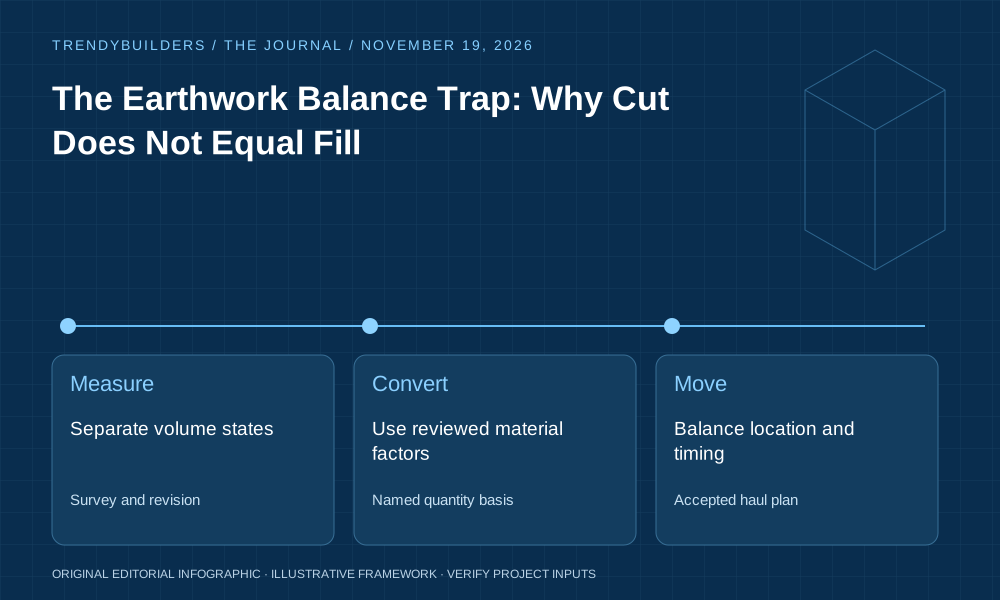
Use this table as a meeting prompt alongside the explanation above. It summarizes the evidence chain; it does not establish technical acceptance or replace the responsible project process. Numerical examples in this article are illustrative and contain no live supplier rates.
| Stage | Action | Evidence |
|---|---|---|
| Measure | Separate volume states | Survey and revision |
| Convert | Use reviewed material factors | Named quantity basis |
| Move | Balance location and timing | Accepted haul plan |
Apply the method in TrendyBuilders
Open Earthwork balance and read the supporting workflow guide before entering project information. Use a reviewed project copy, confirm the measurement units and source revisions, and inspect warnings and exclusions before relying on any output. The calculations depend on the information supplied; selecting a tool does not validate the underlying technical or commercial assumptions.
Keep the accepted project documents and required approvals linked to the planning record. Export the assumptions with a dated result so another reviewer can reproduce the comparison. Where the workflow reveals a missing input or a decision outside the tool's scope, assign that issue to the responsible person rather than treating a blank field as evidence of zero exposure.
Sources and further reading
FHWA: Earthwork design. This primary-source reference provides relevant background in its own stated scope and jurisdiction. It does not endorse this article or TrendyBuilders. Reference checked November 18, 2026. The worked examples and operating recommendations are original editorial analysis; they are not reported project outcomes, quotations or professional certification.
Related reading
- Measure Once. Buy the Right Quantity.
- The Most Expensive Scope Is the Scope Nobody Owned
- The Crane Is Booked Twice. The Programme Still Looks Fine.
Use the moderated discussion to share the decision you are trying to make and the assumptions that matter. Omit confidential drawings, supplier prices and personal information.
The conversation
Constructive, relevant discussion is welcome. Comments are moderated. You may edit your own comment for one hour after its original submission; administrators can edit at any time.
Be the first to contribute a thoughtful comment.