
Executive brief
A programme can satisfy every predecessor relationship and still be impossible to execute. Two activities may need the same crane, pump, specialist crew or access corridor at the same time. If the schedule assumes unlimited resources, those conflicts remain hidden until the work reaches site. Recovery then competes with established deliveries, subcontract commitments and safety constraints.
Resource planning should test both quantity and compatibility. A machine may be available but unsuitable for the task. A crew may have enough people but lack the necessary competence. A useful allocation record identifies the required capability, the amount of capacity, the location and the relevant calendar.
Model the scarce resources first
Do not attempt to describe every person and minor tool before addressing the bottleneck. Start with shared resources whose absence can block important activities. Examples include lifting equipment, concrete supply, specialist testing teams and restricted work areas. Record capacity in a unit that supports the decision, such as equipment units, crew-days or available working periods.
Keep capability tags meaningful. Two cranes are not interchangeable merely because both count as one equipment unit. Capacity, reach, setup, access and the approved lifting arrangement matter. The schedule can represent availability, but competent specialists must establish the safe and technically suitable operating plan.
An illustrative double booking
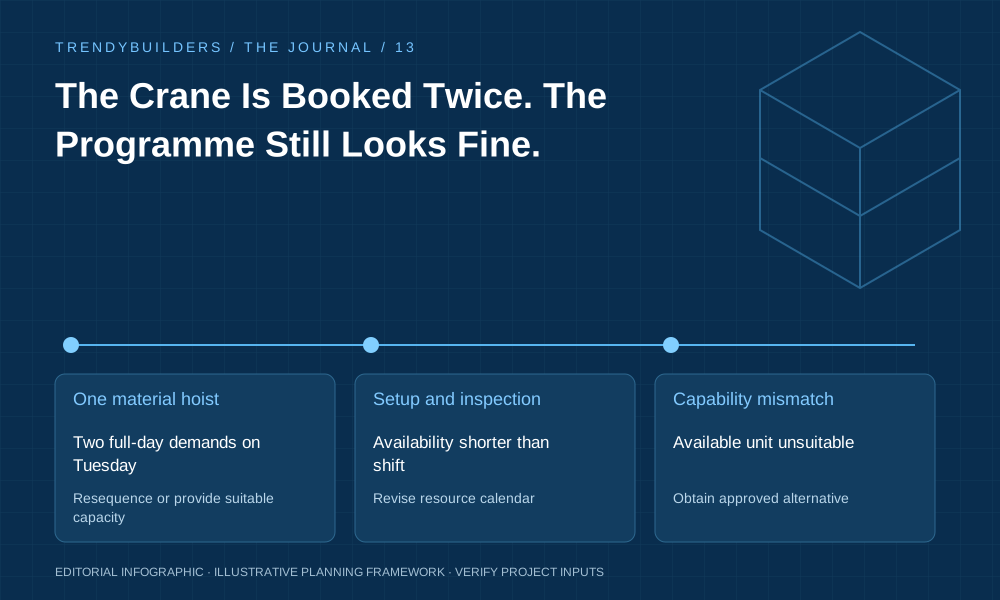
Two floor activities each require the project’s only material hoist for a full working day. Their predecessors finish on Monday, so an unconstrained schedule starts both on Tuesday. The dependency logic is valid, but the allocation is not. One activity must move, the demand must be reduced through a reviewed alternative, or additional suitable capacity must be provided.
Moving the second activity can affect follow-on trades and access. Hiring another hoist introduces installation, certification, operating and removal requirements. Splitting the day may work only if the actual tasks and setup times allow it. Compare those responses using the full consequence rather than assuming that a second resource can appear without preparation.
Account for calendars and nonproductive time
Resource availability should reflect maintenance, inspections, travel, setup and agreed working periods. A machine that is physically on site may still be unavailable for part of the shift. Likewise, a specialist crew may be shared with another location or constrained by access and supervision. Calendar assumptions should be visible and refreshed when those conditions change.
Avoid treating every utilization gap as waste. Some reserve capacity protects critical operations or allows safe maintenance. The objective is a credible plan, not a theoretical one hundred percent utilization rate. A tightly packed schedule with no room for setup or disruption can be less reliable than a slightly longer plan with explicit recovery options.
Use TB resource calendars and leveling
TrendyBuilders Resource calendars can retain typed resource availability and allocations. Resources connects entered production assumptions with manpower, equipment and duration. The standalone resource-leveling tool can explore dependency and capacity scenarios, including blocked activities. Review its assumptions and output before transferring an accepted plan into the project.
The tool does not guarantee universal feasibility, design a lifting operation or create an individual shift roster. Physical workfaces, safe access and specialist competence require separate review. Keep the accepted resource assignment connected to the activity quantity and calendar so a change in scope or production rate triggers a meaningful allocation check.
Escalate conflicts as choices
A conflict report should identify the affected activities, the required capability, the overlap and the consequences of each response. Executives can then compare resequencing, additional capacity and a revised target date. A red resource bar without a decision basis is less useful than a short options note.
After the work, compare planned and observed demand. Repeated setup overruns or unavailable equipment may indicate a weak calendar assumption rather than poor site execution. Use that evidence to improve the next allocation. Resource planning becomes valuable when it explains why a schedule is executable and how the team will respond when capacity changes.
Stress-test the next critical work period
List the activities expected to use the project’s scarce resources in the next look-ahead period. Record the required capability, duration, setup time and work area. Compare those demands with the actual availability calendar. Include inspections, maintenance and known commitments outside the immediate package.
Ask the site team to identify physical conflicts the model does not represent. Two activities may have different equipment allocations but still depend on the same access route or unloading area. A shared support crew can become a hidden constraint. Add only the level of detail needed to expose the real conflict and support a practical decision.
Compare a small set of responses. Resequencing may protect cost but affect a follow-on trade. Additional capacity may require mobilization, setup and approval. Splitting a work period may introduce repeated preparation and reduced output. State those consequences rather than assuming that every available hour is interchangeable.
Check the accepted response against safety and technical requirements. A planning tool does not establish lifting suitability, operating limits or individual competence. Retain the responsible specialist’s basis and use it to constrain the resource scenario. The commercial schedule should follow that approved operating arrangement.
After the period, compare the actual bottleneck with the one anticipated. If the predicted conflict did not occur, determine whether an effective intervention prevented it or whether the demand assumption was wrong. If a new bottleneck appeared, capture the missing dependency. This learning improves future calendars and prevents the same optimistic capacity assumption from recurring.
A practical delivery-control protocol
Define the work package in a measurable unit and identify the acceptance basis. Separate installed quantity from accepted completed scope where the project requires that distinction. Record the location and revision so production observations refer to comparable work. Without that foundation, a productivity or progress percentage can combine activities that need very different effort and controls.
Check readiness before assigning more capacity. Confirm approved information, materials, access, predecessor completion, suitable equipment and inspection arrangements. Record missing conditions as actions with owners and due dates. A scheduled start is an intention; readiness evidence establishes whether the team has a practical opportunity to execute the work.
State the resource and calendar assumptions. Crew composition, equipment capability, working periods, setup and shared constraints can materially change the result. Avoid treating nominal headcount or a full shift as guaranteed productive capacity. Safety, competence and technical operating limits remain the responsibility of the appropriate qualified people and established site processes.
Observe output and effort using a consistent convention. Record interruptions and changes in conditions alongside the quantity. This helps distinguish an unrealistic planning rate from a preventable readiness failure or a genuinely more difficult work area. Use the evidence to improve the production system rather than attributing every difference to the crew.
Recalculate the remaining work from a reviewed remaining quantity. Consider whether the observed rate is suitable for the next areas and whether an intervention changes the assumption. Preserve the original baseline while preparing the current forecast. A realistic response plan is easier to assess when the team can still see the position from which it moved.
Review the wider consequence of a proposed recovery. Additional equipment may need setup and approval; more workers may create congestion; overtime may affect fatigue and supervision. A shorter activity does not automatically shorten project completion if another dependency governs the finish. Explain those limits before describing a recovery as secured.
Close the review with a specific action and an evidence check. At the next meeting, verify whether the material arrived, the access became available or the inspection was released. Compare the resulting output with the forecast. Delivery control becomes reliable when the project repeatedly links a stated constraint, a practical response and an observed result.
Warning signs to investigate
A schedule should be challenged when every activity assumes full access to a shared resource. Review overlapping demands and the actual operating calendar, including setup and inspection. The dependency network may be valid while the resource assignment remains impossible. A small number of scarce-resource checks can expose a large execution risk.
Also watch for resource substitutions made only in the schedule. A different unit or crew may require technical suitability, competence or operating approval. Confirm those conditions before treating the substitute as available capacity. Keep the accepted capability requirement connected to the activity. This prevents a planning adjustment from appearing to solve a conflict by silently changing the conditions under which the work can be performed safely and correctly.
Decision table
This table summarizes the article’s planning distinction. Numerical examples are illustrative, use no live supplier prices, and exclude costs or assessment stages unless expressly stated. Review the complete explanation before applying an example to a project.
| Constraint | Illustrative conflict | Decision to review |
|---|---|---|
| One material hoist | Two full-day demands on Tuesday | Resequence or provide suitable capacity |
| Setup and inspection | Availability shorter than shift | Revise resource calendar |
| Capability mismatch | Available unit unsuitable | Obtain approved alternative |
Put the method to work
Open Resource calendars in the TrendyBuilders workspace and work from a reviewed project copy. Confirm the activity identifiers, measurement units and applicable source revision before changing any input. Read the supporting workflow guide for the tool’s scope and review requirements. Keep a dated backup of the accepted basis and export the assumptions with the result so the next reviewer can reconstruct the decision.
Treat the output as a planning result based on the information supplied. Confirm material specifications, supplier commitments, acceptance criteria and professional approvals through the responsible project processes. Where the calculation exposes missing information, record the missing input and assign a next action instead of treating an empty field or a default value as evidence. Revisit the scenario when the source information changes, and preserve the prior version so the movement remains explainable.
Sources and further reading
ILO: Guidance for employers on occupational safety and health. ILO guidance connects occupational safety management with effective operations. Equipment allocation methods below are original editorial planning analysis. Source checked for the launch collection on November 17, 2026. The worked examples, operating protocols and recommendations are original TrendyBuilders editorial analysis; they are not quotations from the source or professional certification.
Continue the conversation
- When Every Team Has a Different Number
- Rework Is a Procurement and Planning Problem Too
- The Budget Is Moving. Is Your Estimate Keeping Up?
Bring a project-specific question to the moderated discussion below. Explain the relevant scope and assumptions without sharing confidential drawings, prices or personal information. Useful discussion helps other readers understand the decision and its limits.
The conversation
Constructive, relevant discussion is welcome. Comments are moderated. You may edit your own comment for one hour after its original submission; administrators can edit at any time.
Be the first to contribute a thoughtful comment.