
Executive brief
Profit and cash are different project conditions. A package may have an acceptable margin while requiring deposits, early material purchases and labor payments well before customer receipts arrive. If the team reviews only total cost and contract value, it can miss the period when the project needs the greatest working-capital support.
The practical task is to connect commitments and payment assumptions to the programme. Show when money is expected to leave, what triggers each payment and how confident the receipt assumptions are. A smooth cumulative curve should not conceal a large advance payment or a milestone that remains subject to acceptance.
Build the payment logic before the chart
Identify deposits, manufacturing milestones, delivery payments, installation costs, retention and other relevant terms. Distinguish invoice date, contractual due date and expected cash date. These can differ materially. Record tax treatment consistently and check whether a supplier’s offer changes when payment timing changes.
On the receipt side, identify the evidence required before a claim can be submitted and certified. Do not assume that planned physical progress immediately becomes cash. The forecasting convention should state how review, certification and payment periods are represented. Where a receipt is uncertain or disputed, show that status rather than quietly using the most favorable date.
An illustrative timing problem
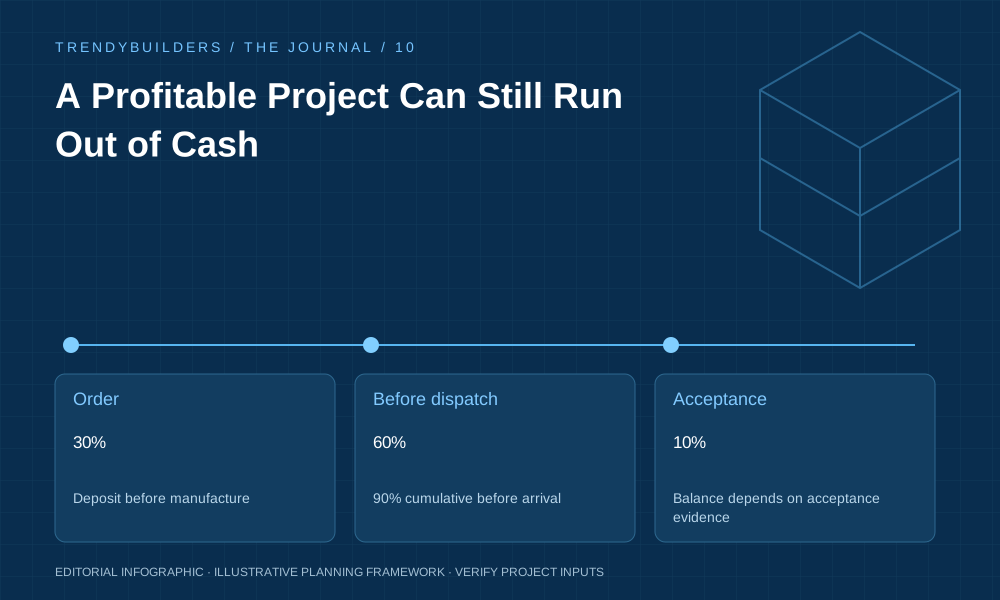
A project purchases equipment for 100,000 currency units. Its terms require thirty percent on order, sixty percent before dispatch and ten percent after acceptance. Before the equipment reaches site, 90,000 may already be payable. If the related customer milestone occurs only after installation and testing, the project must finance the gap even if the package’s expected margin is positive.
The example is illustrative and ignores tax, currency and other project costs. It shows why a purchase decision should be reviewed with timing as well as total price. An alternative with a slightly higher total cost but a different payment profile may deserve consideration. The decision requires the organization’s authorized commercial and financial review, not an automatic rule that later payment is always better.
Test a small number of realistic scenarios
Assess the effect of delayed certification, earlier delivery, changed deposit terms and a slower installation sequence. Keep the cause of each scenario visible. A combined downside can be useful, but it should not mix incompatible assumptions or count the same exposure twice. Identify which response the project can control and which depends on a customer or supplier agreement.
Review storage and preservation costs before choosing early delivery solely to secure price. Check whether an earlier payment actually guarantees a production slot or simply transfers more risk to the buyer. A cash forecast is most useful when it supports a specific decision, such as phasing an order or resolving an acceptance milestone before committing funds.
Use TB as a planning record
TrendyBuilders Cash flow supports planned cost-outflow allocations. Cost control can retain commitments and actual-cost records, while Programme and Procurement provide timing context. Keep those records distinct from bank transactions and formal accounting. The tool is not a bank feed, payment-execution service or substitute for approved financial reporting.
Retain the basis for each major allocation and refresh it when the procurement or programme position changes. Export a dated forecast so reviewers can compare versions. Where the project’s broader receipt model is maintained elsewhere, reconcile the cost-outflow assumptions to that model using the same package references and reporting date.
Escalate the peak gap, not only the final total
An executive needs to know the size and timing of the potential funding gap, the assumptions that create it and the decisions available before it occurs. A final positive margin does not answer those questions. Explain the effect of payment delays and any contractual conditions that remain unresolved.
Use the review to coordinate procurement, project controls and finance. The best response may be operational: finish a testing package, clear a certification query or change a delivery sequence. The value of the forecast lies in bringing those actions forward while the project still has time to respond.
Reconcile one month of forecast outflow
Select the next reporting period and list the major package payments expected within it. For each, identify the commitment, triggering milestone, invoice assumption and expected payment date. Separate confirmed obligations from planning allowances. A forecast that mixes both without status can appear more certain than the available evidence supports.
Compare the procurement schedule with the cost-outflow model. An order moved forward to protect delivery may also bring forward a deposit or manufacturing payment. A deferred delivery may not defer cash if the supplier’s terms require payment before dispatch. These differences should be reconciled explicitly rather than left for finance to discover after the operational decision has been made.
Check the related receipt assumptions through the organization’s established financial process. Identify unresolved certification, acceptance or documentation conditions. The construction team may be able to resolve some of those conditions by completing tests or responding to queries. Keep the planning record connected to those actions without presenting the estimate as an accounting statement.
Assess the largest timing uncertainty and a practical response. That might involve delivery phasing, a different authorized commercial arrangement or earlier completion of a customer milestone. Include the operational consequences and obtain the appropriate review. A lower peak cash requirement is not automatically beneficial if it creates a disproportionate quality, delay or total-cost exposure.
At period end, compare the planned and observed timing, then explain the largest differences. Use that learning to improve the next forecast’s milestone assumptions. Avoid moving every late item into the next month without investigating whether the underlying obligation or expected date has actually changed. A useful cash plan is a maintained explanation of timing, not simply a rolling chart.
A practical cost-control protocol
Establish the reporting boundary before reviewing movement. State the package, currency, tax basis, price date and scope revision. Identify whether the figures describe an estimate, a commitment, an actual cost or a forecast. These records answer different questions and should not be added together indiscriminately. A committed amount may already include expenditure that later appears in actual-cost records, so the reconciliation needs an explicit convention.
Retain a frozen reference for the approved position. Record the current working assumptions separately and explain the difference using a short bridge. The bridge should reconcile exactly to the reported total. If an unexplained balance remains, investigate it rather than assigning it to a vague miscellaneous line. Precision in the presentation is useful only when the underlying categories have a clear meaning.
Give uncertain inputs a status and a next action. A provisional quantity, expired quotation or unresolved scope boundary should remain visible. Identify the information needed to replace the assumption, the person responsible and the decision date. A planning allowance can be appropriate, but it should not be described as a confirmed price or an approved obligation.
Check whether a proposed response changes another cost or timing assumption. Earlier purchasing can affect storage and cash. Resequencing can affect supervision and equipment. An approved material alternative can affect installation effort. Review the whole consequence at a level proportionate to the decision. Do not count a saving in one line while leaving its necessary supporting cost outside the comparison.
Use a consistent refresh trigger. Major scope issues, quote expiry, procurement award and a changed delivery or production position can justify a new forecast. Repeatedly updating every rate without new evidence can create work without improving the decision. Focus effort where exposure is material and where an action can still change the outcome.
Before issuing the report, ask another reviewer to reproduce one important movement from the source records. Confirm that units and dates match and that the same amount has not been counted twice. Record the review and retain the exported version. This gives the next meeting a reliable reference and helps the team explain why the forecast changed.
The final control is ownership. Every material exception should lead to an action, an accepted allowance or an explicit decision to retain the exposure. A cost report becomes useful when it makes that choice clear. The objective is a defensible basis for managing the remaining work, rather than a promise that uncertainty has disappeared.
Warning signs to investigate
Watch for a smooth monthly curve when major equipment terms contain large milestone payments. The chart may have spread cost uniformly instead of following the commercial triggers. Check deposits, pre-dispatch payments and acceptance balances against the accepted terms. The timing difference can matter even when the total amount remains unchanged.
A second warning is a receipt forecast that moves automatically with physical progress. Confirm the requirements for submission, review, certification and payment through the established financial process. Where documentation or acceptance is outstanding, identify the action needed to support the assumed date. This keeps operational planning connected to the conditions that actually govern timing, without confusing a project estimate with an approved financial statement or a guarantee of cash availability.
Decision table
This table summarizes the article’s planning distinction. Numerical examples are illustrative, use no live supplier prices, and exclude costs or assessment stages unless expressly stated. Review the complete explanation before applying an example to a project.
| Equipment milestone | Illustrative share | Cash-planning implication |
|---|---|---|
| Order | 30% | Deposit before manufacture |
| Before dispatch | 60% | 90% cumulative before arrival |
| Acceptance | 10% | Balance depends on acceptance evidence |
Put the method to work
Open Cash flow in the TrendyBuilders workspace and work from a reviewed project copy. Confirm the activity identifiers, measurement units and applicable source revision before changing any input. Read the supporting workflow guide for the tool’s scope and review requirements. Keep a dated backup of the accepted basis and export the assumptions with the result so the next reviewer can reconstruct the decision.
Treat the output as a planning result based on the information supplied. Confirm material specifications, supplier commitments, acceptance criteria and professional approvals through the responsible project processes. Where the calculation exposes missing information, record the missing input and assign a next action instead of treating an empty field or a default value as evidence. Revisit the scenario when the source information changes, and preserve the prior version so the movement remains explainable.
Sources and further reading
UNCITRAL: Model Law on Public Procurement. UNCITRAL provides a public-procurement framework. The cash-planning discussion below is general operational analysis, not legal or financial advice. Source checked for the launch collection on November 17, 2026. The worked examples, operating protocols and recommendations are original TrendyBuilders editorial analysis; they are not quotations from the source or professional certification.
Continue the conversation
- The Lowest Bid Can Become the Highest Project Cost
- Build for the Conditions the Project Will Actually Face
- Small Contractors Need Better Decisions, Not More Software
Bring a project-specific question to the moderated discussion below. Explain the relevant scope and assumptions without sharing confidential drawings, prices or personal information. Useful discussion helps other readers understand the decision and its limits.
The conversation
Constructive, relevant discussion is welcome. Comments are moderated. You may edit your own comment for one hour after its original submission; administrators can edit at any time.
Be the first to contribute a thoughtful comment.