
Executive brief
A correct measured area can produce an incorrect purchase. The drawing may show square metres of finished work, the specification may require layers or coverage, and the supplier may sell whole boxes, bags or stock lengths. Errors appear when those representations are treated as interchangeable. The solution is a documented conversion from work quantity to resource requirement and finally to purchasable units.
This issue affects projects of every scale. Small contractors can lose margin through repeated emergency purchases, while larger projects can hide substantial excess stock inside apparently accurate quantity reports. The control should be simple enough to use every day: identify the measurement basis, state the material conversion, apply a justified allowance and round only where commercial purchasing requires it.
Separate the three quantities
Work quantity describes the installed scope: an area of tile, a volume of concrete or a length of pipe. Material demand converts that scope into the resources needed to complete it. Purchase quantity reflects packaging, minimum orders, stock lengths and usable inventory. Each has a different purpose. Billing or progress measurement may follow installed work while procurement follows commercial units.
Do not bury all differences inside a waste percentage. Breakage, cut layout, laps, test material and minimum packaging have distinct causes. Some are already included in a specification or consumption factor. Applying another blanket allowance can double count them. Conversely, rounding down because the measured work looks precise can create a predictable shortage. Retain enough calculation detail to explain both outcomes.
An illustrative tile purchase
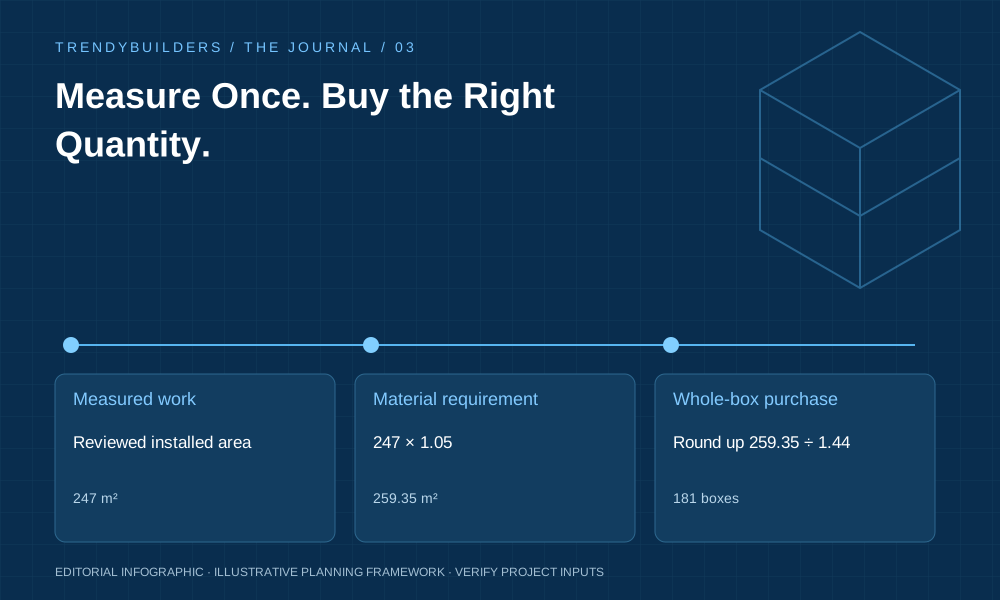
Consider 247 square metres of reviewed tile work, with an illustrative five percent allowance for the agreed layout and expected handling losses. The planning requirement becomes 259.35 square metres. If a box covers 1.44 square metres, the unrounded result is approximately 180.10 boxes. Buying whole boxes requires 181, giving 260.64 square metres of nominal coverage before subtracting any compatible usable stock.
The calculation is not a universal recommendation for a five percent allowance. Pattern, room geometry, tile size, damage experience and spare requirements can justify a different basis. Check that the supplier’s coverage is correct for the actual product and that batch or shade compatibility is acceptable. A box in storage is not automatically a usable offset if it belongs to a different batch or is already committed elsewhere.
Trace the drawing basis
A measurement register should identify the drawing number, revision, location and exclusions. Calibrate a drawing against a known dimension and check a second reference where possible. Scanned sheets can be distorted, and a scale note may not match the displayed or printed size. Count repeated floors deliberately rather than assuming every floor matches the typical plan.
Record openings, thicknesses and measurement conventions consistently. Gross area, net area and procurement coverage are not interchangeable. If design development changes an opening or a wall build-up, review the conversion factors as well as the geometry. The objective is to let another person reproduce the result without guessing which drawing, floor or assumption the estimator used.
Apply the TB workflow
Use the TrendyBuilders calculators and Materials workflow to review quantities, allowances and packaging. For drawing-based inputs, the manual measurement tool supports calibrated tracing and counts. It is a review aid rather than automatic takeoff, and its output does not automatically update a saved project. Inspect the exported measurement register before transferring accepted quantities into the estimate.
For linear materials, mixed stock and offcut planning can evaluate required cuts against entered stock and saw kerf. The planning result does not approve a structural splice or prove global optimality. Check material grade, section, cut compatibility and physical stock condition. Retain the measured work quantity separately so purchasing changes do not silently alter the defined installed scope.
Reconcile before placing the order
The purchase review should show required units, compatible stock, open orders and the proposed new purchase. Check whether minimum-order quantities or delivery lots introduce additional material. Confirm whether the supplier quote is per item, bundle, tonne or another commercial basis. A unit mismatch can overwhelm a carefully measured takeoff in one line of a comparison sheet.
After delivery, compare ordered, received, accepted and installed quantities. Record damage and rejected material rather than treating every delivery as productive stock. Use the difference to improve future allowances, but retain the circumstances: a complex layout and a simple repetitive floor should not automatically share one loss factor. Better purchasing begins when measurement and site feedback form a closed loop.
Audit one material from drawing to receipt
Select a material with repeated emergency purchases or unexplained surplus. Begin with the drawing and reproduce a sample measurement independently. Confirm location, revision, openings and the selected unit. If the source is a scanned drawing, check calibration in more than one direction. A clean-looking exported quantity does not remove the need to verify the geometric basis.
Next, inspect the conversion from installed work to material demand. Identify the consumption factor, number of layers, coverage assumption or cut schedule. Ask whether laps, overlaps, breakage and spare material are included in that factor or added separately. Remove duplicate allowances and make justified allowances explicit. Do not substitute a generic percentage for a known product or layout requirement.
Review the commercial unit using the actual supplier offer. Verify pieces per pack, coverage per box, stock length or mass basis. Confirm whether partial packs can be purchased and whether a minimum order applies. Compare the proposed purchase with compatible usable stock and open orders. Stock that is damaged, unapproved or already allocated should not reduce the new requirement merely because it appears in an inventory total.
At receipt, reconcile the supplier’s delivery unit with the purchase unit. Record accepted quantity separately from delivered quantity where inspection identifies damage or mismatch. After installation, reconcile the accepted scope, retained stock and documented losses. This creates a complete explanation of the material flow and exposes where the original planning basis was weak.
Use the audit to change one practical control. It might be a packaging field, a second calibration check or a clearer rule for repeated floors. Avoid responding with a larger general waste factor unless the evidence supports it. The best improvement reduces the specific error while preserving a transparent relationship between the work being built and the units being bought.
A practical cost-control protocol
Establish the reporting boundary before reviewing movement. State the package, currency, tax basis, price date and scope revision. Identify whether the figures describe an estimate, a commitment, an actual cost or a forecast. These records answer different questions and should not be added together indiscriminately. A committed amount may already include expenditure that later appears in actual-cost records, so the reconciliation needs an explicit convention.
Retain a frozen reference for the approved position. Record the current working assumptions separately and explain the difference using a short bridge. The bridge should reconcile exactly to the reported total. If an unexplained balance remains, investigate it rather than assigning it to a vague miscellaneous line. Precision in the presentation is useful only when the underlying categories have a clear meaning.
Give uncertain inputs a status and a next action. A provisional quantity, expired quotation or unresolved scope boundary should remain visible. Identify the information needed to replace the assumption, the person responsible and the decision date. A planning allowance can be appropriate, but it should not be described as a confirmed price or an approved obligation.
Check whether a proposed response changes another cost or timing assumption. Earlier purchasing can affect storage and cash. Resequencing can affect supervision and equipment. An approved material alternative can affect installation effort. Review the whole consequence at a level proportionate to the decision. Do not count a saving in one line while leaving its necessary supporting cost outside the comparison.
Use a consistent refresh trigger. Major scope issues, quote expiry, procurement award and a changed delivery or production position can justify a new forecast. Repeatedly updating every rate without new evidence can create work without improving the decision. Focus effort where exposure is material and where an action can still change the outcome.
Before issuing the report, ask another reviewer to reproduce one important movement from the source records. Confirm that units and dates match and that the same amount has not been counted twice. Record the review and retain the exported version. This gives the next meeting a reliable reference and helps the team explain why the forecast changed.
The final control is ownership. Every material exception should lead to an action, an accepted allowance or an explicit decision to retain the exposure. A cost report becomes useful when it makes that choice clear. The objective is a defensible basis for managing the remaining work, rather than a promise that uncertainty has disappeared.
Warning signs to investigate
A useful warning signal is repeated small emergency orders for the same material. The cause may be a missing conversion, an underestimated allowance, damaged stock or a procurement schedule that does not match the installation sequence. Review several orders together rather than treating each as an isolated site request. The pattern can reveal a systematic issue that is invisible in one purchase.
Surplus deserves the same attention. Check whether it is genuinely unneeded, reserved for another area or required as an agreed spare. A large stock balance should not automatically be described as waste, but it should have an explained purpose and a usable specification. These checks protect purchasing accuracy without encouraging teams to reduce every allowance simply to make the material schedule look leaner.
Decision table
This table summarizes the article’s planning distinction. Numerical examples are illustrative, use no live supplier prices, and exclude costs or assessment stages unless expressly stated. Review the complete explanation before applying an example to a project.
| Quantity stage | Illustrative calculation | Result |
|---|---|---|
| Measured work | Reviewed installed area | 247 m² |
| Material requirement | 247 × 1.05 | 259.35 m² |
| Whole-box purchase | Round up 259.35 ÷ 1.44 | 181 boxes |
Put the method to work
Open Materials in the TrendyBuilders workspace and work from a reviewed project copy. Confirm the activity identifiers, measurement units and applicable source revision before changing any input. Read the supporting workflow guide for the tool’s scope and review requirements. Keep a dated backup of the accepted basis and export the assumptions with the result so the next reviewer can reconstruct the decision.
Treat the output as a planning result based on the information supplied. Confirm material specifications, supplier commitments, acceptance criteria and professional approvals through the responsible project processes. Where the calculation exposes missing information, record the missing input and assign a next action instead of treating an empty field or a default value as evidence. Revisit the scenario when the source information changes, and preserve the prior version so the movement remains explainable.
Sources and further reading
BIPM: The International System of Units. BIPM provides the international reference for SI units. Project measurement rules and supplier commercial units still require explicit reconciliation. Source checked for the launch collection on November 17, 2026. The worked examples, operating protocols and recommendations are original TrendyBuilders editorial analysis; they are not quotations from the source or professional certification.
Continue the conversation
- One Missing Component Can Stop an Entire Project
- The Labor Shortage Cannot Be Solved by Headcount Alone
- The Most Expensive Scope Is the Scope Nobody Owned
Bring a project-specific question to the moderated discussion below. Explain the relevant scope and assumptions without sharing confidential drawings, prices or personal information. Useful discussion helps other readers understand the decision and its limits.
The conversation
Constructive, relevant discussion is welcome. Comments are moderated. You may edit your own comment for one hour after its original submission; administrators can edit at any time.
Be the first to contribute a thoughtful comment.