
Executive brief
Cost overruns often begin as unclear responsibility. A package price looks complete, but nobody has priced an access requirement, a connection, a temporary measure or a testing obligation. The missing work eventually becomes unavoidable. By then the project may have fewer competitive options and less time to resolve the commercial position.
Scope control begins with a clear statement of what is included, excluded and provisional. It also needs an interface owner. A line that says “by others” is not a complete control unless the other party has accepted the obligation and the associated cost is visible elsewhere.
Separate clarification from change
A clarification explains an existing requirement. A change alters the accepted scope, quantity, specification or other contractual basis. Real projects can dispute that distinction, so a planning record should not automatically classify every revised drawing as an approved variation. Retain the original basis, the new instruction and the reviewer’s assessment.
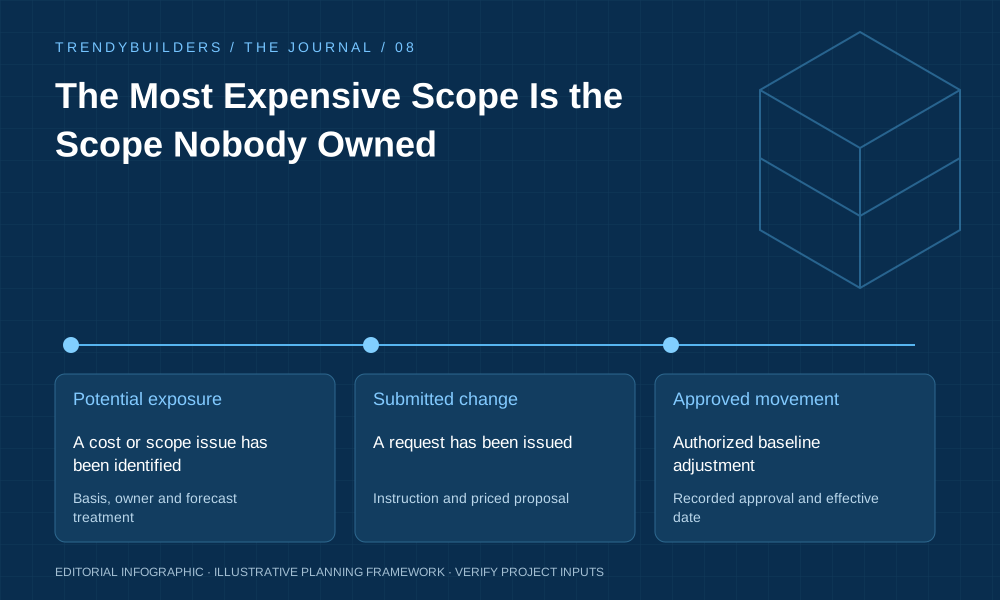
Keep authority explicit. A technical conversation may identify a necessary change without authorizing expenditure. Likewise, a quotation for additional work does not establish entitlement or approval. Record status, decision owner and supporting references. This preserves the difference between identifying exposure, requesting authorization and recording an accepted budget movement.
An illustrative interface gap
Consider a mechanical package that includes equipment supply and installation but excludes the supporting plinth, electrical termination and final commissioning attendance. The civil estimate includes a general concrete allowance but no equipment-specific foundation. The electrical team assumes the vendor will terminate its own panel. Each package can appear internally consistent while the assembled project remains incomplete.
The review should assign every interface, confirm design responsibility and identify whether the necessary quantities and rates exist in the baseline. It may reveal an omission rather than a newly instructed change. That distinction matters for commercial discussions, but either way the forecast must expose the cost and timing implications instead of waiting for the dispute to conclude.
Create an interface matrix that people use
Build the matrix around systems, locations and handover points. For each interface, identify the responsible party, required deliverable, acceptance evidence and due date. Include temporary works, access, testing, permits and reinstatement where applicable. Avoid an enormous generic checklist that obscures the package’s real boundaries.
Review interfaces at design release, procurement award and installation readiness. These are different decision points. A responsibility that was understood in a tender meeting can be lost when the purchase order is issued or a subcontract changes hands. Keep the accepted matrix connected to the actual commercial and technical documents, and record later changes visibly.
Use TB to retain the baseline and movement
In TrendyBuilders, organize scope through Project setup & WBS and the detailed Estimate. Record assumptions and exclusions before calculating the total. Use Change orders to retain variation records and baseline budget movements separately from original scope. Cost control and Cost reconciliation can help distinguish commitments and actual costs from the estimate.
These are internal planning and commercial records. They do not certify a contractual entitlement or replace the authorized administrator’s decision. Retain the relevant instruction, quotation and review reference. Export a dated backup before major revisions so the team can reconstruct the original position rather than relying on memory or a total that has been overwritten.
Report exposure without pretending approval
The executive report should show approved changes, submitted changes, potential exposure and unresolved scope separately. Use a stated forecast treatment for each status. A disputed amount may still deserve a planning allowance, but the report should not imply that the client has accepted it. Conversely, omitting every unapproved item can understate the expected completion cost.
Ask which open interface threatens the next critical activity and what decision is needed. Resolve responsibility while the project still has choices. The strongest change-control process protects both operational continuity and a defensible commercial record: work can be planned without inventing approval, and budget movement can be understood without erasing the original scope.
Hold a boundary review before award
Bring the adjacent package owners together with the relevant drawings and commercial descriptions. Review the physical and functional handover points, including supports, terminations, access, testing and reinstatement. Ask each party to describe what it expects the other to provide. Differences that remain invisible in separate tender reviews often become obvious in this conversation.
Record each boundary in plain language with a responsible party and an evidence reference. Avoid relying on broad statements such as “complete installation” where the package has material exclusions. If an obligation sits elsewhere, identify the accepted record that contains it. If nobody owns it, record an open action and its cost and programme treatment.
Review provisional quantities and design-dependent allowances separately. A provisional amount can be useful, but it should state what decision or information will replace it. Set a due date tied to the procurement or construction sequence. Without that trigger, provisional scope can remain unresolved until the project has little choice but to buy it urgently.
When a later instruction changes the boundary, preserve the original position. Record the instruction, assessment, proposed amount, approval status and operational consequence. Keep the forecast honest while the commercial discussion continues. The team can acknowledge a likely cost without declaring that contractual entitlement has been established.
At closeout, compare final package boundaries with the original matrix. Identify recurring omissions that should be added to future tender reviews. The useful lesson is specific: for example, commissioning attendance was excluded by both adjacent packages. A general instruction to improve coordination is less likely to prevent the same gap on the next project.
A practical cost-control protocol
Establish the reporting boundary before reviewing movement. State the package, currency, tax basis, price date and scope revision. Identify whether the figures describe an estimate, a commitment, an actual cost or a forecast. These records answer different questions and should not be added together indiscriminately. A committed amount may already include expenditure that later appears in actual-cost records, so the reconciliation needs an explicit convention.
Retain a frozen reference for the approved position. Record the current working assumptions separately and explain the difference using a short bridge. The bridge should reconcile exactly to the reported total. If an unexplained balance remains, investigate it rather than assigning it to a vague miscellaneous line. Precision in the presentation is useful only when the underlying categories have a clear meaning.
Give uncertain inputs a status and a next action. A provisional quantity, expired quotation or unresolved scope boundary should remain visible. Identify the information needed to replace the assumption, the person responsible and the decision date. A planning allowance can be appropriate, but it should not be described as a confirmed price or an approved obligation.
Check whether a proposed response changes another cost or timing assumption. Earlier purchasing can affect storage and cash. Resequencing can affect supervision and equipment. An approved material alternative can affect installation effort. Review the whole consequence at a level proportionate to the decision. Do not count a saving in one line while leaving its necessary supporting cost outside the comparison.
Use a consistent refresh trigger. Major scope issues, quote expiry, procurement award and a changed delivery or production position can justify a new forecast. Repeatedly updating every rate without new evidence can create work without improving the decision. Focus effort where exposure is material and where an action can still change the outcome.
Before issuing the report, ask another reviewer to reproduce one important movement from the source records. Confirm that units and dates match and that the same amount has not been counted twice. Record the review and retain the exported version. This gives the next meeting a reliable reference and helps the team explain why the forecast changed.
The final control is ownership. Every material exception should lead to an action, an accepted allowance or an explicit decision to retain the exposure. A cost report becomes useful when it makes that choice clear. The objective is a defensible basis for managing the remaining work, rather than a promise that uncertainty has disappeared.
Warning signs to investigate
A repeated “by others” notation is a useful trigger for review. Ask which accepted package contains the obligation, whether its quantity and cost are visible, and who coordinates the handover. If the answer is uncertain, the interface remains open even if every individual tender description appears complete. Resolve the boundary before award or give it an explicit forecast treatment.
Watch also for approved changes being incorporated into the estimate without a separate movement record. The current total may be correct while the original commercial position becomes impossible to reconstruct. Preserve the baseline and link the adjustment to its authorization. This is especially important when several small changes accumulate: individually they may appear minor, but together they can alter purchasing, resource demand and the project’s completion assumptions.
Decision table
This table summarizes the article’s planning distinction. Numerical examples are illustrative, use no live supplier prices, and exclude costs or assessment stages unless expressly stated. Review the complete explanation before applying an example to a project.
| Record | What it means | Required evidence |
|---|---|---|
| Potential exposure | A cost or scope issue has been identified | Basis, owner and forecast treatment |
| Submitted change | A request has been issued | Instruction and priced proposal |
| Approved movement | Authorized baseline adjustment | Recorded approval and effective date |
Put the method to work
Open Change orders in the TrendyBuilders workspace and work from a reviewed project copy. Confirm the activity identifiers, measurement units and applicable source revision before changing any input. Read the supporting workflow guide for the tool’s scope and review requirements. Keep a dated backup of the accepted basis and export the assumptions with the result so the next reviewer can reconstruct the decision.
Treat the output as a planning result based on the information supplied. Confirm material specifications, supplier commitments, acceptance criteria and professional approvals through the responsible project processes. Where the calculation exposes missing information, record the missing input and assign a next action instead of treating an empty field or a default value as evidence. Revisit the scenario when the source information changes, and preserve the prior version so the movement remains explainable.
Sources and further reading
World Bank: Project procurement rated criteria. World Bank guidance emphasizes project-specific non-price evaluation. This article applies original editorial reasoning to scope and interface control. Source checked for the launch collection on November 17, 2026. The worked examples, operating protocols and recommendations are original TrendyBuilders editorial analysis; they are not quotations from the source or professional certification.
Continue the conversation
- The Delivery Date Is Too Late to Start Planning
- The Lowest Bid Can Become the Highest Project Cost
- The Crane Is Booked Twice. The Programme Still Looks Fine.
Bring a project-specific question to the moderated discussion below. Explain the relevant scope and assumptions without sharing confidential drawings, prices or personal information. Useful discussion helps other readers understand the decision and its limits.
The conversation
Constructive, relevant discussion is welcome. Comments are moderated. You may edit your own comment for one hour after its original submission; administrators can edit at any time.
Be the first to contribute a thoughtful comment.