
Linear quantity can hide nonlinear complexity
Water infrastructure is often described in kilometers of pipe, yet the cost and delivery risk depend on much more than length. Connections, valves, crossings, ground conditions, access, service interruptions and acceptance requirements can dominate difficult sections. A rate applied to the entire route may conceal the locations where the project needs a different method, specialist input or a separate procurement package.
Reliable water services require assets that can be operated and maintained after construction. Procurement therefore needs to connect the physical works with the evidence the future operator will use. This article addresses scope and quantity planning. It does not design a hydraulic network, prescribe water-quality procedures or determine regulatory compliance; those require the responsible technical authorities and local requirements.
Divide the route into meaningful sections
Use stable section identifiers tied to the accepted alignment and revision. Record diameter, material, joint type and the measurement basis for each section. Identify transitions and boundaries explicitly. A route total that combines different materials or installation methods without separation is difficult to price, inspect or reconcile later.
Bring survey, utility and access information into the scope review. Mark uncertain interfaces as unresolved rather than assuming a standard detail applies everywhere. A road crossing or connection to an existing asset may require separate investigation and authorization. Keep the quantity estimate linked to the source information so a later alignment change can be assessed by section instead of recalculating an unexplained total.
Build a component schedule around the line
List fittings, valves, restraints, chambers, supports and other specified components under the accepted design. Check how those items relate to the measured pipe lengths so they are not omitted or counted twice. Establish whether supplier lengths, cutting requirements and joint allowances are included in the purchasing convention. A bare centerline quantity is not automatically an order quantity.
Review interfaces between suppliers. Matching nominal size does not establish compatibility of every connection, pressure class, material or coating. Obtain the required technical acceptance for the actual products. Where an alternative is proposed, assess its effect on adjacent components and operating requirements. Commercial availability alone cannot establish that the substitution is suitable for the system.
A worked example: the short section with a large interface
An illustrative route includes a long open section and a short connection near an operating facility. The short section needs several specified fittings, a controlled outage and particular acceptance evidence. Pricing both sections using one length-based allowance understates the significance of the connection. The team should prepare a separate scope line and identify its prerequisites.
Compare the pipe quantity with the component schedule, access arrangement and accepted connection sequence. Record any unresolved utility information or operator approval. No dimensions, pressures or technical methods in this example are offered as design guidance. Its purpose is to show why procurement packaging should follow the actual interfaces rather than allowing a simple length total to define the entire project.
Plan continuity and acceptance with the operator
Where work affects an operating water system, the operator's requirements are essential to the sequence. Identify the accepted process for outages, connections, inspections, testing and return to service. Include the necessary resources and lead times in the plan. Do not assume a construction completion date is automatically a date on which the operator can accept the asset.
Keep responsibilities clear between contractor, designer, specialist provider and operator. A purchase order for pipe may exclude equipment or services needed for acceptance. Find those exclusions before awarding the package. The applicable technical procedures and public-health controls must come from authorized project requirements, with competent review, rather than from a generic editorial checklist.
Protect the condition and identity of supplied materials
Plan storage, handling and inspection according to the specified products and project procedures. Record damaged or unidentified items and control their disposition. Components delivered early can lose useful identification or become inaccessible beneath later stock. A full laydown area is not evidence that every accepted component is ready for installation.
Retain the link between supplied products, installed sections and acceptance records where required. If a concern arises about a batch or component, the project should be able to identify the affected locations. Use a practical identification method that survives site handling and can be transferred to the operator's asset records without requiring the construction team's memory.
Use quantity tools within the engineering boundary
TrendyBuilders Civil works pipeline planning can support planning quantities from entered, reviewed project data within the tool's stated scope. It does not perform a complete hydraulic design, locate underground utilities, establish safe excavation methods or approve water-system operation. Read the workflow guide and keep the accepted design and operator requirements as the controlling sources.
Compare quantity scenarios when the alignment or packaging changes, keeping assumptions and exclusions visible. Reconcile purchasing quantities with component counts and supplier lengths. Where a required assessment is outside the tool, document it separately and assign it to the appropriate specialist. A complete planning record shows both the calculations performed and the decisions still required.
Hand over an asset record, not a box of files
Agree the operator's required identifiers and record format early. Link installed locations, product information, accepted changes and testing evidence through stable references. Check a sample handover before the whole project reaches completion. Discovering incompatible naming conventions after every record is prepared creates avoidable rework.
At executive review, distinguish physical installation, accepted testing, operator readiness and completed documentation. Report unresolved interfaces by section and assign the next action. A water project becomes a dependable asset when the physical system and its evidence can be understood together, with clear responsibility for every outstanding acceptance decision.
A practical environmental decision protocol
Define the decision and its assessment boundary. Identify the asset function, construction phase, material or operating exposure under review. State what the comparison includes and excludes. A result can be useful within a narrow boundary, provided it is not later promoted as a verified whole-project or whole-life outcome.
Establish the technical basis before comparing commercial or environmental options. The responsible professionals should confirm performance, suitability and applicable requirements. A lower quantity, different product or reused material is not automatically an acceptable substitute. Keep approval status and the supporting evidence connected to the option throughout the review.
Use a consistent quantity basis and record the source of environmental or hazard information. Check units, dates, geographic relevance and the conditions to which the evidence applies. Where specialist interpretation is required, identify that need rather than filling the gap with an unsupported factor. Planning software can calculate entered assumptions without verifying that those assumptions are appropriate.
Compare implementation consequences. An option may change lead time, handling, storage, installation, maintenance or inspection. Include those requirements in the cost and programme assessment at a level proportionate to the decision. A benefit that depends on an unavailable product or an unapproved method remains an opportunity rather than an implemented result.
Assign responsibility for procurement and site verification. Confirm that the approved product or measure is the one actually supplied and installed. Retain substitutions, inspections and other relevant evidence. Without that connection, an early options comparison can become detached from the completed work while still appearing in a final performance claim.
Review residual exposure and uncertainty. A mitigation can reduce a risk without eliminating it, and a material comparison can favor one option while leaving some life-cycle stages unassessed. Explain those limits plainly. A transparent partial assessment is more useful than a broad assertion of sustainability or resilience that the project cannot substantiate.
At completion, reconcile the outcome to the original decision basis and record the lessons for future work. Distinguish estimated, approved and observed results. Identify whether the constraint was technical, commercial, logistical or evidential. This makes the environmental review part of normal project decision-making while protecting the credibility of the claims made about it.
A review routine the team can sustain
Choose one real package for the first review rather than attempting to repair every record at once. Ask its estimator, buyer and field owner to agree the accepted scope and identify the sources they actually use. Write down the unresolved questions and the next decision each one prevents. This short exercise makes the method concrete and reveals where the project needs better evidence before it needs another calculation.
Keep the original working records available while testing a revised approach. Use a dated project copy for scenarios and record the input changes individually. Ask a second person to reproduce a sample result from the stated sources. If they cannot explain the unit, revision or assumption, improve the record before circulating the total as an accepted basis. A reproducible result is more useful than an impressive display that depends on its author's memory.
At the next regular package meeting, compare the planned action with what happened. Identify whether the obstacle was missing information, capacity, authority or a changed site condition. Update the relevant assumption and assign the remaining action to a named person with a practical due date. Keep the previous basis so the movement remains explainable. Avoid silently replacing uncertainty with a default value simply to complete the report.
Scale the process only after the pilot has produced a useful decision. Retain fields that support an actual review and remove duplicate recording that adds no evidence. Tell the people receiving the output which version is accepted and what remains conditional. The goal is a working habit that survives a busy site week: clear sources, visible assumptions, explicit authority and a traceable action when the evidence changes.
Decision table
Use this table as a meeting prompt alongside the explanation above. It summarizes the evidence chain; it does not establish technical acceptance or replace the responsible project process. Numerical examples in this article are illustrative and contain no live supplier rates.
| Stage | Action | Evidence |
|---|---|---|
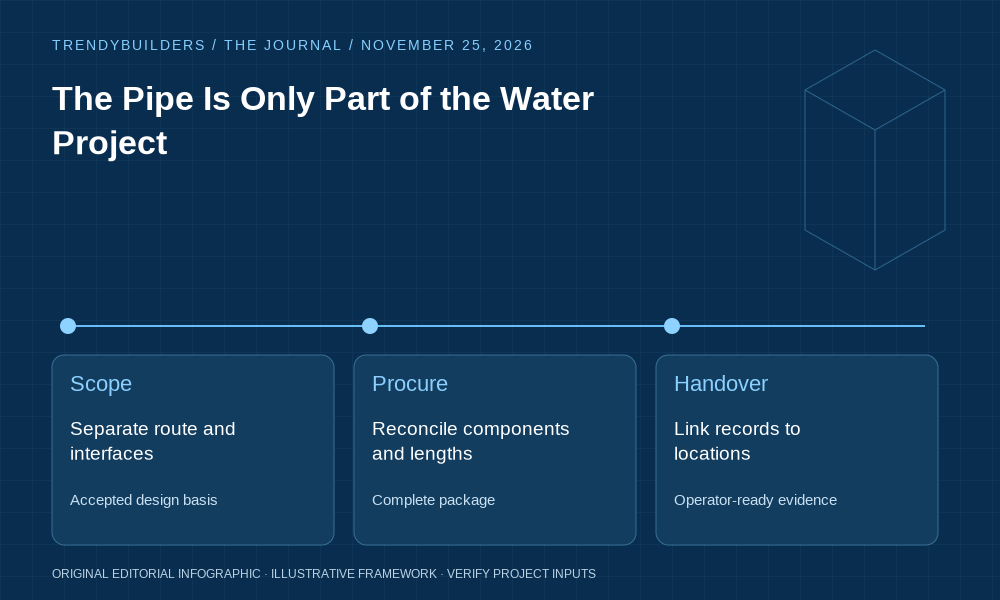
| Scope | Separate route and interfaces | Accepted design basis |
| Procure | Reconcile components and lengths | Complete package |
| Handover | Link records to locations | Operator-ready evidence |
Apply the method in TrendyBuilders
Open Civil works pipeline planning and read the supporting workflow guide before entering project information. Use a reviewed project copy, confirm the measurement units and source revisions, and inspect warnings and exclusions before relying on any output. The calculations depend on the information supplied; selecting a tool does not validate the underlying technical or commercial assumptions.
Keep the accepted project documents and required approvals linked to the planning record. Export the assumptions with a dated result so another reviewer can reproduce the comparison. Where the workflow reveals a missing input or a decision outside the tool's scope, assign that issue to the responsible person rather than treating a blank field as evidence of zero exposure.
Sources and further reading
EPA: Drinking water distribution system resources. This primary-source reference provides relevant background in its own stated scope and jurisdiction. It does not endorse this article or TrendyBuilders. Reference checked November 18, 2026. The worked examples and operating recommendations are original editorial analysis; they are not reported project outcomes, quotations or professional certification.
Related reading
- The Lowest Bid Can Become the Highest Project Cost
- Rework Is a Procurement and Planning Problem Too
- One Missing Component Can Stop an Entire Project
Use the moderated discussion to share the decision you are trying to make and the assumptions that matter. Omit confidential drawings, supplier prices and personal information.
The conversation
Constructive, relevant discussion is welcome. Comments are moderated. You may edit your own comment for one hour after its original submission; administrators can edit at any time.
Be the first to contribute a thoughtful comment.