
Executive brief
Flooding, extreme heat, heavy rainfall and other hazards can affect both the completed asset and the construction process. A project may specify a resilient permanent structure while leaving temporary access, material storage or construction sequencing exposed. The planning task is to translate assessed hazards into decisions that designers, procurement teams and site managers can act on.
Do not treat resilience as one percentage added to the budget. Different hazards create different requirements. Some belong in professional design, others in temporary works, logistics, worker protection or schedule allowances. The estimate should make those responsibilities and assumptions visible without implying that a quantity tool has established the engineering solution.
Separate asset resilience from construction continuity
Permanent design may address drainage, elevation, durability or protection of critical systems. Construction continuity concerns how work proceeds before those permanent measures are complete. Temporary drainage, access roads, dewatering, storage protection and emergency arrangements may require separate design and operating plans.
Record which party establishes the hazard basis and who approves the response. A historical weather average may be insufficient for a critical design decision, while an extreme scenario may be inappropriate as an everyday production assumption. Use the relevant specialist assessment and make the selected planning basis explicit. Procurement should follow approved requirements rather than substituting its own hazard judgment.
An illustrative access exposure
Consider a site where the only delivery route crosses a low section that can become impassable during heavy rain. Even if the building platform remains protected, interrupted access can delay concrete, fuel and specialist equipment. The response may involve an engineered temporary crossing, alternate routing, revised delivery lots or a different construction sequence.
Each option has cost and operating consequences. Larger advance deliveries require storage and preservation. An alternate route may affect vehicle size and travel time. A temporary crossing requires competent design and approval. The comparison should include those consequences and the residual exposure, rather than simply marking the access risk as closed after one mitigation is proposed.
Make weather assumptions operational
Translate the approved planning basis into working calendars, protection requirements and activity constraints. Identify which tasks are sensitive to heat, rainfall, wind or ground conditions. A general weather allowance may hide the fact that a short, critical lifting activity and a long earthworks package face very different exposures.
Set observation and decision triggers using the responsible professional’s guidance and local requirements. Site teams need to know who can stop work, who checks conditions and what evidence permits restart. Do not infer safe thresholds from a scheduling calculation. The programme should reflect the resulting constraints, while the safety and technical systems retain authority over the actual work.
Use TB for the quantified planning consequences
TrendyBuilders Access & temporary works can retain explicit planning allowances, while Haul & supply and Programme can explore entered logistics and working-date assumptions. Resources can help assess the consequence of changed production time. These calculations support budgeting and scenario review; they do not design a temporary structure or establish safe operating limits.
Keep the approved specialist references beside the quantity and cost basis. If a drainage or access design changes, update the associated material, equipment and duration assumptions together. Export the reviewed scenario so the decision maker can see the difference between the hazard assessment, the approved response and the commercial consequence.
Review resilience at the interfaces
A technically sound measure can fail at an interface. Drainage may discharge into an unavailable outlet, stored material may block a flow path, or emergency access may depend on another contractor’s area. Review the response across packages and phases, including the period before permanent systems are operational.
At executive review, ask which exposure remains, which evidence supports the response and who owns the next decision. Resilience is a continuing management task as design and site conditions evolve. A clear record of assumptions and responsibilities is more useful than a broad claim that the project is climate-proof.
Review the temporary-condition exposure
Map the site through its construction phases rather than looking only at the completed asset. Identify when permanent drainage, access, power and protection become operational. Before those dates, the project may depend on temporary arrangements that need separate design, maintenance and operating responsibility. A resilient final layout does not automatically protect the intermediate works.
Check critical deliveries and stored materials against those temporary conditions. Ask whether an access interruption affects concrete supply, fuel, emergency response or specialist equipment. Consider the actual route and vehicle constraints. An alternate route shown on a map may be unusable for the selected vehicle or unavailable during the same hazard event.
Review the proposed response with the relevant specialists. Confirm design and approval requirements for temporary structures, drainage or ground improvement. Establish inspection and maintenance arrangements where the measure must remain effective over time. A mitigation can fail because it was installed incorrectly or not maintained, even if its original design basis was sound.
Translate the approved response into quantities, resources, cost and programme assumptions. Keep the technical basis separate from the commercial calculation. If the response changes, update the affected records together. This avoids a situation where the estimate includes one temporary access arrangement while the logistics plan relies on another.
Set a review trigger for changed conditions, such as a new phase, revised specialist assessment or altered access requirement. Do not describe a risk as permanently closed merely because a planning allowance exists. The executive question is whether the required response is approved, funded, implemented and maintained for the period when the exposure exists.
A practical environmental decision protocol
Define the decision and its assessment boundary. Identify the asset function, construction phase, material or operating exposure under review. State what the comparison includes and excludes. A result can be useful within a narrow boundary, provided it is not later promoted as a verified whole-project or whole-life outcome.
Establish the technical basis before comparing commercial or environmental options. The responsible professionals should confirm performance, suitability and applicable requirements. A lower quantity, different product or reused material is not automatically an acceptable substitute. Keep approval status and the supporting evidence connected to the option throughout the review.
Use a consistent quantity basis and record the source of environmental or hazard information. Check units, dates, geographic relevance and the conditions to which the evidence applies. Where specialist interpretation is required, identify that need rather than filling the gap with an unsupported factor. Planning software can calculate entered assumptions without verifying that those assumptions are appropriate.
Compare implementation consequences. An option may change lead time, handling, storage, installation, maintenance or inspection. Include those requirements in the cost and programme assessment at a level proportionate to the decision. A benefit that depends on an unavailable product or an unapproved method remains an opportunity rather than an implemented result.
Assign responsibility for procurement and site verification. Confirm that the approved product or measure is the one actually supplied and installed. Retain substitutions, inspections and other relevant evidence. Without that connection, an early options comparison can become detached from the completed work while still appearing in a final performance claim.
Review residual exposure and uncertainty. A mitigation can reduce a risk without eliminating it, and a material comparison can favor one option while leaving some life-cycle stages unassessed. Explain those limits plainly. A transparent partial assessment is more useful than a broad assertion of sustainability or resilience that the project cannot substantiate.
At completion, reconcile the outcome to the original decision basis and record the lessons for future work. Distinguish estimated, approved and observed results. Identify whether the constraint was technical, commercial, logistical or evidential. This makes the environmental review part of normal project decision-making while protecting the credibility of the claims made about it.
Warning signs to investigate
A risk entry should be challenged when its mitigation is simply an allowance in the estimate. Funding a response does not establish that it has been designed, approved, installed or maintained. Identify the evidence for each stage and the period over which the measure must remain effective. The construction phase may change before the response is ready.
Another warning is a plan that protects the building footprint but ignores access, utilities or neighboring interfaces. Review the dependencies that allow the site to function during an event. A disruption outside the immediate work area can still interrupt deliveries and critical operations. Keep those connections within the specialist and site review so the commercial plan reflects the actual operating exposure rather than only the permanent asset boundary.
Decision table
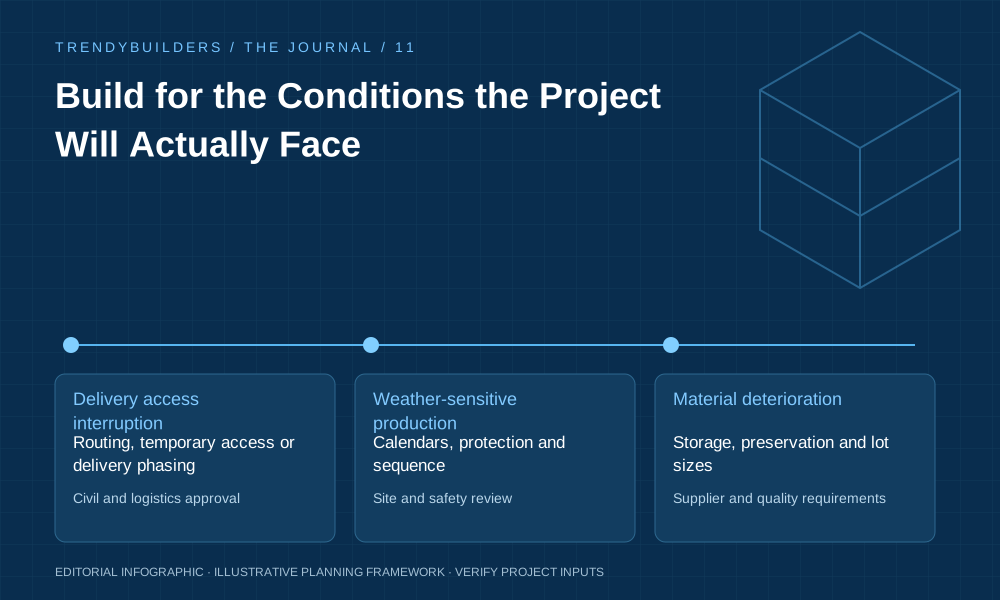
This table summarizes the article’s planning distinction. Numerical examples are illustrative, use no live supplier prices, and exclude costs or assessment stages unless expressly stated. Review the complete explanation before applying an example to a project.
| Exposure | Planning response to assess | Required review |
|---|---|---|
| Delivery access interruption | Routing, temporary access or delivery phasing | Civil and logistics approval |
| Weather-sensitive production | Calendars, protection and sequence | Site and safety review |
| Material deterioration | Storage, preservation and lot sizes | Supplier and quality requirements |
Put the method to work
Open Access & temporary works in the TrendyBuilders workspace and work from a reviewed project copy. Confirm the activity identifiers, measurement units and applicable source revision before changing any input. Read the supporting workflow guide for the tool’s scope and review requirements. Keep a dated backup of the accepted basis and export the assumptions with the result so the next reviewer can reconstruct the decision.
Treat the output as a planning result based on the information supplied. Confirm material specifications, supplier commitments, acceptance criteria and professional approvals through the responsible project processes. Where the calculation exposes missing information, record the missing input and assign a next action instead of treating an empty field or a default value as evidence. Revisit the scenario when the source information changes, and preserve the prior version so the movement remains explainable.
Sources and further reading
IPCC AR6: Cities, settlements and key infrastructure. The IPCC assesses climate risks to settlements and infrastructure. Site-specific design criteria require qualified assessment and applicable local requirements. Source checked for the launch collection on November 17, 2026. The worked examples, operating protocols and recommendations are original TrendyBuilders editorial analysis; they are not quotations from the source or professional certification.
Continue the conversation
- A Profitable Project Can Still Run Out of Cash
- When Every Team Has a Different Number
- A Unit Mismatch Can Erase a Procurement Saving
Bring a project-specific question to the moderated discussion below. Explain the relevant scope and assumptions without sharing confidential drawings, prices or personal information. Useful discussion helps other readers understand the decision and its limits.
The conversation
Constructive, relevant discussion is welcome. Comments are moderated. You may edit your own comment for one hour after its original submission; administrators can edit at any time.
Be the first to contribute a thoughtful comment.