
Executive brief
Supply resilience starts with knowing which missing item can interrupt a critical activity. The most expensive package is not always the most dangerous. A small control component, coupling or approved seal can delay testing of a much larger system. Procurement reporting should therefore connect materials to installation and commissioning dependencies, rather than simply sorting purchase orders by value.
The aim is neither to buy everything early nor to duplicate every supplier. Both approaches can consume working capital and create new quality and storage problems. A resilient plan identifies the few exposures that deserve special attention, documents approved alternatives and keeps enough evidence to distinguish a confirmed supply position from a hopeful promise.
Map the chain beyond the seller
A distributor may offer a different company name while relying on the same factory, shipping lane or specialist subcomponent as the incumbent. That is commercial diversity without operational independence. For critical packages, ask where the goods are manufactured, which parts are constrained, what production slot is reserved and which milestone establishes that the reservation is real.
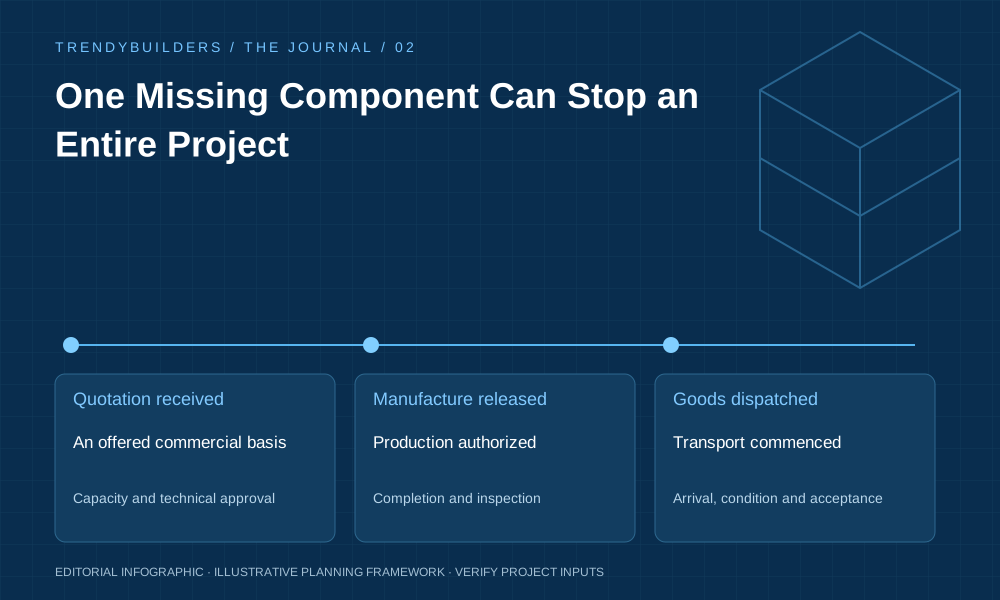
Capture the difference between a quotation, an accepted order, released manufacture, completed inspection, dispatched goods and site receipt. Each stage has different evidence. A supplier email saying that delivery is on track is useful communication, but it does not replace a manufacturing schedule or dispatch record. Keep the confidence level visible and identify the person who must verify the next milestone.
An illustrative pump-station scenario
Suppose a pump station requires four duty-compatible control panels. The installation plan assumes the panels arrive in week twelve. The quote shows an eight-week manufacturing period, but manufacture only starts after approved drawings and a deposit. If drawing approval takes three weeks and order processing takes one, the effective requirement already consumes twelve weeks before transport or site acceptance.
The response is to expose the approval dependency, not simply ask the supplier to deliver faster. The project may bring forward the technical submission, approve a genuinely equivalent panel, or resequence civil and mechanical activities so they remain productive. Any alternative must retain the required electrical, protection, environmental and commissioning characteristics. Commercial urgency is not evidence of technical equivalence.
Choose buffers deliberately
A buffer can be time, inventory, capacity or an approved alternative. Time buffers protect an activity only if the programme still has usable flexibility. Inventory buffers work only when goods can be stored safely and remain traceable. Capacity buffers require a supplier or logistics provider that can actually respond. Approved alternatives need completed technical review before the original source fails.
For each critical package, compare the carrying cost of earlier delivery with the expected consequences of delay. Include insurance, security, preservation, damage risk and warranty commencement. Buying earlier can be sensible, but the business case should not ignore deterioration or the possibility that the design will change. Review the buffer again after design freeze or successful factory testing; the original risk may have reduced.
Make TB procurement records useful
Use the TrendyBuilders Procurement workflow to enter lead times, need dates and planned ordering dates. Connect that record to reviewed quantities and a clear material specification. Orders & stock can distinguish internal purchase records, receipts and available stock, while Haul & supply can explore entered transport capacities. These records support planning; they do not send orders, confirm supplier inventory or reserve a production slot.
The supplier catalogue and RFQ exchange tool can compare locally supplied CSV data by exact identifiers. Check units, currencies, quote validity and exclusions before accepting the comparison. A matched item identifier does not prove that the material is approved for the project. Keep the technical approval reference beside the procurement decision and confirm the supplier’s actual commitment outside the tool.
Escalate before the recovery option disappears
A useful escalation identifies the threatened activity, the missing evidence, the latest decision date and the available responses. Reporting only that a shipment is late gives executives little room to act. Reporting that a panel drawing must be approved by Thursday to preserve a manufacturing slot supports an immediate decision.
Measure milestone reliability, unresolved approvals and the number of critical items without a credible fallback. Do not reward teams for marking uncertain deliveries as confirmed. A reliable amber status is more valuable than a green status that fails without warning. The strongest supply review ends with a short list of actions that preserve choices, followed by a scheduled check that those actions produced the expected evidence.
Test whether the fallback really works
A fallback supplier is credible only if the alternative can meet the approved requirement in the available time. Ask for the product evidence, manufacturing location, capacity position and delivery route. Confirm whether the fallback relies on the same constrained factory or subcomponent as the primary source. Two quotations can create the appearance of resilience while leaving the physical supply dependency unchanged.
Test the activation sequence before disruption occurs. Identify who authorizes the switch, whether a new technical submission is needed, how the commercial comparison will be refreshed and what happens to the original order. Check cancellation, return and warranty implications through the authorized commercial process. A recovery plan that requires unresolved decisions at every step may be too slow to protect the critical activity.
Consider partial delivery carefully. An early shipment is useful only if it contains the components required for a workable installation or testing sequence. A large proportion of the order by value may still leave the system unusable if a small critical item is missing. Review the bill of materials with the installation team and identify a complete, usable first lot. Record any additional handling or repeated testing that split delivery would create.
Use a short evidence ladder for the critical package. At award, confirm the accepted order and production-release conditions. During manufacture, confirm the agreed progress milestones. Before dispatch, confirm inspection release and transport arrangements. At receipt, verify identity, condition and completeness. Each step should reduce a defined uncertainty. Repeating the same optimistic status email does not provide the same assurance.
Finally, examine the cost of doing nothing. Compare the fallback’s premium with the realistic consequence of a blocked workface, extended temporary facilities or delayed commissioning. Keep uncertainty in that comparison visible. The objective is a proportionate resilience decision, not an instruction to pay any price for an alternative or carry unnecessary inventory indefinitely.
A practical procurement-control protocol
Begin with a reviewed demand statement. Identify the item, specification, quantity, commercial unit, required location and need date. Keep the technical approval status visible. If any of those fields remains provisional, identify who must resolve it before commitment. A supplier cannot reliably price or reserve the correct requirement when the project itself has not defined what it intends to buy.
Normalize the commercial basis before comparing offers. Check delivery point, packaging, minimum order, quote validity, currency and tax assumptions. Retain the original quotations and show adjustments separately. Seek clarification where an exclusion or ambiguous term can change the decision. Do not silently complete one supplier’s offer using favorable assumptions that are not applied to the others.
Connect the purchase to its operating dependency. Identify the installation or testing activity that needs the item, and work backward through approval, manufacture, transport and acceptance. Confirm which event starts each quoted lead time. A purchase-order date is not necessarily a manufacturing-release date, and a delivery date is not necessarily the date the material is ready for use.
Keep authority distinct from record entry. A buyer may prepare a comparison while a technical reviewer approves suitability and an authorized commercial role approves commitment. The project-control tool should retain those references without implying that entering an order transmits it or executes payment. Confirm the actual supplier acceptance through the organization’s established process.
Use evidence-based status updates. A quotation, accepted order, released manufacture, dispatch record and accepted receipt establish different conditions. Record the next milestone and the evidence needed to confirm it. Avoid carrying an unsupported green status merely because nobody has reported a delay. An honest uncertainty gives the team time to investigate and preserve options.
At receipt, check identity, condition, quantity and documentation against the approved requirement. Quarantine discrepancies where the quality process requires it. Reconcile accepted stock with the purchasing record before treating it as available for installation. A truck arrival should not automatically close the procurement exposure if critical parts or acceptance evidence remain missing.
Finally, review supplier performance against the assumptions used in the decision. Retain specific evidence about delivery, completeness and support. Use that learning proportionately in future evaluations. The purpose is a reliable flow from reviewed demand to usable material, supported by clear approvals and a comparison that another person can reconstruct.
Warning signs to investigate
Be cautious when a supplier repeatedly confirms the final delivery date but cannot confirm the next manufacturing milestone. The gap may indicate that the status is based on an intention rather than current production evidence. Ask for the specific condition that supports the date and identify the next point at which progress can be verified. Escalation should focus on that missing evidence rather than simply demanding another assurance.
Another warning is a contingency plan that names an alternate supplier without identifying technical approval or available capacity. Test those conditions before counting the fallback as protection. Where no practical alternative exists, make the residual exposure explicit and assess how the project can preserve useful work elsewhere. Honest recognition of a single-source dependency is more valuable than a resilience label unsupported by an executable response.
Decision table
This table summarizes the article’s planning distinction. Numerical examples are illustrative, use no live supplier prices, and exclude costs or assessment stages unless expressly stated. Review the complete explanation before applying an example to a project.
| Supply signal | What it establishes | What remains to verify |
|---|---|---|
| Quotation received | An offered commercial basis | Capacity and technical approval |
| Manufacture released | Production authorized | Completion and inspection |
| Goods dispatched | Transport commenced | Arrival, condition and acceptance |
Put the method to work
Open Procurement in the TrendyBuilders workspace and work from a reviewed project copy. Confirm the activity identifiers, measurement units and applicable source revision before changing any input. Read the supporting workflow guide for the tool’s scope and review requirements. Keep a dated backup of the accepted basis and export the assumptions with the result so the next reviewer can reconstruct the decision.
Treat the output as a planning result based on the information supplied. Confirm material specifications, supplier commitments, acceptance criteria and professional approvals through the responsible project processes. Where the calculation exposes missing information, record the missing input and assign a next action instead of treating an empty field or a default value as evidence. Revisit the scenario when the source information changes, and preserve the prior version so the movement remains explainable.
Sources and further reading
UNCTAD: Review of Maritime Transport 2025. UNCTAD discusses volatility and disruption in maritime transport. Construction teams must translate that broad context into project-specific supply decisions. Source checked for the launch collection on November 17, 2026. The worked examples, operating protocols and recommendations are original TrendyBuilders editorial analysis; they are not quotations from the source or professional certification.
Continue the conversation
- The Budget Is Moving. Is Your Estimate Keeping Up?
- Measure Once. Buy the Right Quantity.
- The Delivery Date Is Too Late to Start Planning
Bring a project-specific question to the moderated discussion below. Explain the relevant scope and assumptions without sharing confidential drawings, prices or personal information. Useful discussion helps other readers understand the decision and its limits.
The conversation
Constructive, relevant discussion is welcome. Comments are moderated. You may edit your own comment for one hour after its original submission; administrators can edit at any time.
Be the first to contribute a thoughtful comment.