
An early delivery can move risk onto the site
Buying early can secure availability while increasing the time materials spend exposed to site conditions. Rain, humidity, heat, wind and flooding can affect packaging, storage access and the condition of supplied products. A procurement saving can therefore be offset by protection, handling, inspection or replacement costs that were absent from the purchase comparison.
This issue affects projects in many climates, including places with strong seasonal patterns and locations where weather variability makes past experience less reliable. The management task is to connect the delivery decision with the actual storage and installation sequence. It is not enough to ask whether a supplier can deliver. Ask whether the project can preserve the material in an accepted condition until use.
Use the product requirements as the starting point
Identify manufacturer instructions, project specifications and accepted storage procedures for each consequential material class. Requirements may differ for electrical equipment, insulation, coatings, cementitious products and fabricated components. Avoid using a generic instruction to keep everything covered as a substitute for understanding the actual limits and inspection needs.
Record who provides the storage facilities, who inspects them and how exceptions are handled. Confirm the commercial consequences of storage conditions and delayed installation through the applicable agreement. A planner should not infer warranty acceptance from a delivery receipt. Where a proposed storage arrangement is uncertain, obtain the required technical confirmation before committing to a long holding period.
Map exposure by location and duration
Divide storage into realistic locations with known capacity and access. Identify products already occupying those spaces and the dates on which they are expected to move. Check whether protection remains effective during unloading, repacking and transfer to workfronts. The vulnerable period can occur between formal storage locations rather than inside the main warehouse.
Use applicable weather information and site assessments to test the plan, with uncertainty made visible. A seasonal average does not determine what will happen on a specific delivery day. Identify the conditions that trigger a review, relocation or suspension under the responsible procedures. Give those actions owners and feasible resources instead of relying on an undefined emergency response.
A worked example: the earlier purchase with a hidden holding cost
Suppose an illustrative offer gives a lower equipment price for delivery six weeks earlier than planned installation. Compare the quoted reduction with the accepted cost of protected storage, extra handling, inspection and any authorized preservation work. Also assess whether the available space displaces another critical package. The earlier date is a commercial option with operating consequences, rather than an automatic saving.
Prepare a base case for delivery near the accepted installation window and an alternative for early receipt. Show unresolved technical or warranty questions separately. No price or protection method in this example represents a supplier recommendation. Use actual product requirements and competent project review to establish the acceptable arrangement and the complete comparison scope.
Separate protection from acceptance
A covered item can still require inspection before installation. Packaging damage, uncertain exposure or incomplete preservation records may create an acceptance question even if the material appears usable. Define the receiving, periodic and pre-installation checks through the project process. Keep held items separate from accepted stock so the purchasing forecast does not overstate availability.
When an exception occurs, document what is known: item identity, location, relevant dates, observed condition and the evidence available. Seek disposition from the responsible authority. Do not substitute an estimator's assumption for an inspection result or quietly remove the record after replacement. Preserving the event helps the project understand both the immediate effect and the cause.
Plan recovery without counting the same allowance twice
Weather-related disruption can affect storage, access, installation and labor productivity simultaneously. Separate those mechanisms before adding allowances. A general contingency and a specific protection line should not silently cover the same cost twice, while leaving another exposure unaddressed. Explain the scope and trigger for each allowance.
Review recovery options with the field team. Moving materials may require suitable vehicles, lifting capacity and an accepted destination at the same time other activities need those resources. A written response that depends on unavailable equipment is incomplete. Preserve alternative sequences for work that can proceed safely under the accepted procedures, without treating recovery planning as authority to ignore weather-related restrictions.
Use purchasing scenarios with dated assumptions
TrendyBuilders Materials purchasing can support a reviewed material requirement and pack-based order plan, while estimate scenarios can help compare user-entered cost assumptions. These tools do not forecast weather, certify storage conditions, validate warranties or determine whether exposed material is acceptable. Keep those assessments in the responsible technical and commercial records.
When comparing delivery dates, include the costs supported by the tool and document any additional assessment separately. Label the scenario date, source quotation and assumed holding period. Retain a copy of the accepted basis before revising it. A clear comparison lets the decision-maker see whether the apparent saving comes from price, timing, scope or an omitted obligation.
Review the material at the point of use
Before releasing a long-stored item to installation, confirm its identity, condition and required evidence under the applicable procedure. Check that the workfront uses the accepted current specification and that later design changes have not made the item unsuitable. The final check connects procurement's early commitment with construction's actual need.
For the executive review, report protection exceptions, held stock, replacement exposure and the effect of changed installation dates. Distinguish planned allowances from observed losses. Better weather-aware procurement makes the full custody period visible, helping teams choose delivery commitments they can support and preserving a credible record of material condition through to acceptance.
A practical environmental decision protocol
Define the decision and its assessment boundary. Identify the asset function, construction phase, material or operating exposure under review. State what the comparison includes and excludes. A result can be useful within a narrow boundary, provided it is not later promoted as a verified whole-project or whole-life outcome.
Establish the technical basis before comparing commercial or environmental options. The responsible professionals should confirm performance, suitability and applicable requirements. A lower quantity, different product or reused material is not automatically an acceptable substitute. Keep approval status and the supporting evidence connected to the option throughout the review.
Use a consistent quantity basis and record the source of environmental or hazard information. Check units, dates, geographic relevance and the conditions to which the evidence applies. Where specialist interpretation is required, identify that need rather than filling the gap with an unsupported factor. Planning software can calculate entered assumptions without verifying that those assumptions are appropriate.
Compare implementation consequences. An option may change lead time, handling, storage, installation, maintenance or inspection. Include those requirements in the cost and programme assessment at a level proportionate to the decision. A benefit that depends on an unavailable product or an unapproved method remains an opportunity rather than an implemented result.
Assign responsibility for procurement and site verification. Confirm that the approved product or measure is the one actually supplied and installed. Retain substitutions, inspections and other relevant evidence. Without that connection, an early options comparison can become detached from the completed work while still appearing in a final performance claim.
Review residual exposure and uncertainty. A mitigation can reduce a risk without eliminating it, and a material comparison can favor one option while leaving some life-cycle stages unassessed. Explain those limits plainly. A transparent partial assessment is more useful than a broad assertion of sustainability or resilience that the project cannot substantiate.
At completion, reconcile the outcome to the original decision basis and record the lessons for future work. Distinguish estimated, approved and observed results. Identify whether the constraint was technical, commercial, logistical or evidential. This makes the environmental review part of normal project decision-making while protecting the credibility of the claims made about it.
A review routine the team can sustain
Choose one real package for the first review rather than attempting to repair every record at once. Ask its estimator, buyer and field owner to agree the accepted scope and identify the sources they actually use. Write down the unresolved questions and the next decision each one prevents. This short exercise makes the method concrete and reveals where the project needs better evidence before it needs another calculation.
Keep the original working records available while testing a revised approach. Use a dated project copy for scenarios and record the input changes individually. Ask a second person to reproduce a sample result from the stated sources. If they cannot explain the unit, revision or assumption, improve the record before circulating the total as an accepted basis. A reproducible result is more useful than an impressive display that depends on its author's memory.
At the next regular package meeting, compare the planned action with what happened. Identify whether the obstacle was missing information, capacity, authority or a changed site condition. Update the relevant assumption and assign the remaining action to a named person with a practical due date. Keep the previous basis so the movement remains explainable. Avoid silently replacing uncertainty with a default value simply to complete the report.
Scale the process only after the pilot has produced a useful decision. Retain fields that support an actual review and remove duplicate recording that adds no evidence. Tell the people receiving the output which version is accepted and what remains conditional. The goal is a working habit that survives a busy site week: clear sources, visible assumptions, explicit authority and a traceable action when the evidence changes.
Decision table
Use this table as a meeting prompt alongside the explanation above. It summarizes the evidence chain; it does not establish technical acceptance or replace the responsible project process. Numerical examples in this article are illustrative and contain no live supplier rates.
| Stage | Action | Evidence |
|---|---|---|
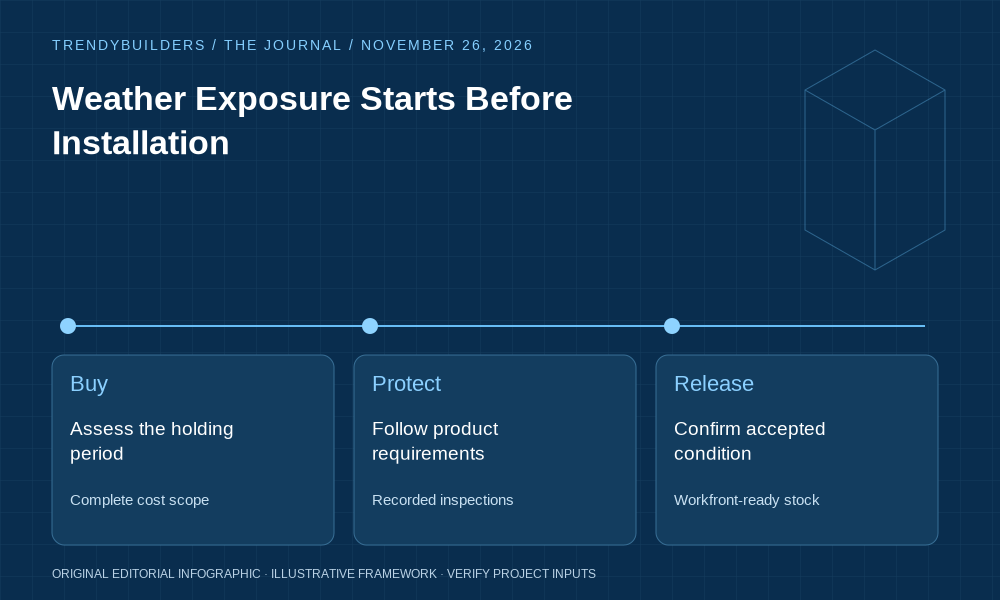
| Buy | Assess the holding period | Complete cost scope |
| Protect | Follow product requirements | Recorded inspections |
| Release | Confirm accepted condition | Workfront-ready stock |
Apply the method in TrendyBuilders
Open Materials purchasing and read the supporting workflow guide before entering project information. Use a reviewed project copy, confirm the measurement units and source revisions, and inspect warnings and exclusions before relying on any output. The calculations depend on the information supplied; selecting a tool does not validate the underlying technical or commercial assumptions.
Keep the accepted project documents and required approvals linked to the planning record. Export the assumptions with a dated result so another reviewer can reproduce the comparison. Where the workflow reveals a missing input or a decision outside the tool's scope, assign that issue to the responsible person rather than treating a blank field as evidence of zero exposure.
Sources and further reading
World Bank: Procurement framework. This primary-source reference provides relevant background in its own stated scope and jurisdiction. It does not endorse this article or TrendyBuilders. Reference checked November 18, 2026. The worked examples and operating recommendations are original editorial analysis; they are not reported project outcomes, quotations or professional certification.
Related reading
- A Profitable Project Can Still Run Out of Cash
- Small Contractors Need Better Decisions, Not More Software
- Measure Once. Buy the Right Quantity.
Use the moderated discussion to share the decision you are trying to make and the assumptions that matter. Omit confidential drawings, supplier prices and personal information.
The conversation
Constructive, relevant discussion is welcome. Comments are moderated. You may edit your own comment for one hour after its original submission; administrators can edit at any time.
Be the first to contribute a thoughtful comment.