
Executive brief
A small contractor rarely has spare capacity for a complicated digital rollout. The same person may price work, buy materials, supervise crews and respond to clients. A tool becomes useful when it removes a real decision problem without creating a larger administrative burden. The first target should therefore be a repeatable workflow, not a long feature list.
Choose one common project type and establish how scope, quantities, material purchases, rates and assumptions will be recorded. Make the output easy to review and explain. A consistent estimate with visible exclusions is more valuable than a sophisticated dashboard built on missing information.
Separate an early budget from a detailed estimate
A preliminary budget helps decide whether an opportunity is worth further investigation. It is not the same as a measured bill of quantities. If a benchmark allowance is presented as a detailed estimate, the client may assume a level of certainty that the contractor has not established. State the basis, range and missing information.
As the design becomes clearer, replace provisional assumptions with reviewed quantities and current supplier evidence. Retain the earlier version so the movement can be explained. This protects the relationship with the client and helps the contractor distinguish genuine scope development from estimating error.
An illustrative first workflow
A contractor frequently prices small renovation packages. The team starts with one template that records rooms, measured areas, finishes, exclusions and access assumptions. It uses the same naming convention for material quantities and supplier quotes. Before sending the estimate, another person checks a sample measurement, the packaging conversion and the tax and delivery basis.
The first benefit is not automatic speed. It is a more reliable conversation about what has been priced. Once the workflow is stable, reusable rates and material data can reduce repeated entry. Copying an old estimate before understanding its scope can do the opposite: it can reproduce hidden omissions and outdated commercial assumptions.
Keep the record light enough to maintain
Record the information that changes a decision. A small job may need a concise quantity basis, dated quotes, a clear allowance and a simple purchasing schedule. It may not need a complex classification system. Avoid adding fields solely because software makes them available. Every required field should have an owner and a practical use.
Build the review into an existing routine, such as the final pricing check or the weekly material order. A separate process that depends on quiet office time may fail during the busiest period. The best adoption plan respects the contractor’s actual working pattern and makes the desired record easier to create than an informal alternative.
Start with the right TB tools
TrendyBuilders Quick Estimate supports benchmark-based preliminary budgets with editable allowances and ranges. Keep it distinct from the detailed Estimate. Use the calculators and Materials workflow when reviewed dimensions and specifications are available. Reports can communicate the basis, and project backups can preserve a portable record.
Check current membership availability before promising a workflow that depends on paid access or team features. Business and Enterprise labels do not by themselves establish an active entitlement. TB does not replace engineering design, formal accounting or a supplier’s confirmed offer. Begin with the supported tools that solve the selected problem, then expand only when the record quality is reliable.
Judge adoption by operating results
Ask whether another person can understand the estimate, whether purchases reconcile to the work and whether the team can find the accepted version. Track avoidable emergency orders, repeated omissions and time spent reconstructing old decisions. These are more useful early indicators than the number of features enabled.
After several comparable jobs, review what the workflow captured well and where people bypassed it. Simplify unnecessary steps and strengthen the fields that prevented a real error. Digital maturity is the ability to make and retain good decisions consistently, including during the weeks when the contractor is too busy for an elaborate process.
Pilot the workflow on a completed job
Choose a familiar completed project with available drawings, supplier information and actual purchasing records. Rebuild the estimate in an isolated working copy. Because the team already knows the job, it can focus on whether the workflow captures the decisions that mattered. Do not use a live bid as the first place to discover basic naming and unit problems.
Ask a second person to review the output without a verbal explanation. Can they identify the scope, exclusions, material assumptions and rate date? Can they reproduce a sample calculation? Where they cannot, improve the record or report. The goal is a clear handover, not a document that only its author understands.
Compare the planned purchases with what the completed job actually used. Investigate differences using the available evidence. Some may reflect scope change, some packaging and some an estimating mistake. Keep those causes separate. Reusing a historical quantity or loss factor without understanding the reason can carry the wrong lesson into the next estimate.
Set a minimum record for the next live job and agree who maintains it. Keep the first rollout narrow enough that the team can complete it during normal work. Add reusable rates and templates only after the basic workflow is reliable. A copied template should accelerate a reviewed process, not encourage the team to skip project-specific scope decisions.
After the pilot, decide whether the workflow saved reconstruction time, prevented an omission or improved the purchasing discussion. Those results provide a practical reason to continue. If a step adds work without changing a decision or preserving useful evidence, simplify it. Small contractors gain most from a process they can sustain consistently under real operating pressure.
A practical information-control protocol
Identify the decision each record is intended to support. A drawing issue, quantity import, estimate, purchase record and progress observation have different authorities. Describe those boundaries instead of assuming that one platform makes every field equally reliable. The project needs to know what has been supplied, reviewed, accepted and applied.
Use stable references across records. Package, activity, source document and revision identifiers make it possible to reconcile exported files and later changes. Keep names readable, but do not depend on a name alone to establish identity. A renamed package should remain traceable to its earlier quantity, quote and progress records.
Treat imported information as a proposal until the relevant checks are complete. Review coverage, units, classification and source revision. A successful import confirms that data was processed; it does not certify completeness or technical accuracy. Preserve missing information and warnings so they can be resolved rather than disappearing inside a clean-looking total.
Retain the approved baseline and a dated current working record. Record why material values changed and who accepted the change. Where a standalone tool produces an output, review it before transferring it into the saved project. This explicit step helps prevent a useful scenario from being mistaken for an already authorized project update.
Keep the workflow proportionate to the team’s capacity. A small, consistently maintained record is more valuable than an elaborate register that people bypass during busy periods. Require fields that support a real decision or preserve necessary evidence. Introduce reusable templates only after the underlying scope and review conventions are clear.
Test the handover. Ask another person to reproduce a sample result and identify the accepted version without relying on the author’s memory. Check that a backup can be located and restored safely in an isolated copy. These practical drills reveal whether the information system remains useful when people, files or project conditions change.
Measure improvement through operating outcomes: fewer unexplained revisions, clearer purchasing decisions, faster reconstruction of a prior estimate and better reconciliation of actual work. The number of uploaded files or enabled features is not the objective. Digital practice succeeds when the project can make a decision, explain its basis and retain the evidence for the next reviewer.
Warning signs to investigate
A rollout needs simplification when staff maintain a separate informal record because the required system is too slow or unclear. Ask which decision the informal record supports and why the main workflow does not. The answer may reveal a missing field, a confusing output or an unnecessary approval step. Improve the working process before demanding more data entry.
Watch also for templates copied from unrelated jobs without a scope review. Reuse should save effort while preserving project-specific judgment. Check units, specifications, quantity factors and rate dates before accepting a reused line. A small contractor benefits from a consistent minimum record, but consistency should not turn a previous project’s assumptions into unquestioned facts about the next one.
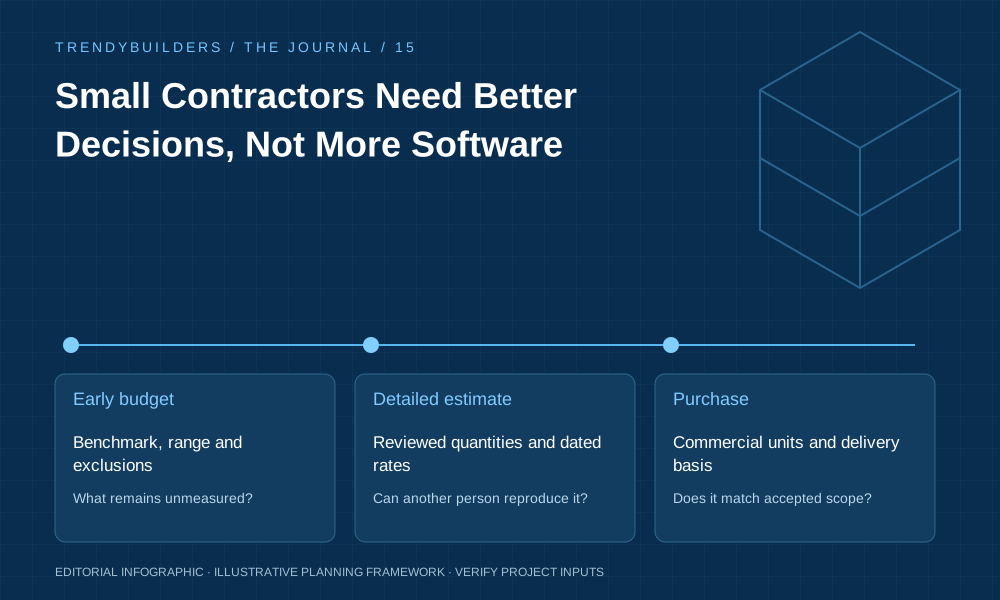
Decision table
This table summarizes the article’s planning distinction. Numerical examples are illustrative, use no live supplier prices, and exclude costs or assessment stages unless expressly stated. Review the complete explanation before applying an example to a project.
| Stage | Useful minimum record | Review question |
|---|---|---|
| Early budget | Benchmark, range and exclusions | What remains unmeasured? |
| Detailed estimate | Reviewed quantities and dated rates | Can another person reproduce it? |
| Purchase | Commercial units and delivery basis | Does it match accepted scope? |
Put the method to work
Open Quick Estimate in the TrendyBuilders workspace and work from a reviewed project copy. Confirm the activity identifiers, measurement units and applicable source revision before changing any input. Read the supporting workflow guide for the tool’s scope and review requirements. Keep a dated backup of the accepted basis and export the assumptions with the result so the next reviewer can reconstruct the decision.
Treat the output as a planning result based on the information supplied. Confirm material specifications, supplier commitments, acceptance criteria and professional approvals through the responsible project processes. Where the calculation exposes missing information, record the missing input and assign a next action instead of treating an empty field or a default value as evidence. Revisit the scenario when the source information changes, and preserve the prior version so the movement remains explainable.
Sources and further reading
NIST: Inadequate interoperability — a closer look at the costs. NIST’s historical work highlights information-transfer problems in construction. The small-business adoption approach below is original editorial guidance. Source checked for the launch collection on November 17, 2026. The worked examples, operating protocols and recommendations are original TrendyBuilders editorial analysis; they are not quotations from the source or professional certification.
Continue the conversation
- Rework Is a Procurement and Planning Problem Too
- A Unit Mismatch Can Erase a Procurement Saving
- Measure Once. Buy the Right Quantity.
Bring a project-specific question to the moderated discussion below. Explain the relevant scope and assumptions without sharing confidential drawings, prices or personal information. Useful discussion helps other readers understand the decision and its limits.
The conversation
Constructive, relevant discussion is welcome. Comments are moderated. You may edit your own comment for one hour after its original submission; administrators can edit at any time.
Be the first to contribute a thoughtful comment.