
Executive brief
An estimate is a statement about a defined scope, a set of quantities and a price basis at a point in time. When those foundations move independently, updating the headline total is insufficient. A project can appear within budget while its purchasing exposure has increased, or appear over budget simply because a previously excluded package has become visible. The practical objective is to explain the movement before deciding whether to absorb, redesign, resequence or renegotiate it.
Across international supply chains, the same package can carry exposure to manufacturer pricing, fuel, freight, currency and delivery timing. Local labor and site overheads add separate pressures. A single inflation percentage conceals those differences. Executives need a short bridge from the approved baseline to the current forecast, supported by package-level evidence and explicit decisions.
Why the headline contingency is not enough
Contingency can be exhausted without anybody making a clearly bad purchase. The problem often starts with applying a percentage to an incomplete estimate and treating that percentage as protection against every uncertainty. Known omissions, price escalation, currency changes and uncertain design development have different causes and should remain distinguishable. Otherwise an apparently comfortable allowance may already be committed several times.
Begin by classifying movements into quantity, specification, rate, timing and commercial basis. A change in reinforcement quantity belongs in a different line from an increase in the quoted rate per tonne. Taxes, freight and handling should have a visible basis. Ask whether a new quote includes the same delivery point and payment terms as the baseline. A lower supplier rate can still produce a higher landed cost if delivery charges or minimum orders have changed.
A worked package review
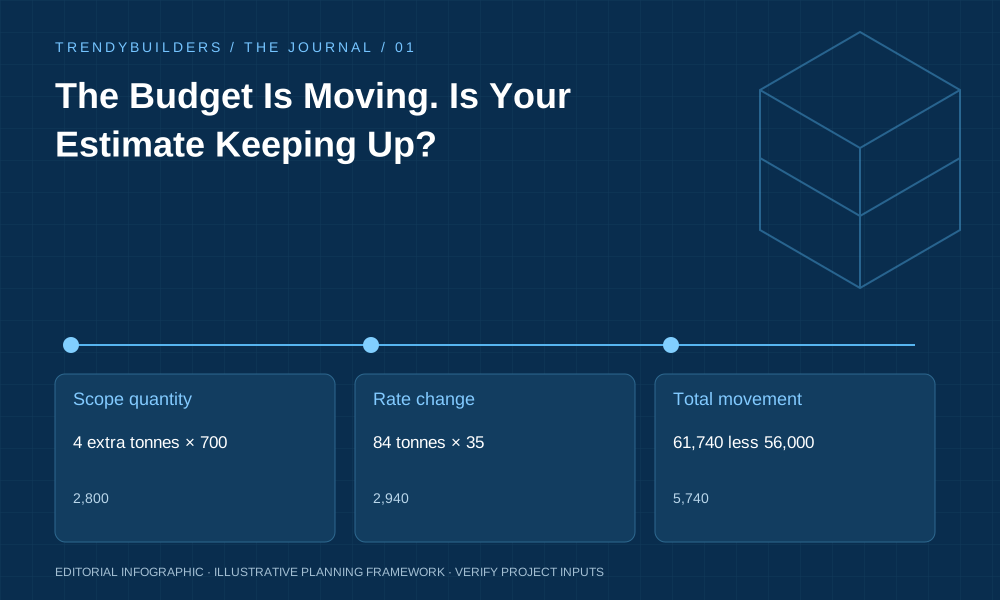
Consider an illustrative steel package with an approved requirement of 80 tonnes at 700 currency units per tonne. Its material baseline is 56,000. A reviewed drawing revision increases the requirement to 84 tonnes, and a fresh comparable quote is 735 per tonne. The revised material amount is 61,740. Explain the 5,740 movement as 2,800 for the extra four tonnes at the baseline rate and 2,940 for the rate increase applied to the revised quantity. This convention is useful because it reconciles exactly, provided it is used consistently.
The result is a planning example, not a market price or a claim about current steel conditions. It excludes freight, tax and project-specific costs. The review should identify which of those items are additional, which are already included, and which remain unknown. If the purchase is phased, assess the uncommitted balance rather than escalating the entire package after some steel has already been secured.
Build a forecast that supports decisions
Freeze the approved baseline and retain its date. Record commitments separately from uncommitted requirements. Reconcile delivered material, usable stock, pending orders and remaining quantities before forecasting future purchases. This prevents a price scenario from inflating already purchased material or overlooking a genuine shortage. Where invoices have not arrived, identify accrual assumptions rather than presenting every figure as an actual cost.
Prepare a base case and a small number of meaningful alternatives. An alternative might change the purchase date, exchange assumption or approved material option. Change one driver first to understand its contribution, then assess combined exposure. Avoid adding every worst case mechanically when the underlying events are mutually exclusive. The final report should identify the decision, its owner, the required date and what evidence would cause the forecast to change.
Use TrendyBuilders without hiding assumptions
In TrendyBuilders, review the detailed Estimate and retain a dated backup before changing rates. Use Scenarios to explore entered material, wage, fuel and exchange assumptions. Keep country, currency and units explicit; selecting a country does not establish an exchange rate or supply a verified market-price database. Use the cost-risk guide to distinguish escalation from contingency and markup.
The tool can make an assumption visible and help calculate its consequences. It cannot guarantee a future supplier price, enforce a commercial hedge or certify the budget. A regional rate import still requires a permitted source, compatible units and a review of tax and date metadata. Export the scenario basis alongside the total so a reviewer can reconstruct why the number changed.
Questions for the investment meeting
Ask which packages account for the largest uncommitted exposure, when their quotations expire and which specifications are still provisional. Ask whether the forecast includes the cost of resequencing and the effect of an earlier purchase on storage and cash flow. Finally, ask what the team can decide now. A report that describes uncertainty without assigning a response does little to protect the project.
Do not turn this discipline into a monthly paperwork exercise. Set refresh triggers around quote expiry, approved design changes and major procurement milestones. A small number of verified package updates can be more valuable than repeatedly applying a broad percentage to the entire project. The measure of success is a forecast that reconciles, a purchasing decision made while options remain available, and an audit trail that explains both.
Run a package-level escalation clinic
Choose the five packages with the largest remaining exposure and assemble the accepted quantity, current quote, planned order date and outstanding technical decisions. Ask the estimator and buyer to reconcile those records together. If they disagree, resolve the basis before discussing the forecast. This prevents a price debate from masking a quantity or specification mismatch. Record the quote’s validity and the point at which a refresh becomes necessary.
For each package, prepare a short cost bridge. Show the baseline amount, approved scope movement, comparable rate movement and any changed commercial terms. Keep tax, transport and currency on a stated basis. Where a quote remains incomplete, show the missing item and its forecast treatment. An explicit provisional allowance is more reviewable than an apparently precise total with an invisible exclusion.
Then assess the response. An earlier order may secure a price but create financing, storage and design-change exposure. A material alternative may reduce cost but require technical review and a different installation method. Resequencing may defer expenditure while extending supervision or equipment use. Compare the whole response and identify the last date on which it remains practical. Do not let an attractive material saving conceal a larger indirect cost.
At the next review, check the decisions against evidence. Was the order accepted on the expected terms? Did the supplier preserve the quote? Has the remaining requirement changed? Remove exposure only when the relevant condition has actually been secured. A purchase request awaiting approval is different from a confirmed commitment. This distinction makes the forecast useful during the period when the project still carries commercial uncertainty.
Keep a concise record of what the team learned. If one material repeatedly requires a fresh quote earlier than expected, change the refresh trigger. If scope revisions dominate the movement, improve the design-release review instead of increasing a generic escalation allowance. The purpose of the clinic is to improve the next decision, not merely explain the last overrun.
A practical cost-control protocol
Establish the reporting boundary before reviewing movement. State the package, currency, tax basis, price date and scope revision. Identify whether the figures describe an estimate, a commitment, an actual cost or a forecast. These records answer different questions and should not be added together indiscriminately. A committed amount may already include expenditure that later appears in actual-cost records, so the reconciliation needs an explicit convention.
Retain a frozen reference for the approved position. Record the current working assumptions separately and explain the difference using a short bridge. The bridge should reconcile exactly to the reported total. If an unexplained balance remains, investigate it rather than assigning it to a vague miscellaneous line. Precision in the presentation is useful only when the underlying categories have a clear meaning.
Give uncertain inputs a status and a next action. A provisional quantity, expired quotation or unresolved scope boundary should remain visible. Identify the information needed to replace the assumption, the person responsible and the decision date. A planning allowance can be appropriate, but it should not be described as a confirmed price or an approved obligation.
Check whether a proposed response changes another cost or timing assumption. Earlier purchasing can affect storage and cash. Resequencing can affect supervision and equipment. An approved material alternative can affect installation effort. Review the whole consequence at a level proportionate to the decision. Do not count a saving in one line while leaving its necessary supporting cost outside the comparison.
Use a consistent refresh trigger. Major scope issues, quote expiry, procurement award and a changed delivery or production position can justify a new forecast. Repeatedly updating every rate without new evidence can create work without improving the decision. Focus effort where exposure is material and where an action can still change the outcome.
Before issuing the report, ask another reviewer to reproduce one important movement from the source records. Confirm that units and dates match and that the same amount has not been counted twice. Record the review and retain the exported version. This gives the next meeting a reliable reference and helps the team explain why the forecast changed.
The final control is ownership. Every material exception should lead to an action, an accepted allowance or an explicit decision to retain the exposure. A cost report becomes useful when it makes that choice clear. The objective is a defensible basis for managing the remaining work, rather than a promise that uncertainty has disappeared.
Warning signs to investigate
Watch for a forecast that improves immediately after a rate update without a corresponding supplier or scope decision. The apparent improvement may come from changing the basis rather than reducing exposure. Check whether quantities, tax treatment or exclusions moved at the same time. Also examine packages with a low original rate but an expired quotation; their apparent saving may no longer be available when the project is ready to order.
A second warning is a large unexplained contingency balance. Ask which risks the balance is intended to cover and whether any are already represented elsewhere. Contingency should not become a balancing figure that makes the report agree with the desired budget. Retain the unresolved exposure and its decision trigger. That discipline helps executives distinguish a recoverable commercial issue from a budget that is simply missing necessary scope.
Decision table
This table summarizes the article’s planning distinction. Numerical examples are illustrative, use no live supplier prices, and exclude costs or assessment stages unless expressly stated. Review the complete explanation before applying an example to a project.
| Movement | Illustrative basis | Amount |
|---|---|---|
| Scope quantity | 4 extra tonnes × 700 | 2,800 |
| Rate change | 84 tonnes × 35 | 2,940 |
| Total movement | 61,740 less 56,000 | 5,740 |
Put the method to work
Open Scenarios in the TrendyBuilders workspace and work from a reviewed project copy. Confirm the activity identifiers, measurement units and applicable source revision before changing any input. Read the supporting workflow guide for the tool’s scope and review requirements. Keep a dated backup of the accepted basis and export the assumptions with the result so the next reviewer can reconstruct the decision.
Treat the output as a planning result based on the information supplied. Confirm material specifications, supplier commitments, acceptance criteria and professional approvals through the responsible project processes. Where the calculation exposes missing information, record the missing input and assign a next action instead of treating an empty field or a default value as evidence. Revisit the scenario when the source information changes, and preserve the prior version so the movement remains explainable.
Sources and further reading
US Bureau of Labor Statistics: Producer Price Index. Producer price indexes describe price movement for defined categories; they are not quotations for a particular construction project. Source checked for the launch collection on November 17, 2026. The worked examples, operating protocols and recommendations are original TrendyBuilders editorial analysis; they are not quotations from the source or professional certification.
Continue the conversation
- From Quantities to Delivery: Close the Planning Loop
- One Missing Component Can Stop an Entire Project
- Lower Carbon Starts Before the Purchase Order
Bring a project-specific question to the moderated discussion below. Explain the relevant scope and assumptions without sharing confidential drawings, prices or personal information. Useful discussion helps other readers understand the decision and its limits.
The conversation
Constructive, relevant discussion is welcome. Comments are moderated. You may edit your own comment for one hour after its original submission; administrators can edit at any time.
Be the first to contribute a thoughtful comment.