
Executive brief
Construction teams can disagree while each is using a legitimate document. The estimator has one drawing revision, the buyer has an earlier quantity schedule and the site has a marked-up change that has not reached the office. The immediate problem is not necessarily calculation accuracy. It is the absence of a controlled relationship between sources, decisions and downstream records.
An effective information chain answers four questions: which source was used, what was accepted, where was it applied and what changed afterward? More software does not automatically answer them. The project needs clear identifiers, revision rules and a deliberate process for accepting changes into the working estimate.
Choose a source of authority for each record
A drawing-management system may control design issue, while a project estimate controls the accepted commercial quantity basis. A supplier quote controls an offered price, and a receipt record controls accepted material delivery. Calling one platform the single source of truth can obscure these different authorities. Define what each record establishes and how it relates to the others.
Use stable package and activity identifiers. Names alone are fragile because teams abbreviate or rename them. Retain the drawing reference and revision beside the measured quantity, then connect the material schedule and purchase record to the accepted activity. A reviewer should be able to follow the chain without guessing that two similar labels refer to the same scope.
An illustrative revision mismatch
A wall package is measured from revision C. Revision D adds openings and changes the finish build-up. The estimator adjusts the net area but the buyer continues using a spreadsheet exported from C. Meanwhile the site orders additional material based on the new build-up. Each action may appear reasonable in isolation, but the project now has incompatible quantity and material bases.
The correction is to identify the accepted revision, recalculate affected conversions and reconcile outstanding purchases. Do not simply rename the spreadsheet “latest.” Record which rows changed, which orders remain valid and which stock can still be used. The information repair is complete only when the downstream consequences have been reviewed.
Treat imports as proposals
A model export, CSV file or drawing measurement can contain useful information without being ready for direct acceptance. Check units, identifiers, coverage and revision metadata. Missing quantities should remain visible. A successful file import proves that the file was processed; it does not prove that every element is complete or correctly classified.
Where an import changes project values, retain the source and the reviewer’s acceptance. Avoid overwriting a working estimate merely because a newer file exists. The new file may contain a different scope boundary or an incomplete export. A controlled comparison is more useful than automatic replacement when the project depends on professional interpretation.
Use the TB review tools as intended
TrendyBuilders drawing revision comparison provides overlays and visual differences. Those differences are review aids, not proof of a design change or automatic quantity adjustment. IFC quantity review reads supported quantities declared in a plain IFC export; it does not derive quantities from full model geometry or import native Revit files.
Use Evidence & audit and project backups to retain the accepted basis. Reports can communicate reviewed scope, rates and assumptions. Standalone tool outputs do not automatically update saved projects, so the transfer requires an explicit review step. That boundary is useful: it creates an opportunity to confirm that the proposed information belongs in the current estimate.
Measure control, not file volume
A project can store thousands of files and still lack a reliable decision trail. Track unresolved revision impacts, missing source references and unaccepted imports. Check whether a sample purchase can be traced back to the reviewed quantity and drawing. These tests reveal whether information management supports actual work.
At each major issue, identify the affected packages and assign the downstream review. The objective is not to force every team into one document format. It is to make the connections between their records explicit enough that a design change reaches the people who must price, buy, install and forecast it.
Perform a traceability drill
Select one live purchase and ask the team to trace it backward to the accepted material requirement, measured activity and source drawing. Record where the chain becomes ambiguous. The drill should be quick and practical. Its purpose is to reveal a weak interface between records, not to audit every document in the project archive.
Then trace one recent design revision forward. Identify which quantities, conversions, purchases, resource assumptions and forecasts were reviewed. A revision may affect more than geometry: a changed material build-up can alter consumption, lead time and installation effort. Confirm whether the downstream owners received the accepted change rather than only the original drawing notification.
Check the status language used in exports. A file marked “issued” or “latest” may not tell a buyer whether its quantities are reviewed and accepted. Add an explicit purpose, source revision and review status where those distinctions affect use. Keep filenames readable, but do not depend on filenames alone to establish authority.
Review the recovery path for an incorrect import or accidental overwrite. A dated backup should be usable, and the team should know which record it restores. Test the process in an isolated copy rather than experimenting on customer or live project data. A backup policy has limited value if nobody can identify the correct version when a mistake occurs.
Use the drill’s findings to improve one interface at a time. A stable package identifier or a mandatory source-revision field can be more effective than adding another repository. The target is a decision chain that remains understandable when staff change, files are exported and a project is revisited months later.
A practical information-control protocol
Identify the decision each record is intended to support. A drawing issue, quantity import, estimate, purchase record and progress observation have different authorities. Describe those boundaries instead of assuming that one platform makes every field equally reliable. The project needs to know what has been supplied, reviewed, accepted and applied.
Use stable references across records. Package, activity, source document and revision identifiers make it possible to reconcile exported files and later changes. Keep names readable, but do not depend on a name alone to establish identity. A renamed package should remain traceable to its earlier quantity, quote and progress records.
Treat imported information as a proposal until the relevant checks are complete. Review coverage, units, classification and source revision. A successful import confirms that data was processed; it does not certify completeness or technical accuracy. Preserve missing information and warnings so they can be resolved rather than disappearing inside a clean-looking total.
Retain the approved baseline and a dated current working record. Record why material values changed and who accepted the change. Where a standalone tool produces an output, review it before transferring it into the saved project. This explicit step helps prevent a useful scenario from being mistaken for an already authorized project update.
Keep the workflow proportionate to the team’s capacity. A small, consistently maintained record is more valuable than an elaborate register that people bypass during busy periods. Require fields that support a real decision or preserve necessary evidence. Introduce reusable templates only after the underlying scope and review conventions are clear.
Test the handover. Ask another person to reproduce a sample result and identify the accepted version without relying on the author’s memory. Check that a backup can be located and restored safely in an isolated copy. These practical drills reveal whether the information system remains useful when people, files or project conditions change.
Measure improvement through operating outcomes: fewer unexplained revisions, clearer purchasing decisions, faster reconstruction of a prior estimate and better reconciliation of actual work. The number of uploaded files or enabled features is not the objective. Digital practice succeeds when the project can make a decision, explain its basis and retain the evidence for the next reviewer.
Warning signs to investigate
Watch for several files carrying the word “final” without an accepted revision or purpose. The naming problem may reveal a deeper absence of review status. Identify which record is authorized for measurement, procurement or construction, and make the distinction visible. Deleting the older file is not a substitute for understanding which decisions depended on it.
Another warning is an imported total that changes without a corresponding exception report. Ask whether coverage, units or classification changed and whether missing data remains visible. A clean total can conceal a partial import. Retain the source and review result so the project can reproduce the change later. Information control is strongest when the team can explain why a number moved, not merely point to a newer file.
Decision table
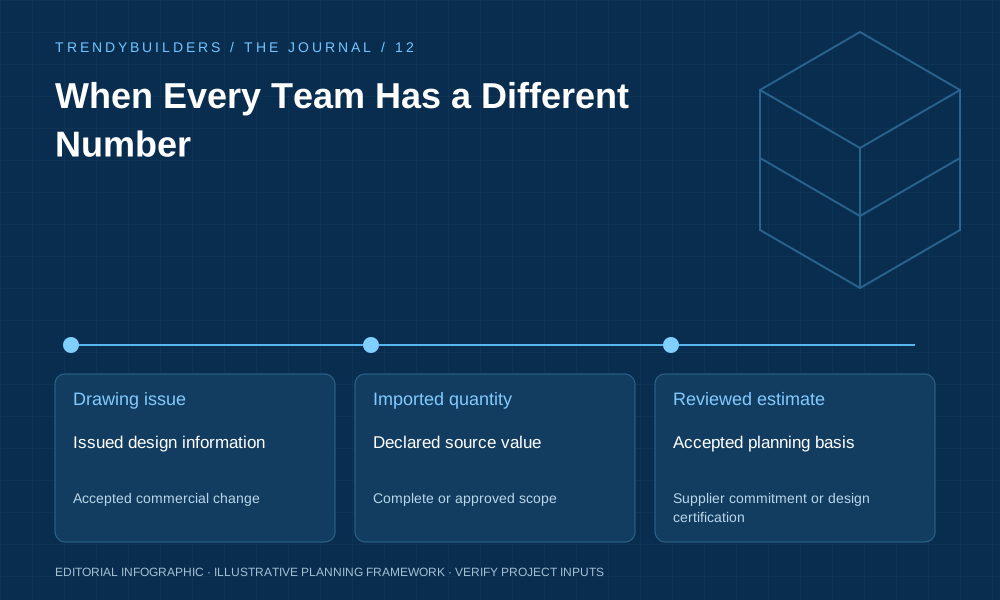
This table summarizes the article’s planning distinction. Numerical examples are illustrative, use no live supplier prices, and exclude costs or assessment stages unless expressly stated. Review the complete explanation before applying an example to a project.
| Record | Establishes | Does not establish |
|---|---|---|
| Drawing issue | Issued design information | Accepted commercial change |
| Imported quantity | Declared source value | Complete or approved scope |
| Reviewed estimate | Accepted planning basis | Supplier commitment or design certification |
Put the method to work
Open Evidence & audit in the TrendyBuilders workspace and work from a reviewed project copy. Confirm the activity identifiers, measurement units and applicable source revision before changing any input. Read the supporting workflow guide for the tool’s scope and review requirements. Keep a dated backup of the accepted basis and export the assumptions with the result so the next reviewer can reconstruct the decision.
Treat the output as a planning result based on the information supplied. Confirm material specifications, supplier commitments, acceptance criteria and professional approvals through the responsible project processes. Where the calculation exposes missing information, record the missing input and assign a next action instead of treating an empty field or a default value as evidence. Revisit the scenario when the source information changes, and preserve the prior version so the movement remains explainable.
Sources and further reading
NIST: Inadequate interoperability — a closer look at the costs. NIST’s historical interoperability research examined information-related costs in capital facilities. Its historical figures are not presented here as current global estimates. Source checked for the launch collection on November 17, 2026. The worked examples, operating protocols and recommendations are original TrendyBuilders editorial analysis; they are not quotations from the source or professional certification.
Continue the conversation
- Build for the Conditions the Project Will Actually Face
- The Crane Is Booked Twice. The Programme Still Looks Fine.
- From Quantities to Delivery: Close the Planning Loop
Bring a project-specific question to the moderated discussion below. Explain the relevant scope and assumptions without sharing confidential drawings, prices or personal information. Useful discussion helps other readers understand the decision and its limits.
The conversation
Constructive, relevant discussion is welcome. Comments are moderated. You may edit your own comment for one hour after its original submission; administrators can edit at any time.
Be the first to contribute a thoughtful comment.