
A decision backlog can become a site constraint
A project can have labor, equipment and money available and still fail to release work. The missing resource is often an accepted decision: an opening detail, a material substitution, a shop drawing response or permission to proceed through a hold point. Teams sometimes call this a coordination problem and leave it outside the schedule. That makes the constraint harder to manage. A request sent is an outstanding obligation until the relevant authority gives a usable response and the project incorporates it into the working documents.
This article uses approval debt to describe the growing stock of unresolved decisions that consume future flexibility. It is an editorial management concept, not a contractual category. Across large infrastructure programs and small building contracts, the operating question is the same: which unanswered question will prevent the next authorized action, when will it do so, and who can resolve it?
Count usable decisions, not outgoing messages
An RFI register that measures only submissions can reward activity while concealing stalled work. Record the question, affected package, current document revision, responsible responder, required response date and the action blocked by the answer. Separate the date an answer was received from the date it was accepted and applied. A response that requests another calculation may move correspondence forward without releasing procurement.
Use a small set of statuses with clear evidence: prepared, submitted, clarification required, response received, accepted and implemented. Do not mark a request closed because a meeting discussed it. Link the actual instruction, drawing or accepted clarification. Otherwise the buyer may act on a verbal answer while the site team continues using a previous revision.
Work backward from the release decision
Begin with the date the project needs a material or workfront. Allow for transport, manufacture, technical review, order preparation and the decision itself. These are separate dependencies with different owners. A long manufacturing duration does not excuse an undefined review period. Nor does a nominal response allowance establish that a particular reviewer has enough capacity to meet it.
The resulting decision-required date is a planning commitment to discuss with the authorized parties. It does not replace contract notice periods or give the planner authority to approve design. Where the response date cannot be agreed, identify the exposure explicitly and prepare an alternative work sequence. Silence should appear as an unresolved dependency, rather than becoming an assumed approval in the forecast.
A worked example: one valve, several decisions
Consider an illustrative plant room package requiring delivery on December 20. The supplier needs twenty calendar days after a technically complete order, and the buyer needs three days to assemble and authorize that order. The project therefore needs the technical basis accepted by November 27, before considering any separate transport or holiday allowance. If the submittal remains incomplete on November 25, the apparent manufacturing problem is already an information problem.
The coordinator should identify whether the missing item concerns performance, connection dimensions, controls or commercial scope. Each may require a different reviewer. An alternate valve could solve availability while creating a new electrical interface. Keep the original option, alternative and acceptance evidence separate. The example dates illustrate backward planning; they are not a recommended universal lead time or evidence of a supplier commitment.
Review the oldest consequential questions first
Aging alone is useful but insufficient. A minor question open for forty days may have less immediate effect than a two-day-old interface issue on the next concrete pour. Review age together with required decision date, downstream float, reversibility and the cost of waiting. Give the team a short list of decisions that need action this week, with the exact next action stated.
Escalation should carry an intelligible choice. Explain what remains unknown, which options are technically available, who must decide and what each option changes. Avoid forwarding a long email chain with an urgent label and no recommendation. Where professional review is required, give that reviewer the evidence and adequate time; commercial urgency cannot supply missing technical acceptance.
Limit the number of questions circulating without ownership
Fragmented requests create duplicate reviews and contradictory answers. Assign one coordinator to each decision record while preserving the authority of the actual approver. Combine related questions when they require one coordinated answer, but avoid bundling unrelated disciplines into a document nobody can close. Establish how a revised submission supersedes the earlier one so outdated responses are not accidentally applied.
Review workload with the design and procurement teams. An ambitious submission schedule can overwhelm reviewers just as an overloaded delivery plan can overwhelm a loading bay. Agree submission batches and completeness checks. A first-pass completeness review often prevents days of circulation for a package missing a basic dimension, calculation reference or equipment schedule.
Make the queue part of the short-term plan
TrendyBuilders advanced scheduling can help represent an approved planning sequence, dependencies and constrained resources. Use it to compare the downstream effect of a late decision and a feasible alternative sequence. It is not an RFI approval system, a contractual notice service or an automated design reviewer. Maintain the authoritative correspondence in the project's established records and transfer only the reviewed planning inputs.
At the weekly meeting, connect each blocked activity to its decision record. Recalculate when a response changes the accepted scope or duration. Preserve the previous scenario so the movement can be explained. If a request is answered but the activity remains blocked, investigate implementation, access and purchasing rather than reporting a false release.
Close the loop after the answer
Before closing a consequential decision, confirm that the buyer, estimator and field supervisor are using the accepted basis. Check whether quantities, delivery dates, installation instructions or inspection requirements changed. Record who updated each affected record. This final implementation step is often where a formally answered question continues to cause practical delay.
An executive review should show the number of release-critical decisions overdue, their next required dates and the actions taken to recover them. Compare promised and actual usable response dates to improve future allowances. The aim is a smaller, better-understood queue that protects safe, authorized work and gives every participant a clear route to a decision.
A practical delivery-control protocol
Define the work package in a measurable unit and identify the acceptance basis. Separate installed quantity from accepted completed scope where the project requires that distinction. Record the location and revision so production observations refer to comparable work. Without that foundation, a productivity or progress percentage can combine activities that need very different effort and controls.
Check readiness before assigning more capacity. Confirm approved information, materials, access, predecessor completion, suitable equipment and inspection arrangements. Record missing conditions as actions with owners and due dates. A scheduled start is an intention; readiness evidence establishes whether the team has a practical opportunity to execute the work.
State the resource and calendar assumptions. Crew composition, equipment capability, working periods, setup and shared constraints can materially change the result. Avoid treating nominal headcount or a full shift as guaranteed productive capacity. Safety, competence and technical operating limits remain the responsibility of the appropriate qualified people and established site processes.
Observe output and effort using a consistent convention. Record interruptions and changes in conditions alongside the quantity. This helps distinguish an unrealistic planning rate from a preventable readiness failure or a genuinely more difficult work area. Use the evidence to improve the production system rather than attributing every difference to the crew.
Recalculate the remaining work from a reviewed remaining quantity. Consider whether the observed rate is suitable for the next areas and whether an intervention changes the assumption. Preserve the original baseline while preparing the current forecast. A realistic response plan is easier to assess when the team can still see the position from which it moved.
Review the wider consequence of a proposed recovery. Additional equipment may need setup and approval; more workers may create congestion; overtime may affect fatigue and supervision. A shorter activity does not automatically shorten project completion if another dependency governs the finish. Explain those limits before describing a recovery as secured.
Close the review with a specific action and an evidence check. At the next meeting, verify whether the material arrived, the access became available or the inspection was released. Compare the resulting output with the forecast. Delivery control becomes reliable when the project repeatedly links a stated constraint, a practical response and an observed result.
A review routine the team can sustain
Choose one real package for the first review rather than attempting to repair every record at once. Ask its estimator, buyer and field owner to agree the accepted scope and identify the sources they actually use. Write down the unresolved questions and the next decision each one prevents. This short exercise makes the method concrete and reveals where the project needs better evidence before it needs another calculation.
Keep the original working records available while testing a revised approach. Use a dated project copy for scenarios and record the input changes individually. Ask a second person to reproduce a sample result from the stated sources. If they cannot explain the unit, revision or assumption, improve the record before circulating the total as an accepted basis. A reproducible result is more useful than an impressive display that depends on its author's memory.
At the next regular package meeting, compare the planned action with what happened. Identify whether the obstacle was missing information, capacity, authority or a changed site condition. Update the relevant assumption and assign the remaining action to a named person with a practical due date. Keep the previous basis so the movement remains explainable. Avoid silently replacing uncertainty with a default value simply to complete the report.
Scale the process only after the pilot has produced a useful decision. Retain fields that support an actual review and remove duplicate recording that adds no evidence. Tell the people receiving the output which version is accepted and what remains conditional. The goal is a working habit that survives a busy site week: clear sources, visible assumptions, explicit authority and a traceable action when the evidence changes.
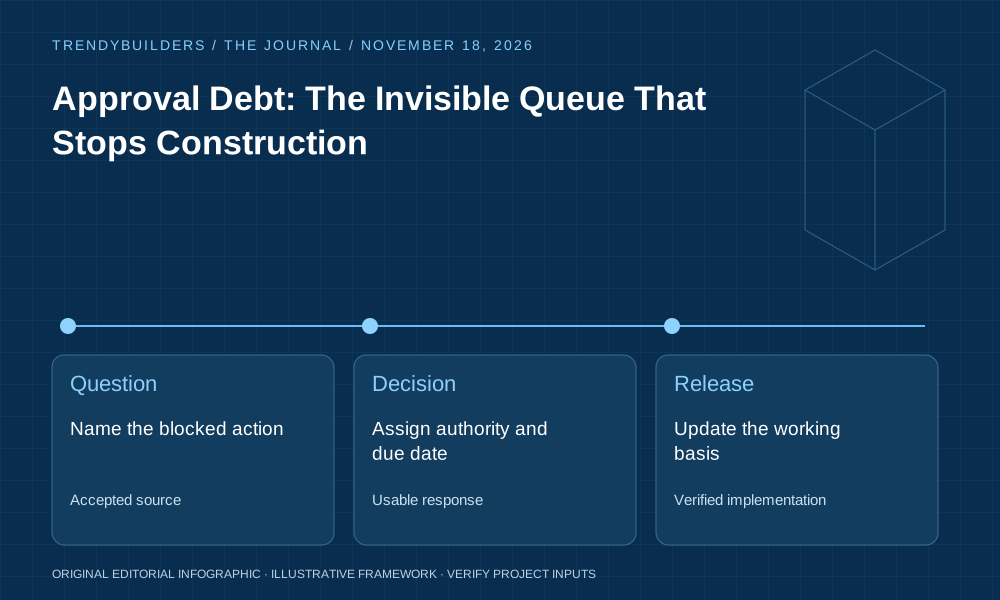
Decision table
Use this table as a meeting prompt alongside the explanation above. It summarizes the evidence chain; it does not establish technical acceptance or replace the responsible project process. Numerical examples in this article are illustrative and contain no live supplier rates.
| Stage | Action | Evidence |
|---|---|---|
| Question | Name the blocked action | Accepted source |
| Decision | Assign authority and due date | Usable response |
| Release | Update the working basis | Verified implementation |
Apply the method in TrendyBuilders
Open Scheduling & resource leveling and read the supporting workflow guide before entering project information. Use a reviewed project copy, confirm the measurement units and source revisions, and inspect warnings and exclusions before relying on any output. The calculations depend on the information supplied; selecting a tool does not validate the underlying technical or commercial assumptions.
Keep the accepted project documents and required approvals linked to the planning record. Export the assumptions with a dated result so another reviewer can reproduce the comparison. Where the workflow reveals a missing input or a decision outside the tool's scope, assign that issue to the responsible person rather than treating a blank field as evidence of zero exposure.
Sources and further reading
World Bank: Contract management guidance. This primary-source reference provides relevant background in its own stated scope and jurisdiction. It does not endorse this article or TrendyBuilders. Reference checked November 18, 2026. The worked examples and operating recommendations are original editorial analysis; they are not reported project outcomes, quotations or professional certification.
Related reading
- One Missing Component Can Stop an Entire Project
- The Delivery Date Is Too Late to Start Planning
- When Every Team Has a Different Number
Use the moderated discussion to share the decision you are trying to make and the assumptions that matter. Omit confidential drawings, supplier prices and personal information.
The conversation
Constructive, relevant discussion is welcome. Comments are moderated. You may edit your own comment for one hour after its original submission; administrators can edit at any time.
Be the first to contribute a thoughtful comment.