
Executive brief
An estimate, a procurement schedule and a programme can each look reasonable while describing different projects. The estimate uses one quantity, the buyer orders another and the schedule assumes a production rate nobody has tested. Integration starts by connecting those assumptions, then checking them against observed work. It does not require pretending that every record updates itself automatically.
The useful planning loop is straightforward: define scope, measure it, translate it into purchases, plan the required resources, record accepted progress and forecast the remainder. At every transition, retain the source and the review. This gives the project a way to explain change rather than merely display a new total or date.
Connect the right quantities
Installed work, material demand, purchase quantity and accepted progress serve different purposes. A procurement adjustment should not silently change the measured scope. Likewise, delivered material should not automatically count as completed work. Define the relationship and keep the quantities distinguishable.
Use a common package or activity identifier across records. The identifier allows a reviewer to follow the scope into material purchases, resource assumptions and cost records. Names can remain readable, but they should not be the only link. A renamed activity should not break the team’s ability to reconcile its earlier commitments and progress.
An illustrative closed loop
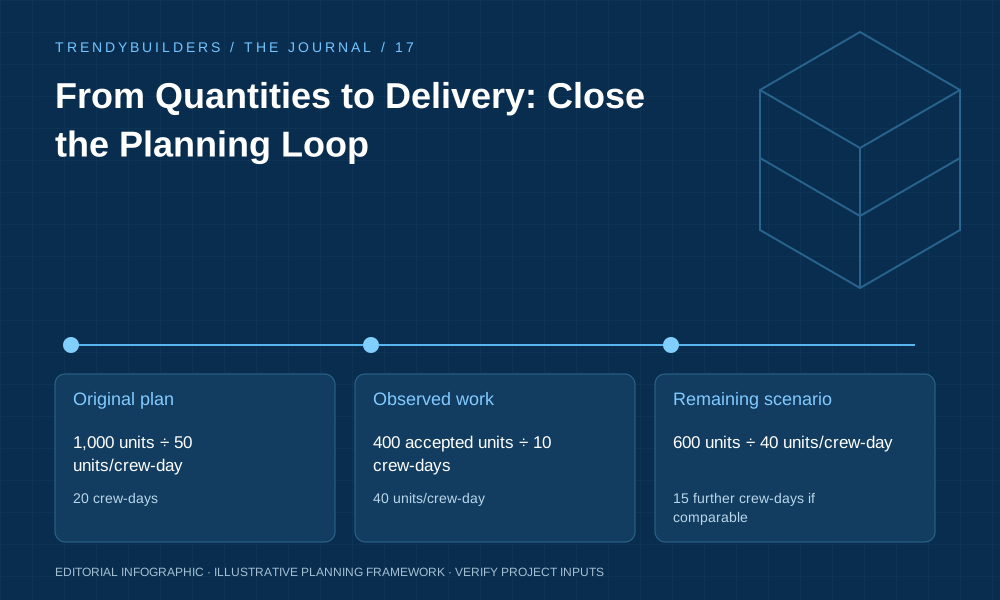
A package begins with 1,000 reviewed units of work and an assumed output of fifty accepted units per crew-day. The initial requirement is twenty crew-days. After ten crew-days, only four hundred units are accepted. The remaining six hundred units require fifteen crew-days at the observed rate of forty, if that rate remains appropriate for the remaining conditions.
The forecast is not automatically twenty-five total crew-days. Investigate why the observed rate differed and whether the remaining work is comparable. A resolved access problem or a more complex next area can change the basis. The calculation is useful because it exposes the question and makes the consequence of a stated assumption clear.
Keep baseline, current plan and actuals distinct
The baseline records what was approved. The current plan records the team’s intended response to present conditions. Actual records describe observed events and costs. Mixing them can make a project appear to meet a target simply because the target was rewritten. Preserve all three and explain the movement between them.
Do not wait for every commercial issue to be settled before forecasting operational exposure. A potential change may affect resources and completion even while its contractual treatment remains unresolved. Record the status and the forecast convention. This allows the project to plan honestly without presenting an unapproved amount as certified entitlement.
Use the connected TB workflows
TrendyBuilders supports quantities, Materials, Procurement, Resources, Programme, Production logs, Cost control and Forecast & completion. Use those workflows with reviewed inputs and explicit assumptions. Reports and project backups help retain the decision basis. Standalone drawing, model, supplier and scheduling tools produce outputs that require review before use in a saved project.
TB does not confirm supplier stock, execute payments, certify engineering or automatically validate every project input. Integration is therefore a managed workflow with review points. The tool’s value is that quantities, rates, calendars and assumptions can be examined together, making it easier to identify when one part of the plan no longer matches the others.
Make the weekly review a decision meeting
Begin with changes that affect the next critical work: revised scope, delayed materials, unavailable resources, production variance and unresolved acceptance. For each, identify the source evidence, the affected package and the response. Avoid spending the entire meeting reading totals that nobody can act on.
End with a short decision log and a dated forecast. At the next review, check whether the agreed actions changed the expected outcome. The planning loop closes when observed work improves the next decision, not when a dashboard refreshes. A connected record helps the team retain that learning across packages and projects.
Chair a review around five connected records
Bring the accepted scope, current material position, resource plan, observed progress and cost forecast to the same review. Use common package references and a shared reporting date. If the records describe different dates or revisions, resolve that mismatch before debating performance. Integration depends on a compatible basis, not merely placing several dashboards on one screen.
Start with the change that most affects the next critical activity. Follow it through the chain. A quantity increase can alter material demand, delivery lots, crew effort and remaining duration. A late delivery can change resource utilization and cost timing. Identify which consequences are already reflected in the forecast and which still require an action.
Keep the original baseline visible while agreeing a current response. The team should be able to explain both what was planned and what it now expects. Do not improve apparent performance by moving the target without recording the decision. Likewise, do not let a historical baseline prevent a realistic current plan from being prepared.
Assign each action to a role that can actually complete it. A buyer can seek a supplier clarification, but may not be authorized to approve a technical substitution. A planner can assess sequence, but cannot certify workmanship. Clear authority avoids decisions being marked complete by people who only recorded the issue.
At the next meeting, verify the action through evidence and recalculate the relevant consequence. If the response did not work, retain the result and choose the next option. The loop becomes valuable when the team learns from observed outcomes and carries that learning into the remaining plan. A refreshed total without that explanation is only a new number.
A practical information-control protocol
Identify the decision each record is intended to support. A drawing issue, quantity import, estimate, purchase record and progress observation have different authorities. Describe those boundaries instead of assuming that one platform makes every field equally reliable. The project needs to know what has been supplied, reviewed, accepted and applied.
Use stable references across records. Package, activity, source document and revision identifiers make it possible to reconcile exported files and later changes. Keep names readable, but do not depend on a name alone to establish identity. A renamed package should remain traceable to its earlier quantity, quote and progress records.
Treat imported information as a proposal until the relevant checks are complete. Review coverage, units, classification and source revision. A successful import confirms that data was processed; it does not certify completeness or technical accuracy. Preserve missing information and warnings so they can be resolved rather than disappearing inside a clean-looking total.
Retain the approved baseline and a dated current working record. Record why material values changed and who accepted the change. Where a standalone tool produces an output, review it before transferring it into the saved project. This explicit step helps prevent a useful scenario from being mistaken for an already authorized project update.
Keep the workflow proportionate to the team’s capacity. A small, consistently maintained record is more valuable than an elaborate register that people bypass during busy periods. Require fields that support a real decision or preserve necessary evidence. Introduce reusable templates only after the underlying scope and review conventions are clear.
Test the handover. Ask another person to reproduce a sample result and identify the accepted version without relying on the author’s memory. Check that a backup can be located and restored safely in an isolated copy. These practical drills reveal whether the information system remains useful when people, files or project conditions change.
Measure improvement through operating outcomes: fewer unexplained revisions, clearer purchasing decisions, faster reconstruction of a prior estimate and better reconciliation of actual work. The number of uploaded files or enabled features is not the objective. Digital practice succeeds when the project can make a decision, explain its basis and retain the evidence for the next reviewer.
Warning signs to investigate
A planning loop is weak when the estimate, purchase record and programme use different reporting dates without explanation. Align the review basis before interpreting the variance. Some differences may be legitimate timing effects, while others may indicate that an approved change has not reached a downstream record. Common package references make that investigation practical.
Another warning is a forecast that changes every week without an action log or a preserved prior version. The new number may be reasonable, but the team cannot learn from its movement. Record the changed assumption, its evidence and the resulting response. At the next review, compare the expected and observed consequence. That is the point at which connected data becomes a useful management process rather than a collection of independently refreshed totals.
Decision table
This table summarizes the article’s planning distinction. Numerical examples are illustrative, use no live supplier prices, and exclude costs or assessment stages unless expressly stated. Review the complete explanation before applying an example to a project.
| Planning stage | Illustrative basis | Review result |
|---|---|---|
| Original plan | 1,000 units ÷ 50 units/crew-day | 20 crew-days |
| Observed work | 400 accepted units ÷ 10 crew-days | 40 units/crew-day |
| Remaining scenario | 600 units ÷ 40 units/crew-day | 15 further crew-days if comparable |
Put the method to work
Open Forecast & completion in the TrendyBuilders workspace and work from a reviewed project copy. Confirm the activity identifiers, measurement units and applicable source revision before changing any input. Read the supporting workflow guide for the tool’s scope and review requirements. Keep a dated backup of the accepted basis and export the assumptions with the result so the next reviewer can reconstruct the decision.
Treat the output as a planning result based on the information supplied. Confirm material specifications, supplier commitments, acceptance criteria and professional approvals through the responsible project processes. Where the calculation exposes missing information, record the missing input and assign a next action instead of treating an empty field or a default value as evidence. Revisit the scenario when the source information changes, and preserve the prior version so the movement remains explainable.
Sources and further reading
UNEP: Global Status Report for Buildings and Construction 2024/2025. UNEP describes the wider need for change in buildings and construction. This integrated planning model is TrendyBuilders editorial analysis. Source checked for the launch collection on November 17, 2026. The worked examples, operating protocols and recommendations are original TrendyBuilders editorial analysis; they are not quotations from the source or professional certification.
Continue the conversation
- A Unit Mismatch Can Erase a Procurement Saving
- The Budget Is Moving. Is Your Estimate Keeping Up?
- The Cheapest Material Is the Material You Do Not Waste
Bring a project-specific question to the moderated discussion below. Explain the relevant scope and assumptions without sharing confidential drawings, prices or personal information. Useful discussion helps other readers understand the decision and its limits.
The conversation
Constructive, relevant discussion is welcome. Comments are moderated. You may edit your own comment for one hour after its original submission; administrators can edit at any time.
Be the first to contribute a thoughtful comment.