
Executive brief
Material waste is often treated as an unavoidable percentage. That can be a useful early estimating allowance, but it is a weak operating strategy. Waste has identifiable causes: over-ordering, poor cut planning, incompatible stock, handling damage, design changes and unused surplus. Different causes require different controls. Reducing one without understanding the others can simply shift cost between purchasing, storage and installation.
The commercial case is broader than disposal charges. Wasted material has already consumed purchase money, transport, handling and storage. It may also require labor to remove and replace it. Material efficiency therefore belongs in the procurement and production plan before the first delivery, rather than only in an environmental report at project closeout.
Define what counts as waste
A short remnant can be useful stock for a compatible later task. A long remnant can be unusable if its grade, condition or traceability is unknown. Separate reusable material, recyclable material, hazardous waste and disposal. Do not count every offcut as an immediate loss or every salvaged piece as an approved resource. The intended next use determines the evidence required.
Track waste by material and cause where practical. A single mixed skip gives little feedback about whether the problem was cut layout, breakage or a specification change. Avoid collecting detail that nobody uses. Start with the highest-value or highest-volume materials, assign a consistent unit and connect the records to a purchasing or handling decision.
An illustrative cutting decision
Suppose a package needs twenty pieces at 2.8 metres and twenty at 3.1 metres, all of compatible material. Pairing one of each produces a nominal 5.9-metre requirement before saw kerf. A six-metre stock length may accommodate that pair if the actual cutting process, end trimming and tolerances allow it. Ordering by total length alone can miss this practical fit and create avoidable short pieces.
The example does not authorize splicing, substitution or reuse of structurally unsuitable stock. Inspect the material specification and approved fabrication details. Record the kerf and any unusable end allowance. After cutting, compare the projected remnants with the pieces physically retained. The inventory record should describe the usable offcut, not simply the mathematical remainder.
Prevent damage before optimizing the order
Delivery lots should match storage capacity and the installation sequence. Material delivered too early can block access or deteriorate before use. Material delivered too late can create emergency handling and rushed unloading. Agree unloading equipment, weather protection, stacking limits and inspection arrangements before scheduling the truck. These practical controls can be more valuable than a small purchasing discount.
Review packaging with the supplier where there is a credible choice. A larger pack may reduce unit price but increase damage or create surplus on a small project. Returnable packaging can help only when collection responsibilities and contamination conditions are clear. Include the cost of handling and return logistics in the comparison instead of treating the packaging decision as free.
Use TB to make material flows visible
TrendyBuilders Materials converts entered requirements into purchasing units. Orders & stock can retain internal receipt and stock records, while the mixed stock and offcut tool can explore compatible cutting requirements and existing lengths. Review shortages, projected remnants and the assumption about saw kerf. The bounded heuristic is a planning aid; it does not guarantee a globally optimal cut schedule or update physical inventory automatically.
Retain a separate allowance for losses that the cutting model does not represent. A mathematically efficient plan can still fail because of handling damage, dimensional tolerance or unsuitable stock. Compare the exported plan with fabrication and installation constraints, then record the accepted result in the project’s working records. This closes the gap between a useful calculation and a controlled site process.
Make the feedback commercially useful
Compare purchased quantity, accepted deliveries, installed quantity, reusable stock and documented losses. Investigate large unexplained balances before automatically increasing the next order. The missing material may be installed but unrecorded, committed elsewhere, rejected or genuinely lost. A reconciliation is more useful than assuming every difference is theft or waste.
Set a small number of improvement actions, such as changing a stock length, protecting a storage area or clarifying a cut list. Assign a responsible person and check the next comparable package. Material efficiency improves when teams can see which intervention changed the result. A generic instruction to reduce waste rarely produces the same learning.
Create a usable offcut register
Begin with a small, clearly defined material family. Record section, grade, length, quantity, condition and storage location. Include the reference needed to establish suitability for reuse. A register that simply says “steel offcuts” is unlikely to support a reliable purchase decision. The future user needs to know whether a specific piece can serve a specific approved requirement.
Set a practical retention rule. Very short or unidentified pieces can consume storage and handling without a credible next use. The rule should reflect the project’s material and fabrication needs, with technical input where suitability matters. Do not choose a universal length threshold merely because it is convenient. Where reuse is not appropriate, identify an approved recovery or disposal route.
Check the register before issuing a new cut or purchase schedule. Confirm that the listed stock still exists and has not been reserved elsewhere. After use, update the record promptly. A mathematically efficient plan built on stale inventory can create shortages and emergency orders. Physical verification is therefore part of the control, not an optional final check.
Review the storage arrangement with the installation and safety teams. Material should remain identifiable and accessible without obstructing work or creating unsafe handling. Protection and segregation may be necessary to preserve condition. Include those costs when judging whether retention is worthwhile. Reuse that requires excessive handling or uncertain quality may not deliver the expected benefit.
At package closeout, compare projected and actual remnants. Investigate recurring differences in kerf, end trimming or damaged pieces. Update the next planning basis using those observations. The aim is to reduce avoidable new purchases and disposal while maintaining suitability and traceability, rather than reporting a large quantity of retained material that nobody can confidently use.
A practical environmental decision protocol
Define the decision and its assessment boundary. Identify the asset function, construction phase, material or operating exposure under review. State what the comparison includes and excludes. A result can be useful within a narrow boundary, provided it is not later promoted as a verified whole-project or whole-life outcome.
Establish the technical basis before comparing commercial or environmental options. The responsible professionals should confirm performance, suitability and applicable requirements. A lower quantity, different product or reused material is not automatically an acceptable substitute. Keep approval status and the supporting evidence connected to the option throughout the review.
Use a consistent quantity basis and record the source of environmental or hazard information. Check units, dates, geographic relevance and the conditions to which the evidence applies. Where specialist interpretation is required, identify that need rather than filling the gap with an unsupported factor. Planning software can calculate entered assumptions without verifying that those assumptions are appropriate.
Compare implementation consequences. An option may change lead time, handling, storage, installation, maintenance or inspection. Include those requirements in the cost and programme assessment at a level proportionate to the decision. A benefit that depends on an unavailable product or an unapproved method remains an opportunity rather than an implemented result.
Assign responsibility for procurement and site verification. Confirm that the approved product or measure is the one actually supplied and installed. Retain substitutions, inspections and other relevant evidence. Without that connection, an early options comparison can become detached from the completed work while still appearing in a final performance claim.
Review residual exposure and uncertainty. A mitigation can reduce a risk without eliminating it, and a material comparison can favor one option while leaving some life-cycle stages unassessed. Explain those limits plainly. A transparent partial assessment is more useful than a broad assertion of sustainability or resilience that the project cannot substantiate.
At completion, reconcile the outcome to the original decision basis and record the lessons for future work. Distinguish estimated, approved and observed results. Identify whether the constraint was technical, commercial, logistical or evidential. This makes the environmental review part of normal project decision-making while protecting the credibility of the claims made about it.
Warning signs to investigate
Watch for purchasing decisions based on total linear length without a reviewed cut arrangement. The total may appear sufficient while the available stock cannot produce the required pieces. Conversely, a large remnant total may contain several useful pieces that should be retained separately. Dimensions and compatibility matter more than a single aggregate balance.
Another warning is a waste report that improves only because material has been moved into an unidentified storage area. Retention is useful when there is a credible next use and the material remains suitable and traceable. Establish a periodic review so obsolete stock does not accumulate indefinitely. The objective is a better material flow from purchase to accepted installation and legitimate reuse, rather than a reporting convention that merely postpones the recognition of loss.
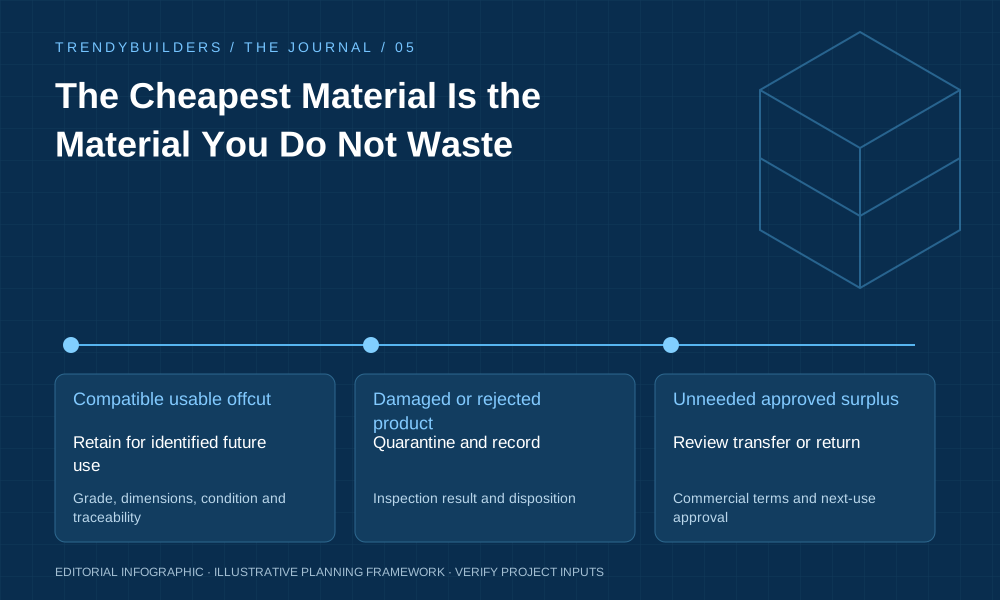
Decision table
This table summarizes the article’s planning distinction. Numerical examples are illustrative, use no live supplier prices, and exclude costs or assessment stages unless expressly stated. Review the complete explanation before applying an example to a project.
| Material state | Treatment | Evidence needed |
|---|---|---|
| Compatible usable offcut | Retain for identified future use | Grade, dimensions, condition and traceability |
| Damaged or rejected product | Quarantine and record | Inspection result and disposition |
| Unneeded approved surplus | Review transfer or return | Commercial terms and next-use approval |
Put the method to work
Open Materials in the TrendyBuilders workspace and work from a reviewed project copy. Confirm the activity identifiers, measurement units and applicable source revision before changing any input. Read the supporting workflow guide for the tool’s scope and review requirements. Keep a dated backup of the accepted basis and export the assumptions with the result so the next reviewer can reconstruct the decision.
Treat the output as a planning result based on the information supplied. Confirm material specifications, supplier commitments, acceptance criteria and professional approvals through the responsible project processes. Where the calculation exposes missing information, record the missing input and assign a next action instead of treating an empty field or a default value as evidence. Revisit the scenario when the source information changes, and preserve the prior version so the movement remains explainable.
Sources and further reading
US EPA: Sustainable management of construction and demolition materials. EPA describes reuse and recovery opportunities for construction and demolition materials. Actual reuse on a project requires suitability and local compliance checks. Source checked for the launch collection on November 17, 2026. The worked examples, operating protocols and recommendations are original TrendyBuilders editorial analysis; they are not quotations from the source or professional certification.
Continue the conversation
- The Labor Shortage Cannot Be Solved by Headcount Alone
- Lower Carbon Starts Before the Purchase Order
- A Profitable Project Can Still Run Out of Cash
Bring a project-specific question to the moderated discussion below. Explain the relevant scope and assumptions without sharing confidential drawings, prices or personal information. Useful discussion helps other readers understand the decision and its limits.
The conversation
Constructive, relevant discussion is welcome. Comments are moderated. You may edit your own comment for one hour after its original submission; administrators can edit at any time.
Be the first to contribute a thoughtful comment.