
Executive brief
A material decision can lock in cost, programme and environmental consequences long before construction begins. Yet carbon comparisons often arrive after the design and supplier choices are effectively fixed. A more useful approach places quantity, technical performance, supply availability and environmental evidence in the same review. The objective is an informed choice, not a lower number detached from the asset’s required function.
The first opportunity is frequently to avoid unnecessary material through an approved design or reuse decision. Procurement teams should work with the responsible designers, rather than changing specifications independently. Cost software can support quantities and commercial scenarios, but it cannot determine whether a lower-carbon alternative meets structural, fire, durability or other project requirements.
Compare the same functional requirement
Two products are not equivalent simply because both are sold per tonne or cubic metre. A comparison needs a defined application, required performance and service conditions. If one option needs more material, additional protection or earlier replacement, its apparently favorable unit figure may be misleading. Establish the approved functional basis before comparing environmental declarations.
Read the boundaries of the environmental evidence. Product-stage figures should not be casually compared with whole-life figures. Transport, installation, maintenance and end-of-life assumptions may differ. A declaration can be credible and still be unsuitable for the exact comparison being attempted. Record the source, date, declared unit and applicable product rather than copying a single carbon factor into an unlabeled spreadsheet.
An illustrative options review
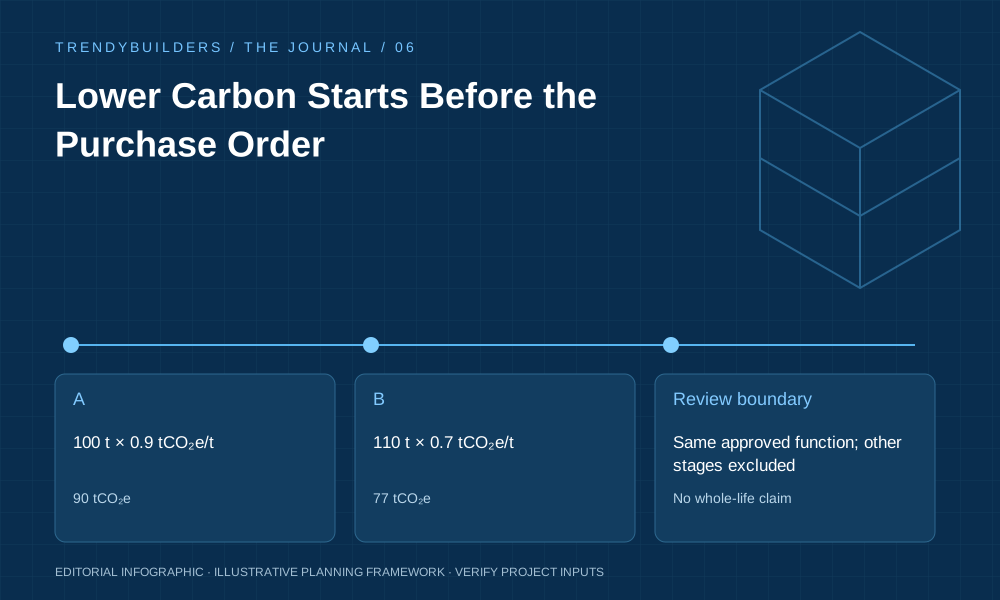
Assume two technically approved options provide the same required function. Option A needs 100 tonnes and carries an illustrative product-stage factor of 0.9 tonnes of carbon dioxide equivalent per tonne. Option B needs 110 tonnes with a factor of 0.7. On that narrow boundary, their totals are 90 and 77 respectively. The calculation demonstrates why both quantity and factor matter; it is not a real product assessment.
Before selecting B, examine whether its transport, installation or replacement assumptions materially change the comparison. Check that the declarations use compatible methods and that the supplier can deliver the approved product. Also compare landed cost, lead time and the consequences of delayed approval. Report the boundary clearly so the decision is not later described as a verified whole-life saving.
Do not let early procurement close the design window
A discounted bulk order can remove the opportunity to optimize material demand. Establish when design decisions become sufficiently stable for commitment and which packages merit an early alternatives review. The schedule should allow technical assessment, sampling and commercial clarification. An alternative raised on the day an order must be placed is unlikely to receive a thorough assessment.
Use a decision log to record the options considered and why one was selected. Where the lower-impact choice is unavailable or unsuitable, retain that reason instead of quietly deleting it from the record. The log supports future learning and helps distinguish a genuine constraint from a missed opportunity. It also prevents the team from claiming a reduction that came from changing the comparison boundary.
Where TrendyBuilders contributes
Use TrendyBuilders to review the material quantities and entered cost scenarios for approved options. Materials and Estimate can make consumption and purchasing assumptions visible. Scenarios can explore commercial sensitivity, and a project backup can retain the basis of each option. Keep the environmental factors and their calculations in a separately reviewed assessment; TB does not supply a verified carbon-factor database or certify a life-cycle assessment.
Link the quantity schedule to the correct specification and environmental declaration reference. If a design revision changes material demand, update both the commercial and environmental comparison using the same accepted quantities. This is a practical contribution: a transparent quantity basis reduces the chance that two teams assess different versions of the project while believing they are discussing the same option.
Procurement evidence that survives handover
The selected product’s environmental claim should remain connected to what was actually supplied. Record approved substitutions, delivery evidence and product identifiers. A strong tender comparison becomes weak evidence if the delivered product differs from the assessed one. Ask the responsible specialist what documentation is needed before treating an estimated reduction as an achieved outcome.
At handover, distinguish the original target, the approved procurement decision and the as-supplied result. Explain any changes in quantity or assessment boundary. This avoids overstating performance and gives the next project a useful starting point. The strongest environmental story is a traceable decision with clear limits, rather than a promotional percentage that nobody can reconstruct.
Write a defensible material-options note
Start the note with the required function and the approved technical criteria. Identify the options that have passed the relevant review, then state the quantity basis for each. This prevents a lower environmental figure from being achieved merely by comparing a weaker or incomplete solution. Any design optimization should be approved by the responsible professionals before its quantities enter the comparison.
List the environmental evidence separately from the arithmetic. Record the product, declaration reference, date, declared unit and assessment boundary. Identify any assumptions about transport, installation, replacement and disposal. Where the available declarations are not compatible, explain the limitation and seek specialist advice rather than forcing a precise ranking from inconsistent evidence.
Present commercial and delivery consequences alongside the environmental result. A product may need a longer approval period, a different construction method or a less familiar supply chain. Those conditions do not automatically rule it out, but they should be included in the decision. Assign actions that could make the option practical, such as early sampling or a supplier clarification.
Distinguish an estimated opportunity from a verified outcome. At procurement, the comparison depends on the proposed product and quantities. At delivery, confirm what was supplied. At completion, reconcile material changes and the agreed assessment boundary. A reduction should not be claimed simply because the preferred option appeared in an early presentation.
Retain the rejected options and reasons in a concise record. Future teams can then see whether cost, availability, technical suitability or missing evidence governed the choice. This is more useful than a final statement that the project selected a sustainable material. It supports a transparent account of the decision while making clear where a qualified environmental assessment is still required.
A practical environmental decision protocol
Define the decision and its assessment boundary. Identify the asset function, construction phase, material or operating exposure under review. State what the comparison includes and excludes. A result can be useful within a narrow boundary, provided it is not later promoted as a verified whole-project or whole-life outcome.
Establish the technical basis before comparing commercial or environmental options. The responsible professionals should confirm performance, suitability and applicable requirements. A lower quantity, different product or reused material is not automatically an acceptable substitute. Keep approval status and the supporting evidence connected to the option throughout the review.
Use a consistent quantity basis and record the source of environmental or hazard information. Check units, dates, geographic relevance and the conditions to which the evidence applies. Where specialist interpretation is required, identify that need rather than filling the gap with an unsupported factor. Planning software can calculate entered assumptions without verifying that those assumptions are appropriate.
Compare implementation consequences. An option may change lead time, handling, storage, installation, maintenance or inspection. Include those requirements in the cost and programme assessment at a level proportionate to the decision. A benefit that depends on an unavailable product or an unapproved method remains an opportunity rather than an implemented result.
Assign responsibility for procurement and site verification. Confirm that the approved product or measure is the one actually supplied and installed. Retain substitutions, inspections and other relevant evidence. Without that connection, an early options comparison can become detached from the completed work while still appearing in a final performance claim.
Review residual exposure and uncertainty. A mitigation can reduce a risk without eliminating it, and a material comparison can favor one option while leaving some life-cycle stages unassessed. Explain those limits plainly. A transparent partial assessment is more useful than a broad assertion of sustainability or resilience that the project cannot substantiate.
At completion, reconcile the outcome to the original decision basis and record the lessons for future work. Distinguish estimated, approved and observed results. Identify whether the constraint was technical, commercial, logistical or evidential. This makes the environmental review part of normal project decision-making while protecting the credibility of the claims made about it.
Warning signs to investigate
A warning sign is an environmental comparison that gives a precise percentage without naming the quantity basis or assessment boundary. Ask what changed, which stages were included and whether the products provide the same approved function. The percentage is difficult to interpret until those questions are answered. Avoid carrying it into marketing or project reporting as an achieved whole-life result.
Also check whether the preferred product remains available in the proposed specification and quantity. A declaration for one product or manufacturing location may not describe a later substitution. Keep the supplier and technical records connected to the assessment. Where evidence changes, revisit the conclusion and explain the change. Credibility comes from a traceable comparison and a clear statement of limits, not from preserving an attractive early claim after its basis has moved.
Decision table
This table summarizes the article’s planning distinction. Numerical examples are illustrative, use no live supplier prices, and exclude costs or assessment stages unless expressly stated. Review the complete explanation before applying an example to a project.
| Option | Illustrative quantity and factor | Product-stage result |
|---|---|---|
| A | 100 t × 0.9 tCO₂e/t | 90 tCO₂e |
| B | 110 t × 0.7 tCO₂e/t | 77 tCO₂e |
| Review boundary | Same approved function; other stages excluded | No whole-life claim |
Put the method to work
Open Scenarios in the TrendyBuilders workspace and work from a reviewed project copy. Confirm the activity identifiers, measurement units and applicable source revision before changing any input. Read the supporting workflow guide for the tool’s scope and review requirements. Keep a dated backup of the accepted basis and export the assumptions with the result so the next reviewer can reconstruct the decision.
Treat the output as a planning result based on the information supplied. Confirm material specifications, supplier commitments, acceptance criteria and professional approvals through the responsible project processes. Where the calculation exposes missing information, record the missing input and assign a next action instead of treating an empty field or a default value as evidence. Revisit the scenario when the source information changes, and preserve the prior version so the movement remains explainable.
Sources and further reading
IEA: Breakthrough Agenda Report 2025 — Building. The IEA identifies embodied emissions in construction materials as part of the building-sector challenge. The comparison method below is an editorial planning framework. Source checked for the launch collection on November 17, 2026. The worked examples, operating protocols and recommendations are original TrendyBuilders editorial analysis; they are not quotations from the source or professional certification.
Continue the conversation
- The Cheapest Material Is the Material You Do Not Waste
- The Delivery Date Is Too Late to Start Planning
- Build for the Conditions the Project Will Actually Face
Bring a project-specific question to the moderated discussion below. Explain the relevant scope and assumptions without sharing confidential drawings, prices or personal information. Useful discussion helps other readers understand the decision and its limits.
The conversation
Constructive, relevant discussion is welcome. Comments are moderated. You may edit your own comment for one hour after its original submission; administrators can edit at any time.
Be the first to contribute a thoughtful comment.