
A comparison is only as current as its scope
Tender packages often evolve while bidders prepare their offers. Revised quantities, clarified specifications and changed delivery conditions may arrive through addenda. If those changes are not controlled, the evaluation can compare prices prepared against different requirements. A low total may reflect an omitted revision rather than a more efficient solution.
The problem matters in public and private procurement across regions, particularly when packages contain many documents and short response periods. The practical objective is a defensible like-for-like review under the applicable procurement rules. Evaluation procedures, permitted clarifications and award authority must follow the actual tender framework. This article describes information and scope controls, not legal advice or permission to change evaluation criteria after receipt.
Maintain one authoritative issue register
Record the tender issue, every addendum, included documents, revision references and dispatch evidence. Make it clear which documents supersede earlier versions and which remain applicable. Avoid distributing an updated file with the same name and no revision explanation. Bidders and evaluators need a stable reference that identifies the actual requirement.
Where questions produce clarifications affecting the competition, handle their circulation through the authorized tender process. Do not give one bidder a material scope instruction through an informal side conversation. Preserve the question, approved response and issue evidence as required. The project should be able to reconstruct what information was available to the participants at the relevant deadline.
Ask for explicit acknowledgement and coverage
Use the tender's accepted acknowledgement mechanism to identify which addenda the offer includes. Review exclusions, qualifications and assumptions alongside that acknowledgement. A checked box does not resolve a contradictory price schedule or an explicit exclusion. Record the issue and seek permitted clarification through the responsible procurement authority.
Prepare a coverage matrix linking consequential requirements to the bidder's response. Separate compliant coverage, declared exception, ambiguity and missing information. Avoid converting every blank into zero cost or every qualification into a presumed inclusion. The matrix should help the evaluator identify questions, not create an unofficial route for rewriting an offer beyond what the procurement rules allow.
A worked example: the added inspection requirement
An illustrative addendum introduces a specified inspection service and changes the required delivery point. Bidder A expressly includes both changes; Bidder B's schedule retains the previous delivery basis and says inspection is excluded. Comparing their totals without addressing those differences misstates the available options. The evaluation team needs a controlled disposition of the exclusions.
Where the rules allow a defined adjustment or clarification, record its method, evidence and approval. Where they do not, follow the applicable responsiveness decision process rather than inventing a private adjustment. The example has no live bidder or market price. It shows why a scope difference must remain visible until an authorized evaluation decision resolves it.
Normalize quantities and units carefully
A price per box is not directly comparable with a price per piece unless the pack basis is known. A supply-only rate cannot be compared with a delivered and unloaded rate without identifying the additional scope. Currency dates, freight, taxes and minimum order quantities may also affect the comparison. Use the convention established for the procurement and apply it consistently.
Retain the original offer values and show any authorized normalization separately. This protects the record from becoming a spreadsheet that looks as though the bidder quoted numbers the evaluator created. Link adjustments to their basis and mark unresolved values explicitly. An incomplete comparison can still inform the next question, provided it does not pretend to support a final award.
Keep qualitative evaluation tied to announced criteria
Quality, delivery capability, technical approach and operating requirements can matter alongside price. Where rated criteria apply, use the announced criteria, weightings and evidence requirements. Establish evaluator guidance before scoring and preserve reasons for consequential judgments. Avoid adding a new preference because one offer looks attractive after opening.
Check that commitments relied upon in the evaluation can be reflected in the resulting contract through the applicable process. A strong narrative without resources, deliverables or a credible schedule may not support the promised outcome. The evaluation record should explain the link between the submitted evidence and the recommendation, with disagreements resolved through the authorized governance procedure.
Use structured comparison without outsourcing judgment
TrendyBuilders supplier catalogue and RFQ exchange can support local data matching and comparisons using supplied files. It can help reveal item, unit and pack differences within its supported scope. It does not run a regulated tender, authenticate bidder commitments, decide responsiveness or award a contract. Maintain the authoritative tender documents and evaluation record in the project's controlled system.
Review imported data against the actual offer and addenda. Preserve original files and document manual interpretations. A tool can make inconsistent inputs easier to see, but the procurement team remains responsible for applying the authorized rules and obtaining the necessary technical and commercial approvals before a recommendation becomes a commitment.
Hand the accepted scope into contract management
The award record should leave a clear final scope, document hierarchy, accepted qualifications and deliverables for the team that will administer the contract. Resolve or explicitly retain outstanding matters through the approved process. An evaluation clarification lost at handover can reappear later as a dispute over what was included.
After award, compare early performance with the commitments used in selection. Record whether difficulties came from unclear requirements, unrealistic promises or weak implementation controls. Feed those lessons into the next tender's information and evidence requirements. A good bid comparison creates an explainable decision and a usable contract basis, with scope differences visible throughout.
A practical procurement-control protocol
Begin with a reviewed demand statement. Identify the item, specification, quantity, commercial unit, required location and need date. Keep the technical approval status visible. If any of those fields remains provisional, identify who must resolve it before commitment. A supplier cannot reliably price or reserve the correct requirement when the project itself has not defined what it intends to buy.
Normalize the commercial basis before comparing offers. Check delivery point, packaging, minimum order, quote validity, currency and tax assumptions. Retain the original quotations and show adjustments separately. Seek clarification where an exclusion or ambiguous term can change the decision. Do not silently complete one supplier’s offer using favorable assumptions that are not applied to the others.
Connect the purchase to its operating dependency. Identify the installation or testing activity that needs the item, and work backward through approval, manufacture, transport and acceptance. Confirm which event starts each quoted lead time. A purchase-order date is not necessarily a manufacturing-release date, and a delivery date is not necessarily the date the material is ready for use.
Keep authority distinct from record entry. A buyer may prepare a comparison while a technical reviewer approves suitability and an authorized commercial role approves commitment. The project-control tool should retain those references without implying that entering an order transmits it or executes payment. Confirm the actual supplier acceptance through the organization’s established process.
Use evidence-based status updates. A quotation, accepted order, released manufacture, dispatch record and accepted receipt establish different conditions. Record the next milestone and the evidence needed to confirm it. Avoid carrying an unsupported green status merely because nobody has reported a delay. An honest uncertainty gives the team time to investigate and preserve options.
At receipt, check identity, condition, quantity and documentation against the approved requirement. Quarantine discrepancies where the quality process requires it. Reconcile accepted stock with the purchasing record before treating it as available for installation. A truck arrival should not automatically close the procurement exposure if critical parts or acceptance evidence remain missing.
Finally, review supplier performance against the assumptions used in the decision. Retain specific evidence about delivery, completeness and support. Use that learning proportionately in future evaluations. The purpose is a reliable flow from reviewed demand to usable material, supported by clear approvals and a comparison that another person can reconstruct.
A review routine the team can sustain
Choose one real package for the first review rather than attempting to repair every record at once. Ask its estimator, buyer and field owner to agree the accepted scope and identify the sources they actually use. Write down the unresolved questions and the next decision each one prevents. This short exercise makes the method concrete and reveals where the project needs better evidence before it needs another calculation.
Keep the original working records available while testing a revised approach. Use a dated project copy for scenarios and record the input changes individually. Ask a second person to reproduce a sample result from the stated sources. If they cannot explain the unit, revision or assumption, improve the record before circulating the total as an accepted basis. A reproducible result is more useful than an impressive display that depends on its author's memory.
At the next regular package meeting, compare the planned action with what happened. Identify whether the obstacle was missing information, capacity, authority or a changed site condition. Update the relevant assumption and assign the remaining action to a named person with a practical due date. Keep the previous basis so the movement remains explainable. Avoid silently replacing uncertainty with a default value simply to complete the report.
Scale the process only after the pilot has produced a useful decision. Retain fields that support an actual review and remove duplicate recording that adds no evidence. Tell the people receiving the output which version is accepted and what remains conditional. The goal is a working habit that survives a busy site week: clear sources, visible assumptions, explicit authority and a traceable action when the evidence changes.
Decision table
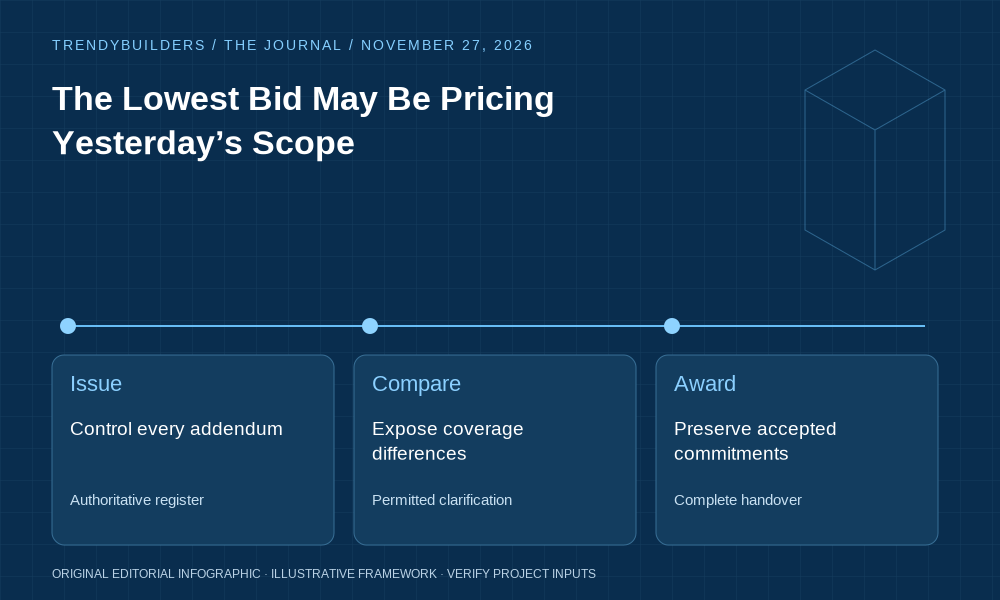
Use this table as a meeting prompt alongside the explanation above. It summarizes the evidence chain; it does not establish technical acceptance or replace the responsible project process. Numerical examples in this article are illustrative and contain no live supplier rates.
| Stage | Action | Evidence |
|---|---|---|
| Issue | Control every addendum | Authoritative register |
| Compare | Expose coverage differences | Permitted clarification |
| Award | Preserve accepted commitments | Complete handover |
Apply the method in TrendyBuilders
Open Supplier catalogue & RFQ exchange and read the supporting workflow guide before entering project information. Use a reviewed project copy, confirm the measurement units and source revisions, and inspect warnings and exclusions before relying on any output. The calculations depend on the information supplied; selecting a tool does not validate the underlying technical or commercial assumptions.
Keep the accepted project documents and required approvals linked to the planning record. Export the assumptions with a dated result so another reviewer can reproduce the comparison. Where the workflow reveals a missing input or a decision outside the tool's scope, assign that issue to the responsible person rather than treating a blank field as evidence of zero exposure.
Sources and further reading
World Bank: Rated criteria. This primary-source reference provides relevant background in its own stated scope and jurisdiction. It does not endorse this article or TrendyBuilders. Reference checked November 18, 2026. The worked examples and operating recommendations are original editorial analysis; they are not reported project outcomes, quotations or professional certification.
Related reading
- Build for the Conditions the Project Will Actually Face
- A Unit Mismatch Can Erase a Procurement Saving
- The Labor Shortage Cannot Be Solved by Headcount Alone
Use the moderated discussion to share the decision you are trying to make and the assumptions that matter. Omit confidential drawings, supplier prices and personal information.
The conversation
Constructive, relevant discussion is welcome. Comments are moderated. You may edit your own comment for one hour after its original submission; administrators can edit at any time.
Be the first to contribute a thoughtful comment.