
Stock visibility is a construction control problem
A busy site can hold substantial material while critical crews wait for a few missing items. The apparent contradiction often comes from a stock record that mixes received, accepted, reserved, damaged and already issued quantities. Another emergency order is raised before anyone checks whether the material is available elsewhere or committed to another workfront. The result can be simultaneous shortages and surplus.
Inventory accuracy matters across global construction supply chains because transport disruption and long replenishment periods magnify small record errors. The solution begins with a practical definition of available material. A quantity is useful only when its identity, condition, location and allocation are understood well enough to support a responsible release decision.
Define the states before counting the units
Separate ordered, dispatched, received, accepted, held, reserved, issued and consumed states where they matter to the project. A delivered item awaiting inspection should not be silently included in usable stock. A reserved quantity may be physically present but unavailable to another package without an authorized reallocation. Keep these distinctions readable enough that the receiving and field teams can maintain them.
Use consistent item identifiers and units. A box, piece, meter and kilogram cannot be exchanged without a documented relationship. Supplier pack sizes can change between orders. Record the applicable pack basis rather than assuming that every line using the same description represents the same quantity. This is especially important when several suppliers use similar names for different products.
Reconcile demand with the accepted work remaining
Begin with the reviewed remaining requirement, then deduct compatible usable stock and confirmed incoming supply according to the chosen planning convention. Check that the requirement does not already include an issued quantity elsewhere. Separate material physically incorporated into work from items issued to a crew but still stored at the workfront. Otherwise consumption can be reported before it occurs.
Tie the reconciliation to a drawing or scope revision. An accurate warehouse count cannot resolve an outdated demand forecast. When scope changes, review affected reservations and open orders before buying the difference. A cancelled workfront can leave material reserved indefinitely unless someone is responsible for returning it to available stock or approving another disposition.
A worked example: the missing fifty pieces
Suppose an illustrative package needs 200 pieces for remaining work. The store shows 150 physically present, but 30 are reserved for another package and 20 remain under inspection hold. Only 100 are available under the current allocation. A confirmed incoming order of 60 pieces would reduce the uncovered requirement to 40, provided its product, acceptance and delivery basis are compatible.
Ordering fifty simply because 200 minus 150 equals fifty ignores the inventory states and the incoming order. Ordering one hundred without checking the incoming sixty creates another distortion. This arithmetic example excludes pack rounding, losses and timing risk. Add those explicitly where applicable, and retain the allocation decisions that make the calculation reproducible.
Use cycle counts to test consequential records
A complete physical stocktake may be disruptive, so many teams also use targeted cycle counts. Select items based on value, replenishment difficulty, criticality or repeated discrepancies. Agree how movements are controlled during the count and how differences are investigated. A count entered while trucks unload and crews withdraw material needs a clear time boundary.
Do not correct a balance without recording the reason and authority. Investigate unit conversion, duplicate receipt, unrecorded issue, location error or damaged stock before concluding that material disappeared. Where the cause cannot be established, preserve that uncertainty. Repeated unexplained adjustments are a process signal requiring attention, not a reason to make the register less transparent.
Make issues and returns simple enough to happen
A stock system fails when recording a withdrawal takes longer than finding the material. Use a proportionate process identifying item, quantity, workfront, date and responsible person. Batch routine movements where appropriate without losing the ability to reconstruct consequential transfers. Give field teams a clear route to return unused material and report damaged or unsuitable items.
Define who can reallocate reserved stock during an urgent shortage. Uncontrolled borrowing can release one crew while creating a hidden shortage for another. Record the decision, notify the affected package owner and update the forecast. A visible trade-off supports better planning than a warehouse balance that remains unchanged while material moves informally between workfronts.
Keep purchasing arithmetic distinct from live inventory
TrendyBuilders Materials purchasing can help translate reviewed requirements, allowances and pack assumptions into a purchasing plan within its supported scope. It is not a live warehouse management system and does not automatically reconcile physical receipts, reservations or consumption. Supply those reviewed inputs through the project's accepted process and inspect the output before placing any order.
Use the supplier catalogue and RFQ exchange where structured local data helps compare pack sizes and descriptions. Successful matching does not verify that stock is physically available or reserved for your project. Keep supplier confirmation, site counts and accepted allocations as separate evidence. A planning quantity should never be presented as an automatically synchronized warehouse balance.
Review surplus before it becomes stranded material
Include slow-moving and excess stock in the regular package review. Check whether it can serve accepted remaining scope, be returned under the purchase terms or be transferred through an authorized process. Consider handling, transport and condition before treating a transfer as a saving. Do not count the same potential recovery in several project forecasts.
At closeout, reconcile the opening balance, receipts, issues, returns and final disposition on consistent units. Record which assumptions caused shortages or surplus. Reliable inventory practice improves delivery by showing what is genuinely usable and improves procurement by making the next order a response to evidence rather than a reaction to uncertainty.
A practical procurement-control protocol
Begin with a reviewed demand statement. Identify the item, specification, quantity, commercial unit, required location and need date. Keep the technical approval status visible. If any of those fields remains provisional, identify who must resolve it before commitment. A supplier cannot reliably price or reserve the correct requirement when the project itself has not defined what it intends to buy.
Normalize the commercial basis before comparing offers. Check delivery point, packaging, minimum order, quote validity, currency and tax assumptions. Retain the original quotations and show adjustments separately. Seek clarification where an exclusion or ambiguous term can change the decision. Do not silently complete one supplier’s offer using favorable assumptions that are not applied to the others.
Connect the purchase to its operating dependency. Identify the installation or testing activity that needs the item, and work backward through approval, manufacture, transport and acceptance. Confirm which event starts each quoted lead time. A purchase-order date is not necessarily a manufacturing-release date, and a delivery date is not necessarily the date the material is ready for use.
Keep authority distinct from record entry. A buyer may prepare a comparison while a technical reviewer approves suitability and an authorized commercial role approves commitment. The project-control tool should retain those references without implying that entering an order transmits it or executes payment. Confirm the actual supplier acceptance through the organization’s established process.
Use evidence-based status updates. A quotation, accepted order, released manufacture, dispatch record and accepted receipt establish different conditions. Record the next milestone and the evidence needed to confirm it. Avoid carrying an unsupported green status merely because nobody has reported a delay. An honest uncertainty gives the team time to investigate and preserve options.
At receipt, check identity, condition, quantity and documentation against the approved requirement. Quarantine discrepancies where the quality process requires it. Reconcile accepted stock with the purchasing record before treating it as available for installation. A truck arrival should not automatically close the procurement exposure if critical parts or acceptance evidence remain missing.
Finally, review supplier performance against the assumptions used in the decision. Retain specific evidence about delivery, completeness and support. Use that learning proportionately in future evaluations. The purpose is a reliable flow from reviewed demand to usable material, supported by clear approvals and a comparison that another person can reconstruct.
A review routine the team can sustain
Choose one real package for the first review rather than attempting to repair every record at once. Ask its estimator, buyer and field owner to agree the accepted scope and identify the sources they actually use. Write down the unresolved questions and the next decision each one prevents. This short exercise makes the method concrete and reveals where the project needs better evidence before it needs another calculation.
Keep the original working records available while testing a revised approach. Use a dated project copy for scenarios and record the input changes individually. Ask a second person to reproduce a sample result from the stated sources. If they cannot explain the unit, revision or assumption, improve the record before circulating the total as an accepted basis. A reproducible result is more useful than an impressive display that depends on its author's memory.
At the next regular package meeting, compare the planned action with what happened. Identify whether the obstacle was missing information, capacity, authority or a changed site condition. Update the relevant assumption and assign the remaining action to a named person with a practical due date. Keep the previous basis so the movement remains explainable. Avoid silently replacing uncertainty with a default value simply to complete the report.
Scale the process only after the pilot has produced a useful decision. Retain fields that support an actual review and remove duplicate recording that adds no evidence. Tell the people receiving the output which version is accepted and what remains conditional. The goal is a working habit that survives a busy site week: clear sources, visible assumptions, explicit authority and a traceable action when the evidence changes.
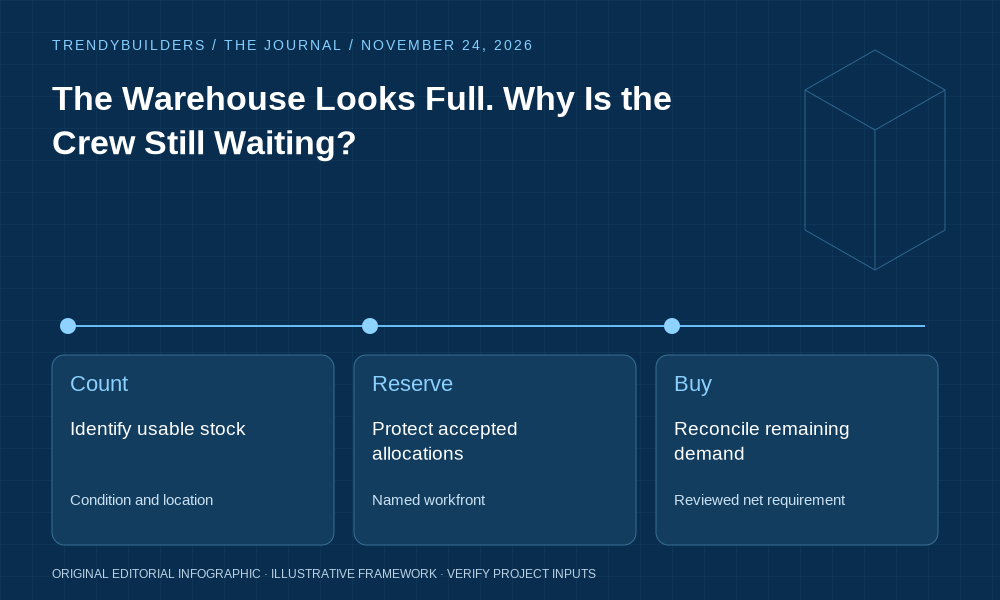
Decision table
Use this table as a meeting prompt alongside the explanation above. It summarizes the evidence chain; it does not establish technical acceptance or replace the responsible project process. Numerical examples in this article are illustrative and contain no live supplier rates.
| Stage | Action | Evidence |
|---|---|---|
| Count | Identify usable stock | Condition and location |
| Reserve | Protect accepted allocations | Named workfront |
| Buy | Reconcile remaining demand | Reviewed net requirement |
Apply the method in TrendyBuilders
Open Materials purchasing and read the supporting workflow guide before entering project information. Use a reviewed project copy, confirm the measurement units and source revisions, and inspect warnings and exclusions before relying on any output. The calculations depend on the information supplied; selecting a tool does not validate the underlying technical or commercial assumptions.
Keep the accepted project documents and required approvals linked to the planning record. Export the assumptions with a dated result so another reviewer can reproduce the comparison. Where the workflow reveals a missing input or a decision outside the tool's scope, assign that issue to the responsible person rather than treating a blank field as evidence of zero exposure.
Sources and further reading
NIST: Supply chain traceability, IR 8536. This primary-source reference provides relevant background in its own stated scope and jurisdiction. It does not endorse this article or TrendyBuilders. Reference checked November 18, 2026. The worked examples and operating recommendations are original editorial analysis; they are not reported project outcomes, quotations or professional certification.
Related reading
- The Most Expensive Scope Is the Scope Nobody Owned
- The Crane Is Booked Twice. The Programme Still Looks Fine.
- The Budget Is Moving. Is Your Estimate Keeping Up?
Use the moderated discussion to share the decision you are trying to make and the assumptions that matter. Omit confidential drawings, supplier prices and personal information.
The conversation
Constructive, relevant discussion is welcome. Comments are moderated. You may edit your own comment for one hour after its original submission; administrators can edit at any time.
Be the first to contribute a thoughtful comment.