
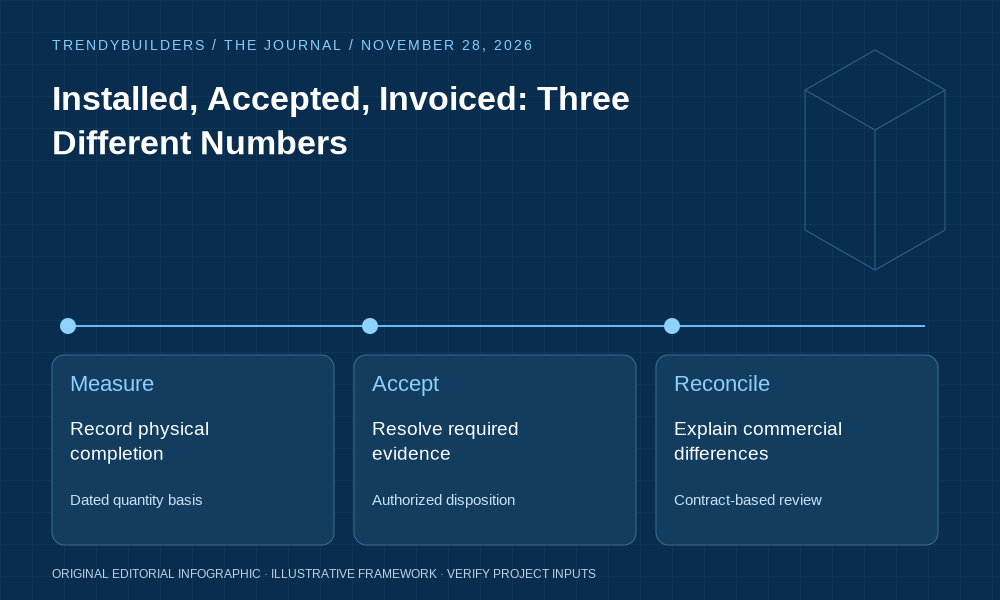
One percentage cannot answer every question
A construction report may show a package as eighty percent complete while a payment application, quality register and site observation imply different positions. The discrepancy is not always an error. Physical installation, accepted work, eligible payment and invoiced amounts serve different purposes and may follow different rules. Problems arise when one number is copied across all reports without its basis.
Executives need a reconciliation that explains these distinctions and connects them to remaining work. This article addresses record clarity and quantity-based planning. It does not determine contractual entitlement, certify payment or provide accounting advice. The governing contract, measurement provisions and authorized certification process control the commercial decisions, supported by the relevant professional review.
Define each measure and its evidence
Physical progress may be based on measured installed quantities or another accepted method. Quality acceptance can depend on inspections, tests and closure of exceptions. Payment eligibility may include different treatment of materials, milestones, retention or other contract provisions. Invoicing records the amount claimed or billed through the applicable process, not necessarily the quantity installed.
Write these definitions beside the report and identify the source date. A site measurement taken on Monday and a payment application covering the previous month should not be expected to match without adjustment. Use stable package and activity identifiers so reviewers can trace each number to its source rather than reconciling similar descriptions by guesswork.
Keep the denominator under control
A progress percentage depends on the total scope against which completion is measured. If the scope changes, the denominator may change even when installed work does not. Preserve the approved baseline and identify how authorized additions, omissions and pending changes are treated in the current view. Do not silently revise historical percentages to make the latest report appear continuous.
Use compatible units and measurement rules. Installed meters, tested sections and completed systems cannot be combined by simple addition. Where a weighted progress method is used, document the weights and avoid counting the same work at several levels. A roll-up should reflect its stated convention and expose incomplete coverage rather than presenting an unsupported overall precision.
A worked example: explaining a forty-unit gap
Suppose an illustrative package has 100 units of approved physical scope. The team records 80 installed, 70 accepted and 60 included in the current payment application. These figures can coexist: ten installed units may await acceptance, while ten accepted units may fall outside the application's cutoff or require another contractual condition. The project must verify the actual explanation rather than infer it from the arithmetic.
The remaining physical requirement is twenty units under this simplified basis. It is not forty simply because sixty were included in the application. Nor does eighty installed establish an entitlement to payment for eighty. The example excludes contract-specific valuation adjustments and uses invented quantities solely to demonstrate why each measure needs a distinct label and reconciliation.
Investigate differences through exception records
Prepare a short exception list connecting the differences to specific items: awaiting test, incomplete documentation, measurement disagreement, cutoff timing or a defined commercial hold. Name the owner and next action for each. Avoid a large unexplained adjustment line that remains on the report month after month without resolution.
Keep observations factual. A pending inspection does not necessarily mean defective work, and a disputed amount does not automatically establish an invalid claim. Preserve the responsible reviewers' decisions and evidence. Where the issue has contractual or legal implications, use the project's authorized channels and qualified advice rather than allowing a dashboard label to decide the outcome.
Reconcile remaining material and work separately
Physical progress can inform a remaining quantity forecast when the scope and measurement basis are compatible. Purchasing needs additional evidence about usable stock, issued material, losses and incoming orders. Do not subtract an invoiced amount from a material quantity or treat a financial percentage as an automatic measure of future procurement demand.
Check whether incomplete work requires remedial material, retesting or specialist attendance. These obligations can remain even where the installed quantity appears complete. Assign them explicit lines or actions so the forecast does not become zero before the package is ready for acceptance. A useful completion view includes both physical remaining work and unresolved conditions that prevent closure.
Use progress tools for the measure they support
TrendyBuilders Progress can support recorded physical progress and planning comparisons within its stated functionality. It does not certify payment, operate a general ledger or determine whether a contract permits billing for an item. Keep payment applications, certificates and accounting records in their authoritative systems and reconcile them using the accepted project identifiers.
Review entered quantities against dated evidence and retain the prior reporting basis. Where the tool calculates a percentage, explain its denominator and included scope. If the project uses a different contractual valuation method, calculate and review that separately. A clear boundary lets the planning tool remain useful without giving its outputs an authority they do not possess.
Make the executive report decision-ready
Show physical scope, accepted scope, payment application status and remaining obligations as separate measures with compatible dates. Highlight the largest differences and the actions required to resolve them. The executive question is whether the project understands its completion exposure and can explain the commercial position through the proper process.
At closeout, reconcile the final quantities, accepted changes and outstanding evidence. Retain the approved measurement and certification records rather than overwriting them with a single final percentage. Transparent reconciliation reduces time spent arguing about labels and gives the project a better basis for forecasting what it still needs to do.
A practical cost-control protocol
Establish the reporting boundary before reviewing movement. State the package, currency, tax basis, price date and scope revision. Identify whether the figures describe an estimate, a commitment, an actual cost or a forecast. These records answer different questions and should not be added together indiscriminately. A committed amount may already include expenditure that later appears in actual-cost records, so the reconciliation needs an explicit convention.
Retain a frozen reference for the approved position. Record the current working assumptions separately and explain the difference using a short bridge. The bridge should reconcile exactly to the reported total. If an unexplained balance remains, investigate it rather than assigning it to a vague miscellaneous line. Precision in the presentation is useful only when the underlying categories have a clear meaning.
Give uncertain inputs a status and a next action. A provisional quantity, expired quotation or unresolved scope boundary should remain visible. Identify the information needed to replace the assumption, the person responsible and the decision date. A planning allowance can be appropriate, but it should not be described as a confirmed price or an approved obligation.
Check whether a proposed response changes another cost or timing assumption. Earlier purchasing can affect storage and cash. Resequencing can affect supervision and equipment. An approved material alternative can affect installation effort. Review the whole consequence at a level proportionate to the decision. Do not count a saving in one line while leaving its necessary supporting cost outside the comparison.
Use a consistent refresh trigger. Major scope issues, quote expiry, procurement award and a changed delivery or production position can justify a new forecast. Repeatedly updating every rate without new evidence can create work without improving the decision. Focus effort where exposure is material and where an action can still change the outcome.
Before issuing the report, ask another reviewer to reproduce one important movement from the source records. Confirm that units and dates match and that the same amount has not been counted twice. Record the review and retain the exported version. This gives the next meeting a reliable reference and helps the team explain why the forecast changed.
The final control is ownership. Every material exception should lead to an action, an accepted allowance or an explicit decision to retain the exposure. A cost report becomes useful when it makes that choice clear. The objective is a defensible basis for managing the remaining work, rather than a promise that uncertainty has disappeared.
A review routine the team can sustain
Choose one real package for the first review rather than attempting to repair every record at once. Ask its estimator, buyer and field owner to agree the accepted scope and identify the sources they actually use. Write down the unresolved questions and the next decision each one prevents. This short exercise makes the method concrete and reveals where the project needs better evidence before it needs another calculation.
Keep the original working records available while testing a revised approach. Use a dated project copy for scenarios and record the input changes individually. Ask a second person to reproduce a sample result from the stated sources. If they cannot explain the unit, revision or assumption, improve the record before circulating the total as an accepted basis. A reproducible result is more useful than an impressive display that depends on its author's memory.
At the next regular package meeting, compare the planned action with what happened. Identify whether the obstacle was missing information, capacity, authority or a changed site condition. Update the relevant assumption and assign the remaining action to a named person with a practical due date. Keep the previous basis so the movement remains explainable. Avoid silently replacing uncertainty with a default value simply to complete the report.
Scale the process only after the pilot has produced a useful decision. Retain fields that support an actual review and remove duplicate recording that adds no evidence. Tell the people receiving the output which version is accepted and what remains conditional. The goal is a working habit that survives a busy site week: clear sources, visible assumptions, explicit authority and a traceable action when the evidence changes.
Decision table
Use this table as a meeting prompt alongside the explanation above. It summarizes the evidence chain; it does not establish technical acceptance or replace the responsible project process. Numerical examples in this article are illustrative and contain no live supplier rates.
| Stage | Action | Evidence |
|---|---|---|
| Measure | Record physical completion | Dated quantity basis |
| Accept | Resolve required evidence | Authorized disposition |
| Reconcile | Explain commercial differences | Contract-based review |
Apply the method in TrendyBuilders
Open Progress and read the supporting workflow guide before entering project information. Use a reviewed project copy, confirm the measurement units and source revisions, and inspect warnings and exclusions before relying on any output. The calculations depend on the information supplied; selecting a tool does not validate the underlying technical or commercial assumptions.
Keep the accepted project documents and required approvals linked to the planning record. Export the assumptions with a dated result so another reviewer can reproduce the comparison. Where the workflow reveals a missing input or a decision outside the tool's scope, assign that issue to the responsible person rather than treating a blank field as evidence of zero exposure.
Sources and further reading
Asian Development Bank: Contract management guidance. This primary-source reference provides relevant background in its own stated scope and jurisdiction. It does not endorse this article or TrendyBuilders. Reference checked November 18, 2026. The worked examples and operating recommendations are original editorial analysis; they are not reported project outcomes, quotations or professional certification.
Related reading
- When Every Team Has a Different Number
- From Quantities to Delivery: Close the Planning Loop
- The Cheapest Material Is the Material You Do Not Waste
Use the moderated discussion to share the decision you are trying to make and the assumptions that matter. Omit confidential drawings, supplier prices and personal information.
The conversation
Constructive, relevant discussion is welcome. Comments are moderated. You may edit your own comment for one hour after its original submission; administrators can edit at any time.
Be the first to contribute a thoughtful comment.