
Arrival is only the beginning of delivery
A truck reaching the project boundary has not completed the construction delivery task. The load still needs safe entry, inspection, unloading, storage or direct movement to the workfront. On dense urban sites these steps compete for limited gates, lifting equipment and protected space. A purchasing schedule that ends at arrival can therefore promise several deliveries the site cannot actually process.
The problem appears in expanding cities worldwide, where construction shares streets with residents, public transport and other businesses. The practical response is a coordinated receiving plan grounded in local access requirements and competent site safety arrangements. Treat the gate and unloading area as constrained operating resources, with explicit capacity and ownership, rather than assuming every supplier can arrive whenever production finishes.
Define the receiving conditions before ordering
For each package, confirm vehicle restrictions, access hours, booking rules, unloading responsibility, inspection needs and the accepted delivery point. Include packaging and load-sequencing requirements where they affect handling. Make the commercial scope clear: delivery to a roadside location is different from placement in a designated storage zone or at the installation position.
Check local permits and project-specific traffic arrangements through the responsible authorities. A general logistics plan cannot establish permission to stop, unload or lift over a public area. Confirm how exceptional deliveries are authorized and how residents or neighboring activities are protected. Keep those requirements separate from the estimator's assumed travel time so the cost and schedule consequences remain visible.
Use slots based on the complete receiving cycle
A delivery slot should allow for the relevant gate check, positioning, unloading, inspection and departure. Where these stages use different constrained resources, show their overlap and dependencies. A gate may become available while the crane remains occupied. Reserving only the entry time can allow another truck into a location where it has no safe place to wait.
Use observed cycle times from comparable work and revise them after early deliveries. Record causes of delay without assuming every late truck is a supplier failure. Missing paperwork, an occupied unloading area or inaccessible storage can originate on site. A useful log distinguishes arrival variance from the site's own receiving performance and the downstream release to installation.
A worked example: three loads and one unloading area
Imagine three illustrative deliveries, each requiring a forty-minute unloading operation, sharing one accepted unloading area. Booking them all at 8:00 does not create three simultaneous operations. The nominal unloading demand alone is two hours, before vehicle changes, inspections or interruptions. If the first package also needs the same crane as a planned installation, the receiving sequence may conflict with productive work.
Compare an earlier delivery, a revised installation sequence and a smaller split shipment. Identify additional handling, freight and storage implications for each option. None is automatically best. This example illustrates resource contention rather than prescribing a safe unloading duration or vehicle arrangement. The actual handling plan and safety controls require competent project assessment.
Link deliveries to genuinely ready workfronts
Direct-to-workfront delivery can reduce storage and rehandling when access and installation readiness are reliable. It can also create disruption if the destination is incomplete or the receiving crew is unavailable. Confirm prerequisites such as accepted drawings, inspections, supports and access before releasing a tightly timed shipment. Avoid using a logistics commitment to conceal unresolved construction readiness.
Keep a fallback plan for a missed slot or rejected load. Name the decision-maker and approved holding arrangements; do not improvise roadside waiting. Communicate changes through one controlled booking process so suppliers do not receive conflicting instructions from different supervisors. A schedule change is useful only when the people dispatching and receiving the load know which version applies.
Evaluate consolidation with the full cost boundary
An off-site consolidation point may reduce the number of large deliveries entering a constrained site. It also adds rent, handling, inventory control, damage exposure and another custody handover. Assess those costs against the actual constraints being relieved. A proposal that counts fewer vehicles without considering double handling presents an incomplete case.
Compare compatible measures: delivery movements, accepted quantities, handling hours, damaged items and site storage demand. Where environmental claims are made, define the transport and energy boundaries and use a defensible method. A shorter on-site queue alone does not prove lower total emissions if additional travel and handling occur elsewhere in the supply chain.
Represent shared resources in the planning model
TrendyBuilders advanced scheduling can support a reviewed sequence with dependencies, resource pools and calendar constraints. Model only the resources and durations that the tool supports, using explicit project assumptions. It does not book vehicles, issue traffic permits, operate a live gate system or design lifting arrangements. Maintain the authoritative delivery booking and safety records through the established site processes.
Use the planning result to ask whether the proposed sequence fits available capacity. Review alternative priorities and examine the effects on installation work. A feasible arithmetic schedule still needs a practical check with receiving, lifting and field teams. Preserve exceptions and missing information instead of treating them as unlimited capacity.
Measure flow through to usable material
The executive view should connect planned deliveries with accepted receipt and workfront availability. Review missed slots, waiting time, receiving exceptions and avoidable rehandling. Check whether a reduction in queues was achieved by improving coordination or simply by pushing delay back to suppliers. A shared process should make the total flow clearer.
After a difficult delivery, document the specific lesson: unsuitable packaging, an unrealistic slot, an unready destination or a communication gap. Update the relevant requirement and verify that the next shipment uses it. Reliable last-kilometer logistics emerges from these concrete corrections, supported by clear authority and realistic capacity, rather than from an increasingly optimistic arrival schedule.
A practical delivery-control protocol
Define the work package in a measurable unit and identify the acceptance basis. Separate installed quantity from accepted completed scope where the project requires that distinction. Record the location and revision so production observations refer to comparable work. Without that foundation, a productivity or progress percentage can combine activities that need very different effort and controls.
Check readiness before assigning more capacity. Confirm approved information, materials, access, predecessor completion, suitable equipment and inspection arrangements. Record missing conditions as actions with owners and due dates. A scheduled start is an intention; readiness evidence establishes whether the team has a practical opportunity to execute the work.
State the resource and calendar assumptions. Crew composition, equipment capability, working periods, setup and shared constraints can materially change the result. Avoid treating nominal headcount or a full shift as guaranteed productive capacity. Safety, competence and technical operating limits remain the responsibility of the appropriate qualified people and established site processes.
Observe output and effort using a consistent convention. Record interruptions and changes in conditions alongside the quantity. This helps distinguish an unrealistic planning rate from a preventable readiness failure or a genuinely more difficult work area. Use the evidence to improve the production system rather than attributing every difference to the crew.
Recalculate the remaining work from a reviewed remaining quantity. Consider whether the observed rate is suitable for the next areas and whether an intervention changes the assumption. Preserve the original baseline while preparing the current forecast. A realistic response plan is easier to assess when the team can still see the position from which it moved.
Review the wider consequence of a proposed recovery. Additional equipment may need setup and approval; more workers may create congestion; overtime may affect fatigue and supervision. A shorter activity does not automatically shorten project completion if another dependency governs the finish. Explain those limits before describing a recovery as secured.
Close the review with a specific action and an evidence check. At the next meeting, verify whether the material arrived, the access became available or the inspection was released. Compare the resulting output with the forecast. Delivery control becomes reliable when the project repeatedly links a stated constraint, a practical response and an observed result.
A review routine the team can sustain
Choose one real package for the first review rather than attempting to repair every record at once. Ask its estimator, buyer and field owner to agree the accepted scope and identify the sources they actually use. Write down the unresolved questions and the next decision each one prevents. This short exercise makes the method concrete and reveals where the project needs better evidence before it needs another calculation.
Keep the original working records available while testing a revised approach. Use a dated project copy for scenarios and record the input changes individually. Ask a second person to reproduce a sample result from the stated sources. If they cannot explain the unit, revision or assumption, improve the record before circulating the total as an accepted basis. A reproducible result is more useful than an impressive display that depends on its author's memory.
At the next regular package meeting, compare the planned action with what happened. Identify whether the obstacle was missing information, capacity, authority or a changed site condition. Update the relevant assumption and assign the remaining action to a named person with a practical due date. Keep the previous basis so the movement remains explainable. Avoid silently replacing uncertainty with a default value simply to complete the report.
Scale the process only after the pilot has produced a useful decision. Retain fields that support an actual review and remove duplicate recording that adds no evidence. Tell the people receiving the output which version is accepted and what remains conditional. The goal is a working habit that survives a busy site week: clear sources, visible assumptions, explicit authority and a traceable action when the evidence changes.
Decision table
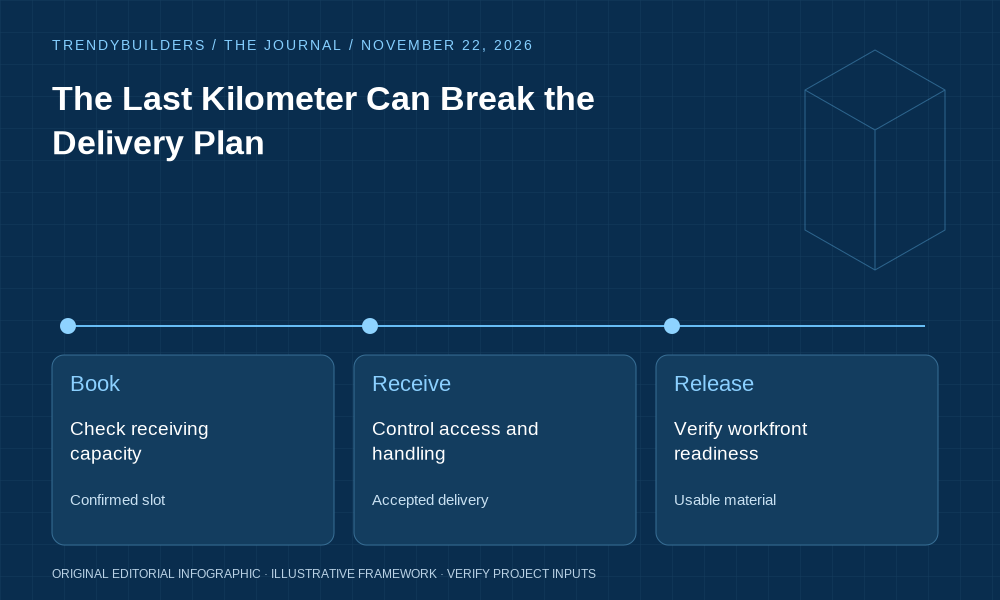
Use this table as a meeting prompt alongside the explanation above. It summarizes the evidence chain; it does not establish technical acceptance or replace the responsible project process. Numerical examples in this article are illustrative and contain no live supplier rates.
| Stage | Action | Evidence |
|---|---|---|
| Book | Check receiving capacity | Confirmed slot |
| Receive | Control access and handling | Accepted delivery |
| Release | Verify workfront readiness | Usable material |
Apply the method in TrendyBuilders
Open Scheduling & resource leveling and read the supporting workflow guide before entering project information. Use a reviewed project copy, confirm the measurement units and source revisions, and inspect warnings and exclusions before relying on any output. The calculations depend on the information supplied; selecting a tool does not validate the underlying technical or commercial assumptions.
Keep the accepted project documents and required approvals linked to the planning record. Export the assumptions with a dated result so another reviewer can reproduce the comparison. Where the workflow reveals a missing input or a decision outside the tool's scope, assign that issue to the responsible person rather than treating a blank field as evidence of zero exposure.
Sources and further reading
ILO: Safety and health in construction, C167. This primary-source reference provides relevant background in its own stated scope and jurisdiction. It does not endorse this article or TrendyBuilders. Reference checked November 18, 2026. The worked examples and operating recommendations are original editorial analysis; they are not reported project outcomes, quotations or professional certification.
Related reading
- Lower Carbon Starts Before the Purchase Order
- Build for the Conditions the Project Will Actually Face
- A Unit Mismatch Can Erase a Procurement Saving
Use the moderated discussion to share the decision you are trying to make and the assumptions that matter. Omit confidential drawings, supplier prices and personal information.
The conversation
Constructive, relevant discussion is welcome. Comments are moderated. You may edit your own comment for one hour after its original submission; administrators can edit at any time.
Be the first to contribute a thoughtful comment.